
To turn sleep journal habits into something useful in 2026, look for a repeated evening situation, choose one action you can control, and review whether that action fits your life. Treat the notes as clues rather than proof: your goal is a doable routine, not a perfect score or a guaranteed change in sleep.
- Sleep journal habits work best as small experiments: notice a pattern, choose one action, and review its fit.
- A sleep journal records your experience; it does not establish what caused a difficult night.
- Restweft sleep coaching suits adults who want personal guidance and ongoing check-ins for practical evening routines.
- Keep the habit small enough for a busy evening, and record usefulness without grading yourself.
How do you turn sleep journal notes into one habit to try?
Choose a recurring situation from your notes, then write one action linked to an existing evening activity. Make the action specific enough that you can tell whether you tried it, while leaving room for evenings that do not go to plan.
If your entries are scattered, a sleep journal template gives you a consistent place to record them. You do not need to reconstruct every missing night before making a small adjustment.
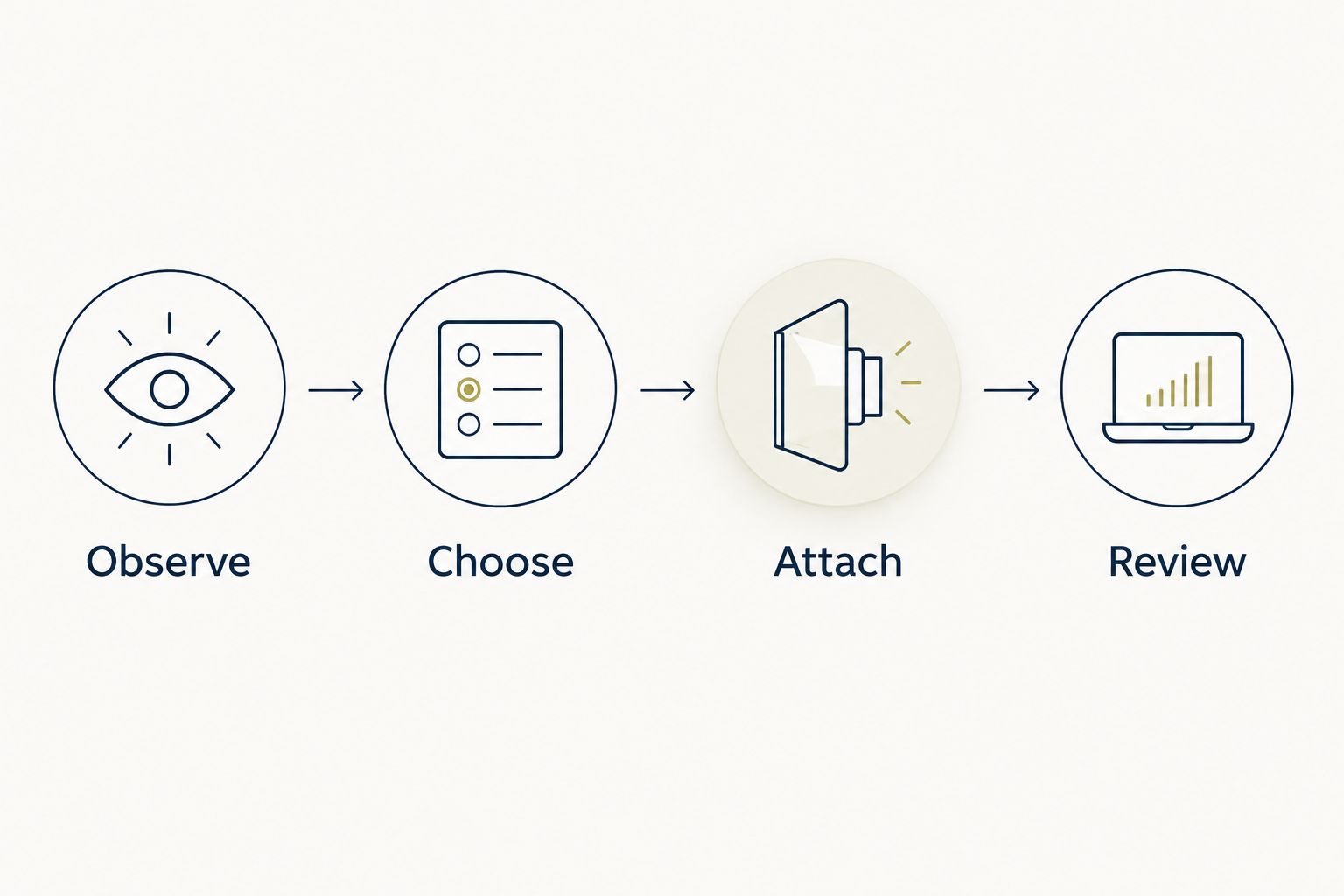
Use this sequence:
- Observe: Find a situation that appears across your entries, such as finishing work and moving straight into household tasks.
- Choose: Pick one response within your control, such as writing down unfinished tasks before closing your laptop.
- Attach: Connect that response to something you already do, such as shutting down work.
- Review: Note whether you tried it, what got in the way, and whether it felt useful.
These steps organize a personal experiment. They are not a test that proves an evening activity caused better or worse sleep.
A worked example: from a note to an action
Imagine your journal says you kept thinking about unfinished work after getting into bed. Similar notes appear on other evenings when work ended late. That is a situation worth exploring, not evidence that work explains every difficult night.
A vague goal would be to worry less. A usable habit would be: after closing the work laptop, spend 2 minutes writing the next task and where to resume it.
The 2-minute limit is an example boundary, not a recommended dose or a promise of better sleep. You can shorten the action to one sentence if that fits your evening better.
Your follow-up note might say: wrote down tomorrow's task; still felt busy-minded; easier to leave the desk. That observation is useful even without a different sleep outcome.
Why this matters
A journal can become another evening obligation if every entry seems to demand an explanation. Turning notes into one manageable action gives your attention somewhere practical to go. You can ask what is workable instead of judging the whole night.
For your 2026 journal, keep the distinction clear: you choose the habit; you do not command the sleep outcome. A routine should fit the life you actually live, including late dinners, family responsibilities, and unfinished tasks.
There is also a boundary to what a journal can tell you. Personal notes describe your experience, but they do not diagnose a sleep condition or establish cause and effect. Keep medical questions separate from everyday routine experiments.
Start with a repeated situation, not the worst night
Read your entries for ordinary details that recur. Look at what happened before bed, what you tried, and how you described the evening afterward. A dramatic entry deserves attention, but it does not automatically identify the habit to change.
Try reviewing 3 entries as a manageable starting exercise. This is a suggested amount of reading, not a threshold that makes a pattern reliable. If the notes describe unrelated evenings, acknowledge that rather than forcing a common explanation.
Separate what you recorded from what you inferred:
- Recorded: You answered work messages after dinner.
- Recorded: You described feeling mentally occupied at bedtime.
- Inferred: Answering messages caused the entire night's sleep difficulty.
The first two observations can help you choose an experiment. The third conclusion goes beyond what those notes establish.
If your entries contain only judgments such as bad night, add a little context next time. A short description of the evening gives you more to work with than a label alone. Avoid turning the journal into a detailed reconstruction exercise.
Choose an action small enough for your busiest evening
A useful habit describes something you can do, not a feeling you must achieve. Put tomorrow's essentials together is an action. Feel completely relaxed is an outcome you cannot simply check off.
Before adopting a habit, ask whether it needs supplies, silence, cooperation from someone else, or an uninterrupted stretch of time. None of those requirements makes an activity wrong. They do affect whether it belongs in your everyday routine.
Use this sentence to make the choice concrete:
After an existing activity, I will take one small action, with a shorter version for busy evenings.
For example, after putting away dinner dishes, you might prepare what you need for the morning. The shorter version could be placing just the essential item where you will find it.
Keep your 2026 habit note separate from a wish list of improvements. If you also want to change the bedroom, reorganize mornings, and stop working late, record those ideas elsewhere. You are choosing a starting point, not rejecting everything else.
Give the habit a smaller version
Decide what counts when the evening gets crowded. A shorter version keeps the choice flexible without requiring you to pretend that every night has the same demands.
For a 5-minute quiet activity, the smaller version might be reading a paragraph. For writing down unfinished tasks, it might be noting only the next action. These durations are planning examples, not sleep prescriptions.
If even the smaller version feels like another demand, change the habit. The routine is there to serve you, not to create another standard you have to meet.
Why your next habit varies
Choose the action from the circumstances your notes actually describe. A routine built around an imagined free evening is different from one that accommodates your real responsibilities.
- Your work finish: A habit attached to closing work needs a different cue when work ends at changing times.
- Your evening responsibilities: Caregiving, meals, and household tasks affect what you can reasonably add.
- Your existing routine: An action can attach to something already present, rather than requiring a new schedule.
- Your preferred way to record: Paper, an app, or a brief note changes how you capture the experience.
- Your need for support: You can review the notes yourself or bring them to a personal coaching conversation.
These factors help you select a workable action; they do not explain every difference between nights. When your journal leaves something unclear, keep it unclear rather than assigning a cause.
Should you use a journal, an app, or personal guidance?
Choose support according to the task you want help with. Recording an evening, deciding what to try, and discussing how it went are different needs. No single format has to carry all of them.
| Approach | Best for | Useful role | Limitation |
|---|---|---|---|
| Self-guided journal | Adults who prefer to reflect independently | Keeps your observations and chosen action together | You decide what to try and how to interpret the notes |
| Sleep app | Adults who prefer a digital recording format | Provides a place to record information when the app supports journaling | Features vary; recording information does not establish its cause |
| Restweft personal sleep coaching | Adults who want personal guidance and ongoing check-ins | Connects sleep-pattern tracking with practical evening routines | Everyday wellness coaching, not diagnosis or medical treatment |
Restweft sleep coaching is best for adults who want personal guidance and ongoing check-ins for a doable evening routine. Independent journaling remains a reasonable choice when you prefer to make and review your own adjustments.
If personal support fits what you need, Restweft invites you to create an account and complete a private sleep profile. Bring the ordinary details: what evenings look like, what you have tried, and what feels difficult to repeat. There is no need to arrive with a polished explanation.
Make room for your routine
Create an account and complete a private sleep profile to share your evening routines and sleep patterns.
How do you review a habit without grading your sleep?
Review the action and its fit before deciding what to change. Ask whether you tried it, whether the cue was easy to recognize, and whether the activity felt manageable. Then read your sleep notes without treating them as a verdict on your effort.
A short review can cover:
- What happened: Describe the action you actually took.
- What helped or interfered: Record the circumstances without blame.
- What comes next: Keep the action, make it smaller, or choose a different one.
Avoid changing several parts of the routine at once and then assigning the outcome to a single change. Your journal cannot separate those influences for you. A narrower experiment gives you a clearer account of what you tried, even when the sleep outcome remains uncertain.
In a 2026 review entry, useful can mean that the habit required less effort or fit better beside existing responsibilities. It does not have to mean that every sleep note improved. Restweft's personal guidance can help you discuss the routine, while questions about symptoms belong with a qualified healthcare professional.
What if my sleep journal does not show a clear pattern?
No clear pattern means you should avoid inventing an explanation. Choose a low-pressure action based on an evening difficulty you can name, or continue making brief observations before deciding.
For example, if preparing for tomorrow feels rushed, you can choose a small preparation habit without claiming it will change your sleep. Give the action an honest purpose: making that part of the evening more manageable.
How long should I try one sleep journal habit?
Use a review point you choose, not a promised deadline for better sleep. Mark a day to look back at whether the action was doable, then shorten, keep, or replace it according to what you observed.
There is no need to persist with an activity that feels burdensome just to complete an arbitrary streak. A skipped evening is context to record, not proof that you failed.
Can I use sleep journal habits when my evenings change?
Attach sleep journal habits to an activity rather than demanding an identical clock time. Closing work or finishing dinner can provide a cue even when the evening runs differently.
Keep the shorter version available. On an unusually demanding evening, leaving the routine alone is also a choice; record what happened without turning it into a debt for tomorrow.
FAQ
What's the easiest way to turn sleep journal notes into a habit?
Choose one repeated evening situation and attach a small action to something you already do. Record whether the action was manageable rather than expecting a particular sleep result.
How many sleep journal entries do I need before changing a habit?
You do not need a fixed entry count to choose a practical evening action. Reviewing 3 entries is a manageable starting exercise, not evidence that a pattern is reliable or that one activity caused your sleep experience.
Should I change several sleep habits at once?
Start with one action if your goal is to keep a clear record of what you tried. Changing several things together makes it harder to describe the role of any individual adjustment.
Is a sleep app better than a paper sleep journal?
Neither format is automatically better for your routine. Choose the format you find manageable, and check which recording features an app actually provides.
What should I write if the habit did not help me sleep?
Write what you tried, whether it was doable, and what you noticed without claiming a cause. An unchanged sleep outcome does not make the entry useless or mean you performed the habit incorrectly.
Can personal sleep coaching replace medical advice?
Personal sleep coaching does not replace qualified healthcare advice. Restweft provides everyday wellness coaching, not diagnosis or treatment; discuss persistent sleep concerns with a qualified healthcare professional.
One last thing
For your next 2026 journal entry, write the decision before adding more detail: keep the habit, shrink it, or set it aside. Then add the observation that informed that choice.
A useful journal does not need to produce a new rule every night. Sometimes its most practical outcome is recognizing that an evening already asks enough of you.