
Prepare for your first sleep coach conversation in 2026 by bringing a rough picture of your evenings, the sleep patterns you notice, and one change you want help making. You do not need perfect records or a polished bedtime routine; the conversation should leave room for your schedule, your questions, and the limits of everyday wellness coaching.
- Your first sleep coach conversation needs honest observations, not perfect sleep records.
- Restweft sleep coaching is best for adults seeking personal guidance with practical evening routines.
- Bring your schedule, a manageable goal, and questions about ongoing check-ins.
- Sleep coaching supports everyday habits; it does not diagnose or treat medical conditions.
How do you prepare for your first sleep coach conversation?
Bring the evening you actually have, not the evening you think a coach wants to hear about. If work runs late, caregiving interrupts your plans, or bedtime changes across the week, those details belong in the conversation. They help you explain what a doable routine needs to accommodate.
Restweft offers personal online sleep coaching for adults in the United States who want help with practical evening routines and tracking sleep patterns. You can start with Restweft by creating an account and completing a private sleep profile. Describe your current experience plainly rather than trying to make it sound organized.
Use these preparation steps as options, not an assignment you must finish before asking for support.
- Describe a typical evening. Start with the end of work or your main daytime responsibilities, then describe what happens before bed.
- Note the patterns you notice. Include approximate bedtimes, wake times, and anything that regularly interrupts your intended routine.
- Choose a practical goal. Name something you want help doing, such as making the transition from work to rest feel less rushed.
- List your questions. Ask about personal guidance, check-ins, and what happens when a suggested habit does not fit.
- Name your boundaries. Explain what you cannot change, what you prefer not to track, and what needs a healthcare conversation instead.
You can keep these notes in a notebook or on your phone. The format matters less than whether you can use it comfortably during the conversation.
Why this matters
A routine that ignores your responsibilities is difficult to use. Preparing for a coaching conversation helps you put those responsibilities into words before discussing possible changes.
For example, an adult who finishes work late needs a different starting point from someone whose evening centers on caring for a family member. Neither person needs to present a tidy version of life. Your preparation should make the constraints visible, not hide them.
For your 2026 preparation, focus on what is happening now. An old routine that once worked can provide context, but your current evening is the useful starting point.
Describe your evenings without grading them
Begin with the sequence of events rather than a judgment about your habits. Explain when your responsibilities ease, what still needs doing, and how you usually move toward bed.
A useful note might describe answering work messages after dinner, finishing household tasks, and then realizing you have not made space to settle down. Another might describe a quiet evening that becomes unpredictable when someone needs your help. These are descriptions, not failures.
Include the parts you want to keep. Reading, talking with a partner, or having time alone can matter to you even when you want to adjust how the evening unfolds.
The goal is not to remove everything enjoyable from your night. It is to identify what a workable routine needs to respect. Tell the coach which activities feel important and which feel more like unfinished obligations.
You do not need to account for every moment. A rough sequence gives you something concrete to discuss without turning preparation into another demanding task.
Bring sleep observations, not a perfect dataset
Write down what you already notice about your sleep and evenings. Approximate times are useful when you remember them; if you do not, describe the pattern in ordinary language.
You might notice that bedtime shifts after late work, that you feel rushed when preparing for the next day, or that weekends look different from weekdays. Keep observations separate from explanations. Noticing a pattern does not establish what causes it.
If you want a place to organize your notes, the sleep journal template is a relevant starting point. Use only the parts that help you explain your experience rather than treating every field as mandatory preparation.
Consider bringing notes on:
- Evening responsibilities: Work, household tasks, caregiving, or other commitments.
- Bedtime patterns: Whether you usually head to bed at a similar point in your evening or at changing times.
- Morning patterns: When you need to get up and how you describe feeling afterward.
- Previous attempts: What felt manageable, what became frustrating, and what you stopped doing.
- Tracking preferences: Whether writing things down feels helpful or adds pressure.
If you already use a sleep app or wearable, you can mention it. You do not need to buy a device to describe your experience, and a device report does not replace qualified healthcare advice.
Choose a goal you can explain in everyday language
A useful coaching goal describes the support you want, not a sleep result you expect someone to guarantee. You might want help ending the workday, choosing a simpler evening routine, or reviewing patterns without judging every night.
Make the goal specific enough to discuss while leaving room to adjust it. Wanting an easier transition after late work gives the conversation a clearer starting point than wanting every night to be perfect.
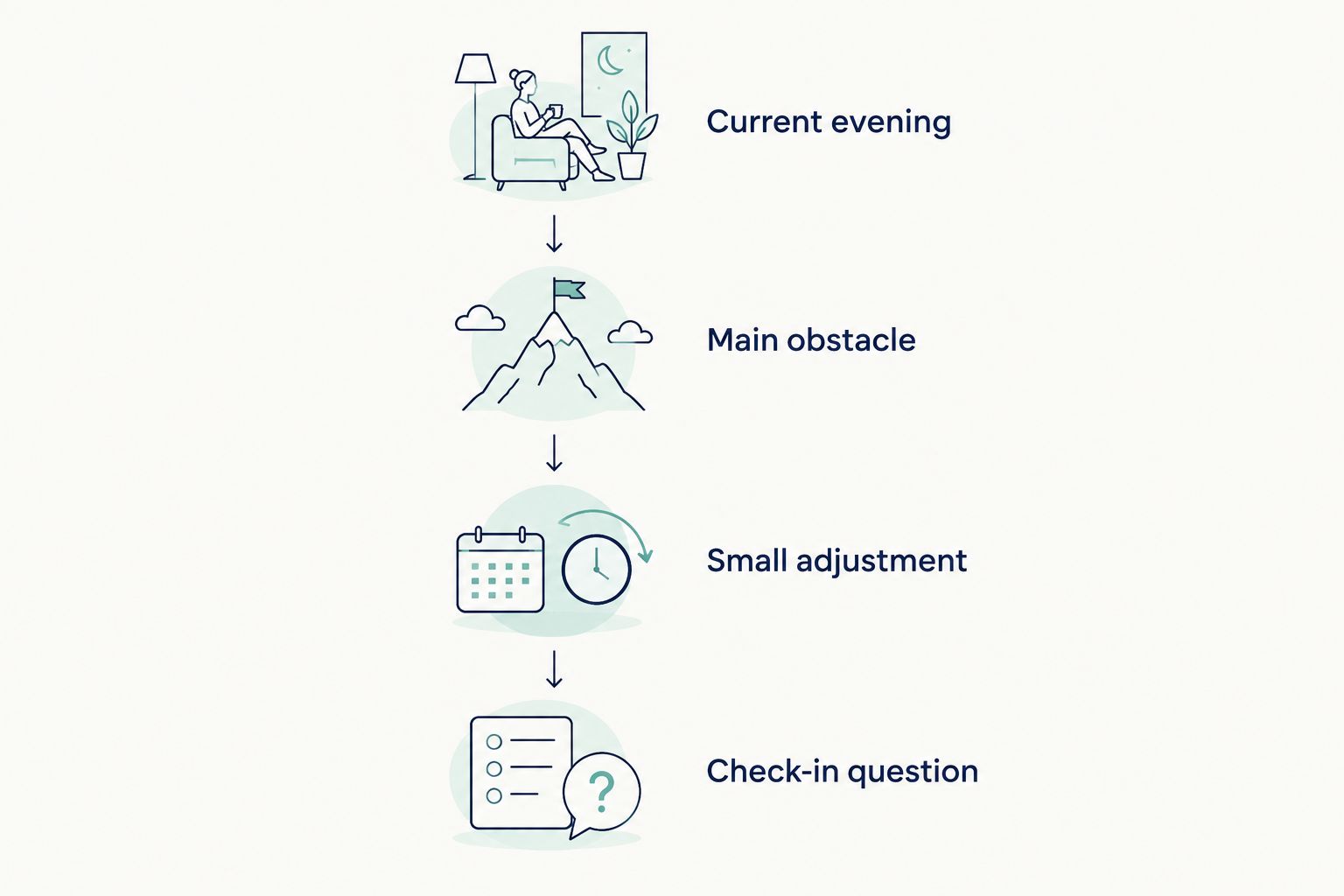
For a first conversation in 2026, you can organize your goal around these preparation prompts:
- Current evening: What usually happens before bed?
- Main obstacle: Where does the routine become difficult?
- Small adjustment: What would you like help trying?
- Check-in question: What would you want to review afterward?
These prompts describe a process, not a promise. You can change your goal when the discussion helps you see that another starting point fits better.
Ask how guidance and check-ins will work
Personal guidance is most relevant when you want help adapting an idea to your circumstances. Ask how your coach will discuss obstacles, review your observations, and respond when a routine does not fit the life you actually live.
Restweft sleep coaching is best for adults who want personal guidance with doable evening routines and ongoing check-ins. Its scope is everyday wellness coaching, not medical care, diagnosis, or treatment.
Bring questions that let you understand the working relationship:
- What information would help you understand my evenings?
- How will we choose an adjustment that fits my responsibilities?
- What should I note between conversations?
- How do ongoing check-ins work?
- What happens if I cannot follow the routine we discuss?
- Which concerns fall outside sleep coaching?
Listen for an explanation you understand. You should be able to describe the proposed next step in your own words, including how you will discuss it again if it feels impractical.
Make room for your first conversation
Create an account and complete a private sleep profile to describe your evenings and goals.
Personal coaching, sleep apps, or a self-guided routine?
These approaches offer different ways to organize your efforts. Use the comparison to identify the kind of support you want, not to rank every option as universally better or worse.
| Approach | Best for | Useful role | Limit to consider |
|---|---|---|---|
| Personal sleep coaching | Adults wanting guidance and ongoing check-ins | Discussing how practical routines fit real responsibilities | Requires participation and does not provide medical care |
| Sleep apps | Adults who prefer using a digital tool independently | Organizing observations or following prompts, depending on the app | Features differ; a tool does not automatically provide personal guidance |
| Self-guided routines | Adults who prefer choosing and adjusting habits themselves | Trying an evening structure you can change independently | You are responsible for deciding what to change and reviewing how it fits |
Choose support based on the help you want, not on how much information you can collect. A detailed record does not answer every practical question about an evening, and a simple note can still give you something useful to discuss.
For your 2026 conversation, mention any tools or routines you already use. Explain whether they help you understand your evenings or make preparation feel more complicated.
Why preparation varies from person to person
Your notes should reflect your circumstances rather than someone else's ideal evening. The same preparation format does not need to suit every adult.
These factors can shape what you bring:
- Work schedule: Explain whether work ends predictably or continues into the evening.
- Care responsibilities: Describe interruptions or obligations a routine needs to accommodate.
- Current habits: Bring what you already do, including parts you want to preserve.
- Tracking comfort: Say whether detailed notes help you or feel burdensome.
- Preferred support: Explain whether you want help choosing a starting point, adapting it, or reviewing it through check-ins.
There is no need to solve these constraints before the conversation. Naming them is useful preparation in itself.
What if I have not tracked my sleep before the conversation?
You can prepare without an existing sleep record. Describe what you remember about recent evenings, including what varies and what feels difficult to explain.
If you decide to start taking notes, keep the task manageable. Ask what information would be useful before committing to detailed tracking that you do not want to maintain.
What if I feel embarrassed about my evening habits?
You can discuss an evening habit without defending it or labeling it as bad. Explain what the activity gives you, such as quiet time after responsibilities, and what you want to be different.
That distinction makes the conversation more practical. Replacing an activity without understanding its place in your evening leaves an important part of the picture out.
What if my concern needs medical attention instead of coaching?
Sleep coaching is not the right place for diagnosis or treatment decisions. Bring health concerns to a qualified healthcare professional rather than asking an everyday wellness coach to assess a medical condition.
You can ask a coach to explain the boundary between routine support and medical care. Do not treat a coaching conversation as a substitute for healthcare advice.
FAQ
What should I bring to my first sleep coach conversation?
Bring a rough description of your evenings, the sleep patterns you notice, a practical goal, and questions about support. Existing notes are useful, but you do not need perfect records.
Do I need a sleep tracker before talking to a sleep coach?
You do not need a sleep tracker to describe your evenings and sleep patterns. If you already use one, explain what you find helpful or confusing about its information.
How should I prepare for online sleep coaching in 2026?
Prepare for online sleep coaching in 2026 by organizing a few notes about your current schedule, routine, and goals. Keep your questions accessible during the conversation so you can discuss what matters to you.
Is personal sleep coaching better than a sleep app?
Personal sleep coaching fits adults who want guidance and ongoing check-ins, while a sleep app fits people who prefer using a digital tool independently. The useful choice depends on the support you want; neither replaces medical care.
What if I cannot follow the routine a coach suggests?
Tell the coach which part does not fit and why. Use the discussion to ask about a smaller or different adjustment rather than treating the mismatch as a personal failure.
Can Restweft diagnose or treat a sleep condition?
Restweft provides everyday wellness coaching, not medical diagnosis or treatment. Take concerns about a medical condition to a qualified healthcare professional.
What should I ask about ongoing sleep coaching check-ins?
Ask how check-ins work, what observations to bring, and how you will discuss adjustments that feel impractical. Clarify the process rather than assuming a particular schedule or format.
One last thing
Bring an example of an evening that felt manageable, not only one that felt difficult. Describe what was different, what you enjoyed, and which parts you would like to keep.
That gives the conversation something to build around without pretending that every night can look the same. You are making room for a rhythm, not looking for a reset button.