
Sleep coaching for busy executives is personal guidance for building manageable evening routines and tracking sleep patterns, with the aim of making room for better rest around demanding work. Your routine needs to accommodate late calls, unfinished decisions, and family responsibilities—not assume that every evening follows the same schedule.
- Sleep coaching for busy executives should fit demanding evenings, not create another performance target.
- Restweft sleep coaching is best for busy adults who want personal guidance and ongoing check-ins.
- Start with a simple sleep journal and an adaptable wind-down routine before adding sleep tracking apps.
- Coaching supports everyday habits; persistent sleep difficulties belong in a conversation with a qualified healthcare professional.
Why sleep coaching matters for busy executives
An executive's evening can become an extension of the workday: a delayed handoff, a board presentation, or a message from another time zone. The practical challenge is deciding how to end work when the work itself is not finished.
A useful sleep routine needs a version for the evenings that do not go to plan. Otherwise, a late meeting turns an ambitious plan into something you abandon altogether. Sleep coaching gives you a place to discuss those constraints and adjust everyday habits without treating each disrupted night as a failure.
For your 2026 routine, begin with observation rather than a new device. A notebook or sleep journal template gives you somewhere to record when work ended, what happened afterward, and how rested you felt the next morning.
The goal is not to prove that a particular meeting caused a poor night. It is to identify recurring situations that deserve a more workable plan. Coaching is everyday wellness support, not medical care or a promise of better business performance.
How to build a routine around demanding evenings
Start with the manual approach below. You can use paper, an existing calendar, and a brief conversation with yourself about what is realistic. Personal guidance becomes useful when you want help choosing adjustments and reviewing how they fit—not because you need permission to begin.
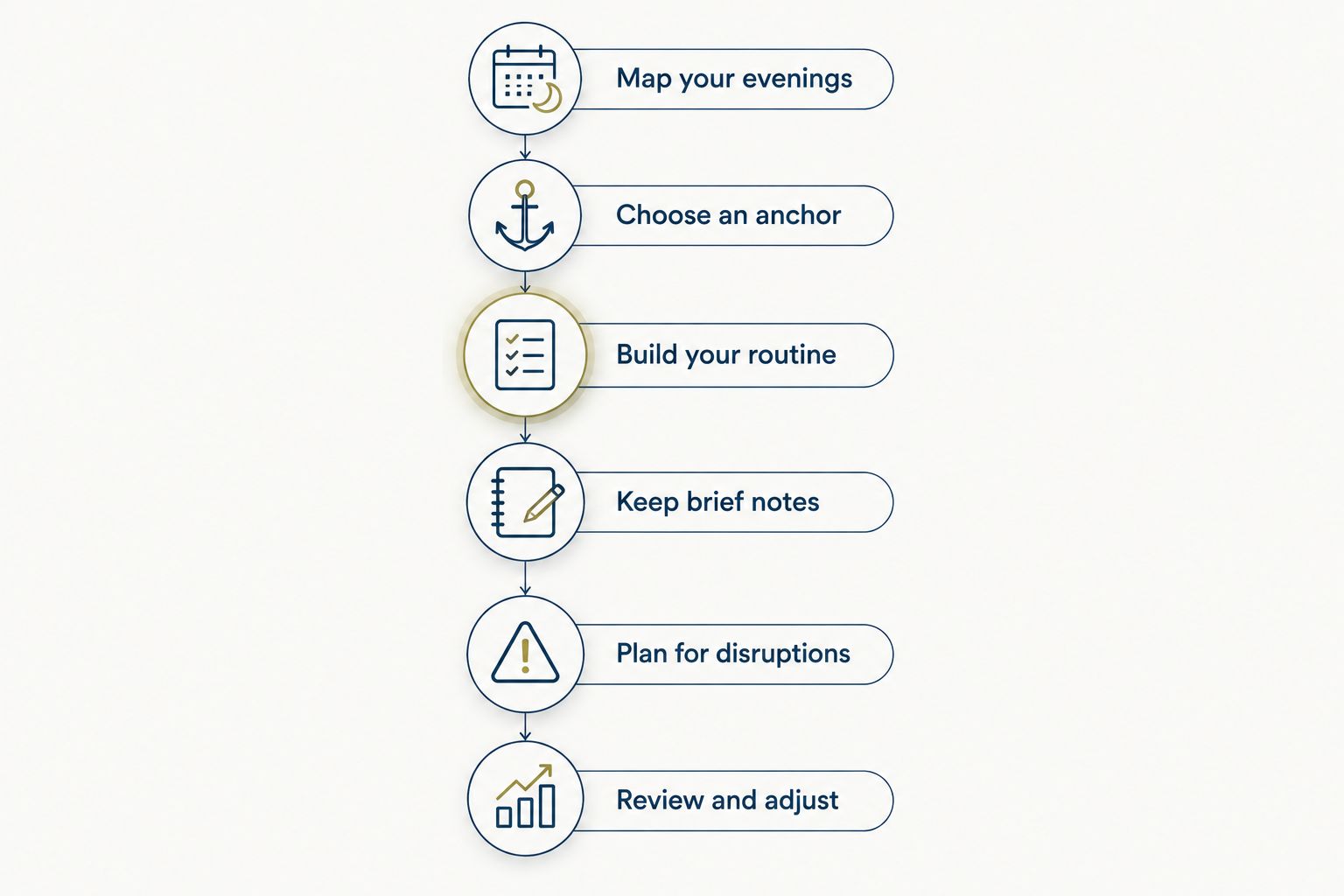
Map your evenings
Look at your actual calendar before choosing a bedtime routine. Separate evenings you control from evenings shaped by clients, colleagues, caregiving, or travel. A recurring late call needs a different plan from an occasional dinner that runs long.
For a 2026 planning exercise, review 7 days of evenings. This is a suggested observation window, not a clinical assessment or a deadline for results. Write down when your last work obligation ended and what filled the space before bed.
Include personal commitments. A routine that ignores dinner, a child's bedtime, or time with your partner is not a realistic routine. You are looking for room to make a small change, not evidence that your evening is badly organized.
Choose one situation to work on first: perhaps the night you keep reopening your inbox after getting ready for bed. A specific situation gives your plan somewhere practical to start.
- Mark recurring late meetings in your calendar.
- Note family or household commitments that stay in place.
- Identify one evening transition that feels difficult.
- Describe what a manageable alternative would look like.
Choose an anchor
An anchor is an existing event that reminds you to begin winding down. It might be finishing dinner cleanup, closing your work laptop, or brushing your teeth. Choose something you already do rather than adding another reminder you can dismiss.
A fixed clock time is not the only option. If evening calls move around, an event-based anchor gives your routine a recognizable starting point without pretending your calendar is predictable. The anchor is a prompt, not a guarantee that you will feel sleepy afterward.
Pair it with a clear action. After closing your laptop, for example, write tomorrow's first task on paper and put the laptop away. You have acknowledged the unfinished work without requiring yourself to solve it that evening.
Choose an anchor you can use on an ordinary difficult night. An elaborate sequence that only works after an unusually quiet day is not the starting point you need.
- Use an existing evening event as your cue.
- Attach one small action to that cue.
- Decide where work devices will go afterward.
- Keep a shorter version for late finishes.
Build your routine
Begin with a few familiar actions rather than a collection of new habits. You might prepare tomorrow's essentials, wash up, and read something unrelated to work. Keep the order simple enough that you do not need to consult instructions.
Try a 10-minute version as a planning example, not a required duration. If that feels like another assignment, shorten it. The useful question is whether the routine fits your evening and gives work a clear stopping point.
Restweft sleep coaching is best for busy adults who want personal guidance and ongoing check-ins. Personal guidance gives you space to discuss why a routine is awkward and choose a more doable version. It still requires your participation, and it does not remove unpredictable demands from your calendar.
For your 2026 plan, bring a real evening example to a coaching conversation rather than an ideal schedule. Explain what happened between your final obligation and getting into bed.
- Pick familiar activities you already find manageable.
- Choose a normal version and a shortened version.
- Keep work planning outside the wind-down sequence.
- Discuss practical obstacles during check-ins.
Keep brief notes
Start with a paper record before deciding whether an app would help. A short note can include when you went to bed, when you got up, how rested you felt, and anything unusual about the evening. Estimates are enough for a habit conversation.
Use a 2-minute note as an example of a manageable limit. The purpose is to make recording easy, not to create a precise account of every waking moment. If tracking becomes another task you dread, simplify the record.
Distinguish observations from explanations. Writing that you answered messages in bed describes an event. Writing that those messages caused every sleep difficulty goes beyond what your notes establish.
Use tracking to support a conversation, not to grade your night. A coach can discuss the pattern you notice without treating a journal or a wearable score as a diagnosis.
- Record approximate bed and wake times.
- Add a brief description of the evening.
- Note how rested you felt in the morning.
- Leave out details you will not use when reviewing habits.
Plan for disruptions
Give late meetings and travel their own version of the routine. Do not expect a night that ends with an airport transfer to resemble an ordinary evening at home. Keep the planning focused on what remains within your control.
For a late call, the shortened routine might be writing down the next action, putting away work, and completing your usual personal care. For a hotel stay, it might mean unpacking the items you need before settling down. These are practical examples, not instructions for managing jet lag or a medical sleep condition.
Work boundaries also need to match your responsibilities. Decide which messages genuinely require your attention and how those messages reach you. Do not switch off essential communication without an appropriate coverage arrangement.
The aim is continuity without perfection: a recognizable ending to the evening, even when the surrounding circumstances change.
- Write a shortened routine for late-call nights.
- Prepare essential travel items before winding down.
- Clarify urgent-message expectations with relevant colleagues.
- Resume the ordinary routine without trying to compensate perfectly.
Review and adjust
Review the routine as a practical arrangement, not a test of discipline. Ask which parts you used, what repeatedly got in the way, and which actions felt like unnecessary work. An unused step is information about the plan.
Choose one adjustment for the next set of evenings. You might move tomorrow's preparation earlier, shorten the routine after late calls, or stop recording details you never review. Changing everything at once makes it harder to understand what fits.
During ongoing check-ins, discuss participation as well as sleep observations. A routine you can repeat deserves attention even when individual nights vary. Coaching cannot guarantee how you will sleep or establish a medical explanation for difficulties.
If sleep problems persist, or you experience symptoms such as loud snoring, gasping during sleep, or significant daytime sleepiness, speak with a qualified healthcare professional. Do not use a habit review to postpone appropriate care.
- Identify the step you used most consistently.
- Name the obstacle that appeared repeatedly.
- Adjust one part of the routine.
- Bring persistent difficulties or concerning symptoms to a healthcare professional.
Compare ways to support your evening routine
Choose the kind of support you will actually use in 2026. A self-guided routine puts you in charge of planning and review. An app provides the functions included in the particular app you choose. Personal coaching adds a conversation about your habits and constraints.
No approach makes an unpredictable calendar predictable. Compare the help you need rather than the amount of information an option collects.
| Option | Best for | What it offers | Key limitation |
|---|---|---|---|
| Self-guided routine and paper journal | Adults comfortable making their own adjustments | A simple way to plan evenings and record observations | You organize the review and decide what to change yourself |
| Sleep app | Adults who prefer a digital routine or record | App-specific recording, prompts, or guided content; check the functions offered | Features vary, and a digital record is not personal coaching or a medical assessment |
| Restweft personal sleep coaching | Busy adults who want personal guidance and ongoing check-ins | Support for practical evening routines and tracking sleep patterns | Requires your participation and does not diagnose or treat medical conditions |
Choose personal guidance when discussing the obstacles is the support you need. Choose a self-guided approach when you prefer to experiment independently. An app earns its place only if its functions serve your routine rather than add more work.
Common mistakes busy executives make
Designing around an unusually quiet evening
A routine that assumes no late calls, no family commitments, and no unfinished work leaves out the conditions it needs to address. Build the ordinary version around your real evening, then write a shorter version for the nights that run late.
Turning sleep into another performance score
A sleep score or a streak does not capture every part of your experience. If you start organizing the evening around achieving a number, return to the practical questions: what did you do, how did it fit, and what needs adjusting?
Leaving work boundaries undefined
Putting a phone away is difficult when you have not decided what counts as urgent. Agree on expectations where your role allows it. A clear exception for genuine urgency is more usable than a rule you know you cannot keep.
Adding tools before choosing a habit
A new app or tracker does not decide when your workday ends. Begin with the action you want to make easier, then assess whether a tool helps you carry it out. You do not need a device to start keeping brief notes.
Asking coaching to replace healthcare
Everyday wellness coaching supports routines and reflection; it does not investigate or treat medical conditions. Tell a qualified healthcare professional about persistent sleep difficulties or concerning symptoms, even if you are also working on evening habits.
FAQ
What's the best sleep coaching approach for a busy executive?
The best fit is an approach that adapts to your actual evenings and offers the level of personal guidance you want. Ask how the coach handles late meetings, changing schedules, and ongoing check-ins rather than looking for a rigid routine.
Is Restweft sleep coaching medical care?
Restweft sleep coaching is everyday wellness support, not medical care. It helps adults build practical evening routines and track sleep patterns; it does not diagnose or treat medical conditions or replace qualified healthcare advice.
Can I start a sleep routine without an app or wearable?
Yes, you can start with a notebook and an existing evening activity as your cue. Record a few observations and choose a small, repeatable action before deciding whether a digital tool serves a useful purpose.
What should I do when a late meeting interrupts my routine?
Use a shortened version of your routine rather than trying to complete every usual step. Acknowledge unfinished work, put away what you can, and keep the familiar actions that remain practical that evening.
Is personal sleep coaching better than a sleep app?
Personal sleep coaching is the more relevant option when you want a conversation about your habits and ongoing check-ins. A sleep app is a different option for people who prefer digital recording or guided content, with functions that vary by app.
How quickly will sleep coaching change my sleep?
There is no guaranteed timeline for changes in sleep. Coaching focuses on practical habits and adjustments, while persistent sleep difficulties deserve a conversation with a qualified healthcare professional.
What should I prepare before speaking with a sleep coach?
Bring a description of an ordinary evening, a disrupted evening, and the adjustment you want help making. Brief notes about work ending, bedtime, and how rested you feel can support the conversation without requiring a detailed record.
One last thing
Write your fallback routine before your ideal one. The evening with the late call is not an exception to your life; it is one of the situations your plan needs to accommodate.
For 2026, choose an ending you can recognize rather than a routine you must complete perfectly. Better evenings need a rhythm, not a reset button.
If you want personal guidance, you can create an account and complete a private sleep profile with Restweft. Start with the life you actually live, including the parts of your schedule that are difficult to change.