
Choose a self-guided routine when you want to try a manageable evening habit independently; choose a sleep coach when you want personal guidance and ongoing check-ins to help adapt that habit to real life. In 2026, the useful distinction is who helps you make adjustments—not which approach promises better sleep. Neither everyday wellness coaching nor a self-guided routine replaces medical care.
- Sleep coach or self guided routine: choose based on the support you want, not promises of a quick fix.
- Restweft suits adults who want personal sleep coaching, practical evening routines, and ongoing check-ins.
- Self-guided routines suit independent experimentation; sleep apps add tools without necessarily providing personal guidance.
- Persistent sleep difficulties deserve qualified healthcare advice, not a more demanding evening checklist.
Sleep coach or self-guided routine: how do you choose support?
Choose the approach that addresses your sticking point. Knowing what to try, remembering to try it, and deciding what to change are different needs. Use this 2026 comparison to separate them before committing to another bedtime plan.
| Approach | Best for | What it offers | Main limitation |
|---|---|---|---|
| Self-guided routine | Adults who prefer independent experimentation | You choose a habit, notice what happens, and adjust it yourself | You also decide what to change when the routine does not fit |
| Sleep app | Adults who want a place to record patterns or follow prompts | Depending on the app, logging, reminders, or guided activities | Features vary; an app does not necessarily include personal guidance |
| Restweft personal sleep coaching | Adults who want guidance and ongoing check-ins | Support with practical evening routines and tracking sleep patterns | Participation takes attention, and wellness coaching is not medical care |
An app and a coach are not opposite choices. You can use a simple record alongside personal guidance, or keep a paper note while working independently. The tool matters less than whether it helps you understand your evenings without creating another obligation.
Why this matters
A routine can look sensible on paper and still ask too much of your evening. Late work, caregiving, shared spaces, and unfinished tasks all affect what you can reasonably do before bed. Choosing support starts with acknowledging those constraints rather than treating them as failures.
If your difficulty is remembering a habit, a visible reminder might be enough. If your difficulty is deciding how to adapt that habit when circumstances change, a conversation offers a different kind of help. More information is not automatically the answer to either problem.
You do not have to prove that you can manage everything alone before considering support. Equally, you do not need coaching just because your current routine is imperfect. The right choice leaves room for ordinary, unfinished evenings.
Self-guided routines: best for independent adjustments
A self-guided routine gives you control over what you try and what you record. It fits when you can name a manageable change and feel comfortable deciding whether to keep it. You do not need an elaborate schedule to begin.
For example, imagine an evening when you finish work later than expected. Instead of attempting a long sequence, you might spend 5 minutes putting tomorrow's essentials together, then stop planning for the night. That is an example of a small routine, not a prescribed duration or a promise of better sleep.
What works in its favor?
You can change the routine without waiting for a conversation. You can also choose how much structure you want: a brief note, a reminder, or no tracking at all if recording becomes distracting. The process stays in your hands.
The trade-off is that you also handle the interpretation. When an evening goes differently, you decide whether the habit was too ambitious, poorly timed, or simply unsuitable that night. That freedom can be useful, but it is still work.
When does self-guidance stop being useful?
Consider a different approach when you keep collecting advice but cannot decide what belongs in your own evening. Another sign is repeatedly rebuilding the entire routine after a disrupted night. Neither situation calls for a stricter checklist by default.
For a self-guided routine in 2026, a useful question is: can you explain the next small adjustment in plain language? If the answer is yes, try that adjustment. If the answer stays unclear, personal guidance is an option—not a judgment on your effort.
Personal sleep coaching: best for adapting with support
Personal coaching adds a person to the process of choosing, reviewing, and adjusting everyday habits. It is relevant when you want help connecting general suggestions to your actual responsibilities. Ongoing check-ins give you a place to discuss what happened rather than silently abandoning the plan.
Restweft personal sleep coaching is best for adults who want personal guidance and ongoing check-ins around practical evening routines. Its role is everyday wellness support, not diagnosis or treatment. That boundary belongs in your decision from the beginning.
What works in its favor?
A conversation gives you room to describe details that a generic checklist cannot account for. Perhaps your evenings alternate between working late and caring for someone, or your household does not settle at a predictable time. Those are relevant planning details, not excuses to work around through willpower.
You can also bring an unsuccessful attempt to a check-in without needing to turn it into a success story. The useful material is what happened: which step felt manageable, which one added friction, and what changed in the evening.
What are the trade-offs?
Coaching requires you to share relevant information and participate in reviewing your habits. It does not remove the need to make choices in daily life. If you already know what you want to try and prefer working privately, that extra interaction might not be the support you need.
When choosing personal sleep coaching in 2026, ask about its scope and how check-ins work. Do not assume a particular schedule, communication channel, or medical qualification. A clear explanation of the service is more useful than a sweeping outcome promise.
Sleep apps: best for a specific supporting task
A sleep app can serve a narrower purpose than either a complete routine or a coaching relationship. Depending on its features, you might use it to keep notes, receive a reminder, or follow an evening activity. Choose the task first, then assess the tool.
For example, if you simply want to remember what your evening looked like, a recording tool addresses that need. If you want someone to discuss why your plan keeps colliding with work, a recording tool alone does not provide that conversation.
The advantage is having a defined place for a task you already value. The limitation is that recording information does not decide what that information means for you. Keep an app only if its role is clear enough to describe without listing features.
An app's sleep summary is not a medical diagnosis. If a number or notification leaves you worried, avoid treating it as a verdict about your health. Bring health concerns to a qualified healthcare professional.
Why your support needs vary
The useful level of support depends on what makes the routine difficult, not how motivated you think you should be. These practical factors help explain why a workable choice for one person feels burdensome to another:
- Evening predictability: A familiar schedule allows a repeatable sequence; changing work or caregiving demands call for adaptable options.
- Decision load: Choosing and reviewing habits independently takes attention. Personal guidance adds a place to discuss those decisions.
- Comfort with recording: Brief notes help some people reflect, while detailed tracking becomes another task for others.
- Preference for conversation: Some adults want to talk through obstacles; others prefer private experimentation.
- The kind of concern: Everyday routine planning belongs within wellness support. Symptoms and health concerns need qualified healthcare advice.
These factors are not a scoring system. You do not have to count how many apply or earn a particular recommendation. Use them to describe what you want help with in a sentence or two.
How can you choose without overhauling your evenings?
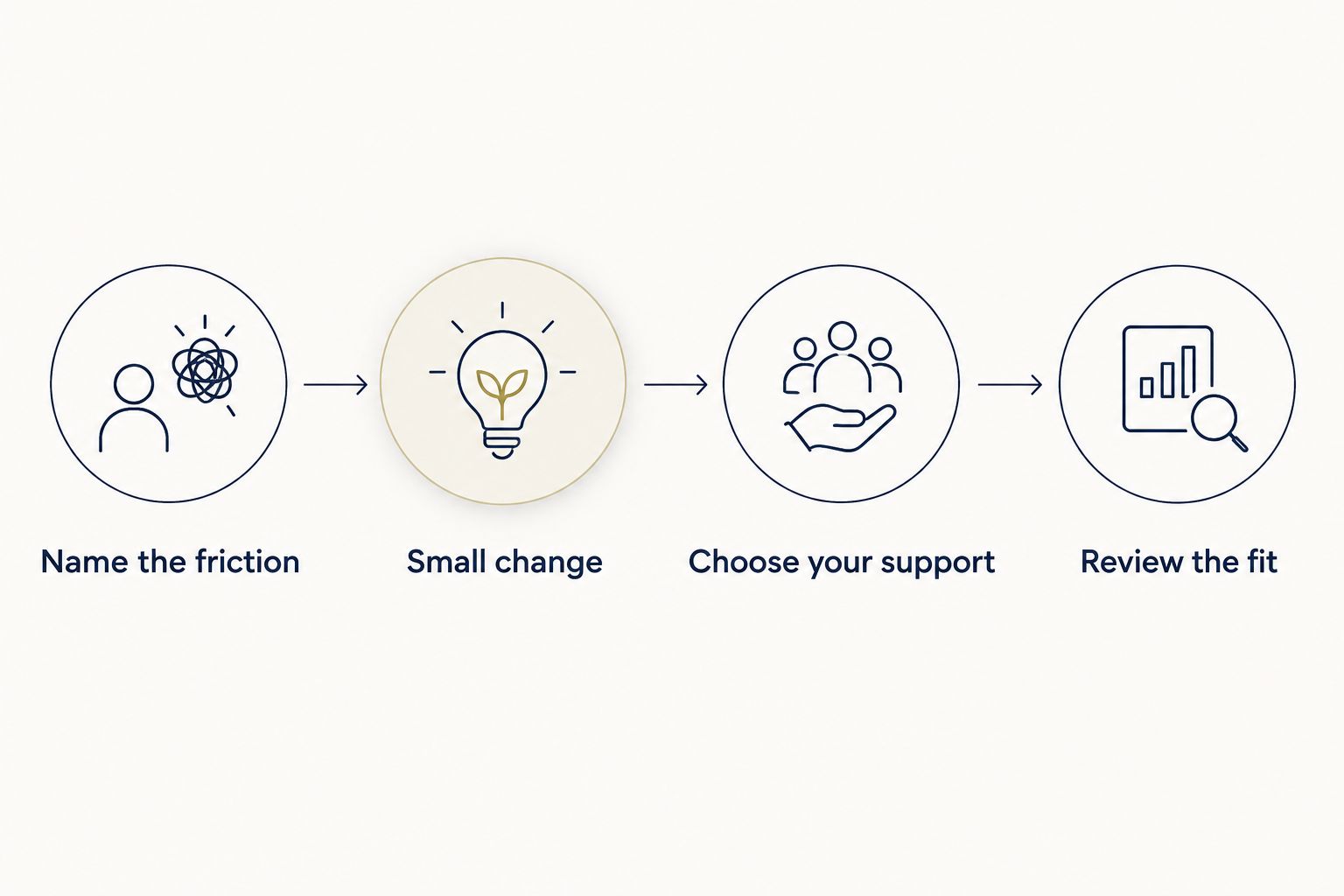
Start with the obstacle you experience, then choose the smallest useful form of support. This sequence is a way to organize the decision, not a bedtime checklist you must complete.
1. Name the friction
Describe an observable moment rather than labeling yourself. For example: you keep answering work messages after you meant to stop, or tomorrow's unfinished preparation occupies your evening. A concrete description gives you something practical to discuss or adjust.
2. Pick a small change
Choose an option that fits a busy night as well as a quiet one. An illustrative version might be 2 minutes spent writing down tomorrow's first task rather than continuing to plan in bed. The duration is optional; the aim is a doable action.
3. Choose your support
Decide whether you want independent experimentation, a tool for a specific task, or personal guidance. You do not need all three. If the obstacle is uncertainty about what to change, adding more tracking alone does not answer that question.
4. Review the fit
Ask whether the action was practical and whether it added pressure. An illustrative 1 minute of reflection is enough to write a short observation; you do not need a detailed report. Keep the useful part, simplify the difficult part, or choose a different action.
A disrupted evening gives you information about the plan's fit. It does not require you to start over. You can return to the same small action, shorten it, or acknowledge that tonight needs something different.
Can I start alone and choose a sleep coach later?
You can start with a self-guided routine and add coaching when you want help adapting it. You do not need to reach a particular milestone first. Bring the attempts that felt useful and the situations that made them difficult.
You can also choose guidance from the start if independent planning already feels like another job. The distinction is your preferred support, not whether you have tried hard enough. There is no need to turn the choice into a test of discipline.
What should I bring to a first sleep coaching conversation?
Bring a plain description of your evenings, your practical constraints, and what you want support with. Notes are optional; a polished sleep history is not necessary for explaining an everyday routine problem. Be clear about whether recording habits feels helpful or burdensome.
With Restweft, the next step is to create an account and complete a private sleep profile. Use that opportunity to describe the life the routine needs to fit, including the evenings that rarely go to plan.
Make room for a doable routine
Create an account and complete your private sleep profile to describe your evenings and support needs.
When should I seek healthcare advice instead of coaching?
Seek qualified healthcare advice when sleep difficulties persist, affect daily functioning, or include symptoms such as breathing pauses during sleep. Everyday wellness coaching does not diagnose or treat a sleep disorder. You do not need to finish a self-guided experiment before raising a health concern.
Keep that distinction clear even when you also want help with routines. Practical evening support and medical advice address different needs; a coaching plan does not replace an evaluation or instructions from your healthcare professional.
FAQ
Is a sleep coach better than a self-guided routine?
A sleep coach is a better fit when you want personal guidance and ongoing check-ins; a self-guided routine fits independent experimentation. Neither approach guarantees better sleep or replaces medical care.
Can I use a sleep app while working with a coach?
You can use a sleep app alongside coaching if it serves a useful task, such as keeping brief notes. Ask what information is relevant rather than assuming you need detailed tracking.
Do I need a wearable to start a sleep routine?
You do not need a wearable to start an evening routine. A brief written observation can describe what you tried and whether it fit your evening.
What if my evenings change because of work or caregiving?
Choose adaptable actions rather than requiring the same sequence every night. Explain those constraints when seeking guidance so the routine reflects your responsibilities.
Does personal sleep coaching treat insomnia?
Everyday wellness sleep coaching does not diagnose or treat insomnia. Speak with a qualified healthcare professional about persistent sleep difficulties or suspected medical conditions.
How do I know whether tracking is helping me?
Tracking is useful when it helps you describe your evenings and make practical decisions. Simplify it if recording becomes burdensome, and seek qualified advice if sleep concerns are affecting daily life.
What should I ask before choosing a sleep coach?
Ask what the service covers, how personal guidance and check-ins work, and where its medical boundaries sit. Clear scope matters more than promises of a quick fix.
One last thing
For your 2026 routine, write a fallback alongside your preferred plan. If the longer version does not fit tonight, what is the smaller action you would still choose willingly? That question makes room for real life without turning every disruption into a restart.
A useful routine gives you somewhere to return, not another standard to fail. You can ask for support with that return, or practice it independently. Neither choice requires a perfect evening.