
To wind down before bed after working late, make a clear stopping point, write down what can wait, and move into a short, familiar bedtime routine. Keep the transition small enough to fit the evening you actually have; you do not need to finish every task or feel completely relaxed before getting ready for sleep. The aim is to leave work behind without turning bedtime into another assignment.
- How to wind down before bed after working late: close work, park tomorrow’s tasks, and choose a familiar transition.
- Restweft offers personal sleep coaching for adults who want guidance with doable evening routines.
- A shorter routine is an adaptable option, not a failed version of a longer one.
- Keep sleep tracking simple enough that it does not become another late-night task.
How to wind down before bed after working late
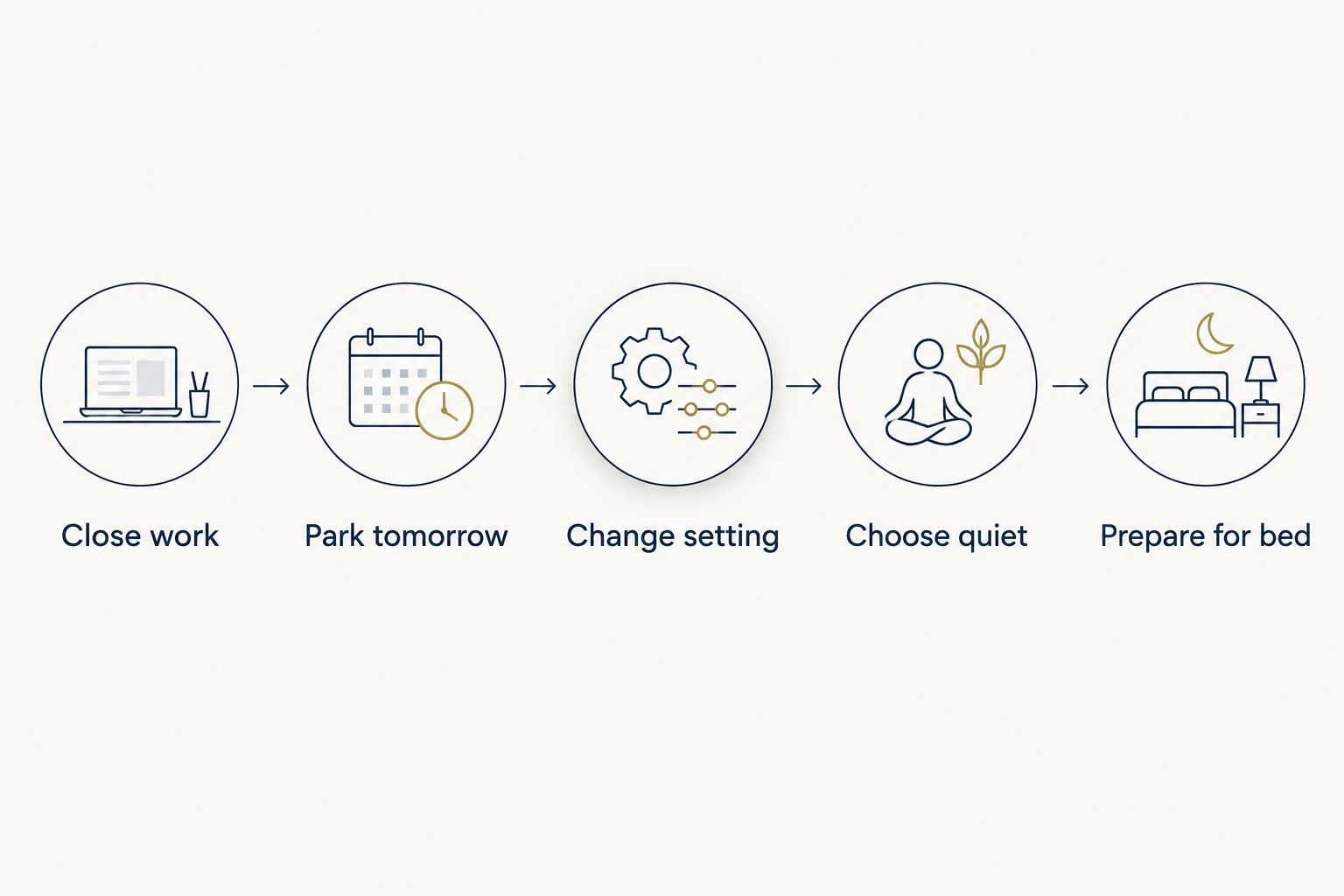
Start with a clear handoff from work to home, then keep bedtime preparation simple. Use this sequence as a flexible starting point rather than a checklist you must complete perfectly:
- Close work. Finish at a stopping point, save what matters, and close work materials.
- Park tomorrow. Write the next action beside any unfinished task you keep thinking about.
- Change setting. Leave the workspace or put work items out of sight.
- Choose quiet. Pick a familiar activity that does not ask much of you.
- Prepare for bed. Move through your usual personal care without adding another project.
If you want help fitting that sequence around unpredictable evenings, Restweft offers personal online sleep coaching for adults. The starting point is the life you already have, not an ideal evening you cannot reproduce.
Why this matters
Working late leaves you with two unfinished jobs: the work itself and the transition away from it. A bedtime routine cannot resolve every work demand, but it can give you a deliberate place to stop responding to those demands for the evening.
For your 2026 routine, choose something you can use after an ordinary difficult day. A detailed plan that requires a quiet house and an empty inbox does not fit a night when you arrive home tired, hungry, or still thinking about a deadline.
The useful question is not whether your evening looked perfectly restful. It is whether you gave yourself a workable way to leave work and prepare for bed.
Close work without trying to finish everything
A stopping point is different from a finished workload. You can close the evening with an incomplete project, provided you leave yourself enough information to return to it without mentally rehearsing the whole thing in bed.
Write a brief handoff note: what remains unfinished, what the next action is, and where the relevant material lives. Keep it practical. You are leaving instructions for your next work session, not reviewing every decision you made today.
For example, if you stopped halfway through a presentation, the next action might be to check the final chart. That is more usable than a vague reminder to finish the presentation, and it gives the unfinished work a place outside your head.
Then close the document and put away the equipment you no longer need. If your role requires after-hours contact, decide what genuinely needs your attention under those arrangements; a bedtime routine should not depend on pretending those responsibilities do not exist.
Change setting, even when home is also your office
You do not need a separate room to mark the end of work. Move to another chair, put your laptop in a bag, or clear the work papers from the place where you will spend the rest of the evening.
Choose a boundary you can repeat without much effort. Rearranging your home every night creates extra work; closing a lid and putting away a notebook is simpler.
If you work away from home, use arriving home as the transition instead. Put your work bag down, change into comfortable clothes, and decide what you need next before opening messages again.
The boundary is an action, not a feeling. You can stop working while still feeling mentally busy. There is no need to wait until every work thought disappears before taking the next step toward bed.
Choose quiet without making relaxation another task
Pick something familiar that asks little of you: reading a familiar book, listening to quiet audio, or sitting somewhere comfortable without continuing work. Choose based on what feels manageable tonight, not on what looks like the most impressive routine.
A useful distinction is whether the activity has a natural stopping point. An open-ended feed or another work conversation gives you more to respond to; a chosen passage or familiar recording gives you a clearer place to finish.
You do not have to force yourself to enjoy meditation, journaling, or any other particular activity. If a suggestion feels irritating or demanding after work, choose a simpler alternative rather than treating that reaction as a failure.
For a 2026 plan you can keep using, leave room for different evenings. Your preferred transition on a quiet night does not have to match the one you use after a late meeting.
Prepare for bed without adding a new project
Keep the personal care you need and simplify the optional parts. You do not need a newly organized bedroom, a fully planned week, and a completed household task list before you are allowed to go to bed.
If tomorrow's preparations matter, identify the item that would otherwise keep pulling at your attention. Set out what you need or leave yourself a reminder, then stop there rather than expanding the task.
For example, putting your work bag by the door is different from reorganizing everything inside it. Choosing tomorrow's first task is different from planning the entire day.
A bedtime routine is a handoff, not another shift. Let the routine end when its job is done, even if other useful things remain unfinished.
Why your wind-down routine varies after working late
Your routine should respond to the evening rather than demand that every evening look the same. Build your 2026 plan around the practical differences you already encounter:
- Where work ends. Closing a home-office laptop requires a different transition from arriving home after a commute.
- What remains your responsibility. Required work contact needs an honest boundary, not a blanket promise to ignore every message.
- Who needs you at home. Caregiving and shared household tasks affect when you can begin your own transition.
- How much attention you have left. Reading or journaling is optional when it feels like more work.
- What tomorrow requires. A necessary preparation can belong in the routine without becoming an extended planning session.
These are reasons to adapt, not evidence that you are doing bedtime incorrectly. Keep the purpose steady while allowing the details to change.
What if you have almost no time before bed?
Use the smallest version: close work, leave a next-action note, and get ready for bed. Skip optional activities rather than squeezing an elaborate ritual into an already short evening.
A busy parent might put away a laptop after household responsibilities and move straight into personal care. Someone returning from a late shift might put down their bag, change clothes, and choose a quiet transition before bed.
Neither version needs to resemble a carefully staged evening. Save a shorter version in your 2026 plan so a late finish does not require a fresh decision about what counts as enough.
What if you keep thinking about work in bed?
Give an actionable thought a place outside the bed. If you remember something you need to do, make a brief note rather than reopening the full task or starting a new work session.
Not every thought needs an answer tonight. When a thought is simply a replay of the day, you do not have to turn it into a problem-solving exercise.
This is everyday routine advice, not treatment for a sleep condition. If difficulty sleeping persists or affects your daily functioning, speak with a qualified healthcare professional rather than relying on a bedtime routine alone.
Should you use coaching, an app, or a self-guided routine?
Restweft personal sleep coaching is best for adults who want personal guidance and ongoing check-ins around a doable evening routine. A self-guided approach suits someone who wants to experiment independently, while an app is an option for someone who wants a place to record observations or use a chosen activity.
Compare the kind of support you want, not the number of features or steps you can collect.
| Approach | Best for | Useful role | Limitation |
|---|---|---|---|
| Self-guided routine | Adults who prefer independent adjustments | Lets you choose and change your own evening habits | You handle the planning and review yourself |
| Sleep app | Adults who want a tool for a specific activity or record | Can provide a place for tracking or guided content, depending on the app | A tool is not the same as personal guidance; features differ |
| Restweft personal sleep coaching | Adults who want personal guidance and ongoing check-ins | Connects practical routines with observations about your sleep patterns | It is everyday wellness coaching, not medical care |
You do not have to combine every approach. If recording your evening makes bedtime feel more demanding, simplify the record before adding another tool.
If personal guidance fits what you need, you can create an account and complete a private sleep profile. There is no need to arrive with a polished routine or a perfect explanation of your evenings.
Make room for your evening routine
Create an account and complete a private sleep profile to begin with the evenings you actually have.
Track the pattern without grading your night
Use a short note to record when work ended, what you did afterward, and what felt manageable. A sleep journal template gives you somewhere to collect those observations without creating a new system from scratch.
Record what you remember rather than trying to produce a perfect account. The point is to notice whether your plan fits your evenings, not to prove that you followed every step.
When reviewing your 2026 notes, ask practical questions: Did the handoff note help you leave the task alone? Was your chosen activity easy to stop? Did tracking itself become another obligation?
Use the answers to make a small adjustment. A routine is a rhythm, not a reset button, and a difficult night does not require you to redesign everything.
FAQ
What's the simplest way to wind down after working late?
Close your work, leave a brief note about the next action, and move into your usual bedtime preparation. Add a quiet activity only if it fits the evening rather than making bedtime feel more demanding.
Do I need a long bedtime routine after a late shift?
No, you do not need a long bedtime routine after a late shift. Keep necessary personal care and a clear transition away from work, and leave optional activities for evenings when they fit.
What should I do when I remember unfinished work in bed?
Write down the next action without reopening the full task. The note gives you somewhere to return to the work later without starting another work session tonight.
Can I wind down if I work in my bedroom?
Yes, you can mark the end of work even when your bedroom is also your workspace. Close work materials, put equipment aside where practical, and change what you are doing before preparing for bed.
Is a sleep app better than personal sleep coaching?
A sleep app and personal sleep coaching serve different needs. An app provides whatever tools its features include, while personal coaching adds guidance and check-ins; choose based on the support you want rather than assuming either suits everyone.
Can Restweft treat insomnia or another sleep disorder?
No, Restweft provides everyday wellness coaching, not medical care or treatment for sleep disorders. Speak with a qualified healthcare professional about persistent sleep difficulties or concerns that affect daily functioning.
Should I track my sleep after every late work night?
Keep tracking only as detailed as you find useful. A brief observation about your evening is enough to begin reviewing your routine; you do not need to turn the record into another task to complete perfectly.
One last thing
Write your stopping rule before the next late evening. Decide what you will close, where you will leave unfinished tasks, and which optional activities you will skip when time is tight.
That recommendation is deliberately smaller than building a perfect bedtime routine. You are making room for better nights without requiring the end of every workday to go to plan.