A practical wind down routine for sleep in 2026 starts with a clear stopping point for evening tasks, a quieter activity, and a simple transition toward bed. Keep a shorter version for busy nights: the routine should fit your evening, not become another task you have to finish perfectly.
- Build your wind down routine for sleep around a stopping point, a quiet activity, and an easy bedtime transition.
- Restweft sleep coaching fits adults who want personal guidance with practical evening routines.
- Use a shorter bedtime routine on crowded evenings instead of abandoning your wind-down entirely.
- Treat sleep tracking as a way to notice patterns, not a nightly performance score.
What wind down routine for sleep fits a busy evening?
Choose a small sequence you can repeat, with permission to shorten it. Start with these steps rather than a long list of bedtime rules:
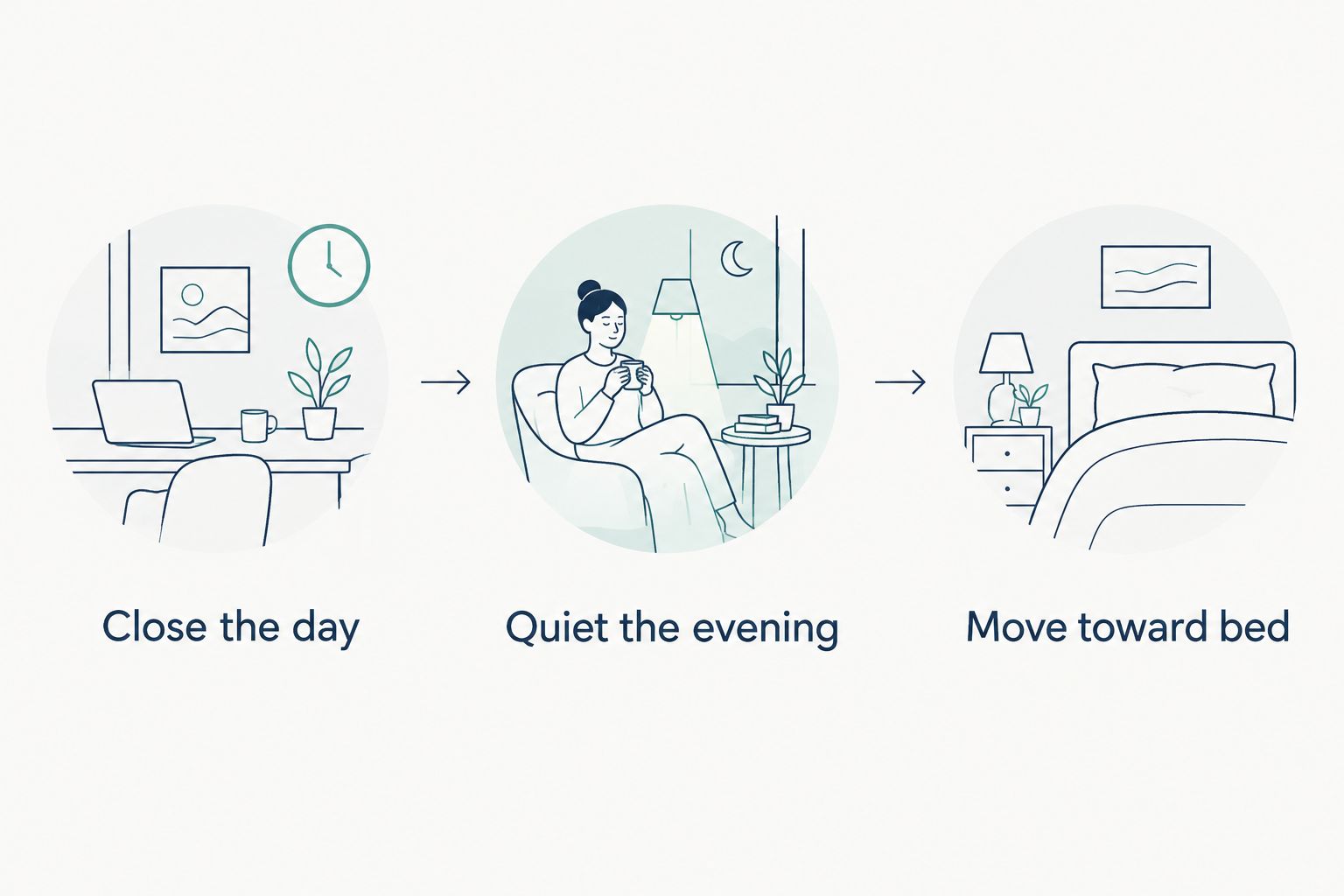
- Close the day. Write down the unfinished task you want to return to tomorrow, then put work materials aside.
- Quiet the evening. Choose something low-demand, such as reading a familiar book or listening to quiet music. Lower bright lighting where practical.
- Move toward bed. Complete your usual personal care and leave the next activity for another day. Let sleepiness guide the transition rather than treating the routine as a countdown.
For adults who want help adapting those steps, Restweft offers personal online sleep coaching. It is everyday wellness support, not medical care.
Why this matters
An evening routine has to share space with dishes, messages, caregiving, and whatever work followed you home. A plan that only works when nothing interrupts you is a poor fit for a busy household.
Your 2026 routine does not need an elaborate setup. It needs an understandable stopping point and a manageable next step, including on evenings when your plans change.
Build the routine around transitions, not perfection
The useful question is not whether you completed every bedtime habit. Ask whether you made room to move out of daytime tasks.
Close the day
Give an unfinished task somewhere to wait. Write a brief reminder, leave the relevant item ready for tomorrow, or decide when you will return to it.
For example, if an unanswered message keeps drawing you back to your phone, note that you will address it after breakfast. This does not resolve the task; it gives you a plan without requiring you to finish it tonight.
Avoid turning this step into a full planning session. A short note is enough if it helps you put the task down.
Quiet the evening
Choose an activity that does not ask much of you. Familiar reading, quiet music, or sitting comfortably without taking on another task are options, not requirements.
Notice the difference between an activity you enjoy and one that keeps pulling you into another round. A hobby with a natural stopping point might fit better here than something you find difficult to leave unfinished.
Move toward bed
Keep the final transition familiar: finish personal care, set aside what you are using, and move toward bed when you feel sleepy. Avoid adding extra steps just because a routine online includes them.
If you are not sleepy, do not use completion of the routine as proof that you must fall asleep now. A bedtime routine is preparation, not a switch.
Short evening: a 2-minute starting point for 2026
Use this as a suggested planning example, not a required duration or a promise about sleep. On a crowded evening, the smallest version can simply mark the end of tasks and the start of personal care.
You might spend 1 minute writing tomorrow's reminder and another 1 minute putting work materials out of sight. Then continue with the bedtime care you already do, without adding a separate activity.
The advantage is that this version asks little of your evening. The limitation is that it leaves little space for a quiet activity, especially if you still feel absorbed in work or household responsibilities.
Best for: evenings when adding another task would make the routine harder to start. Keep the short version available rather than treating it as a lesser effort.
Roomier evening: a 10-minute example for 2026
If you have more room, try this optional allocation:
- 2 minutes to close the day: note what remains unfinished and put it aside.
- 5 minutes to quiet the evening: read something familiar, listen to quiet music, or sit comfortably.
- 3 minutes for a transition: begin your usual personal care and put away what you no longer need tonight.
These are planning suggestions, not established thresholds. Extend personal care as needed; there is no reason to hurry through it to satisfy the example.
The advantage is a defined space between tasks and bed. The limitation is that a timed plan can become another obligation if you start watching the clock closely.
Best for: evenings with an open gap you want to protect from extra tasks. Drop the timer if keeping track of minutes makes the routine feel demanding.
Why your wind-down routine varies
The sequence can stay familiar while its length and details change. Choose the version that fits the evening you actually have.
- Work finishing late: use a brief stopping note instead of trying to complete every remaining task.
- Caregiving responsibilities: leave room for interruptions and resume at the next useful step, rather than restarting.
- Shared space: choose quiet activities that work with other people's needs; a private room is not a requirement.
- Changing schedules: connect the routine to finishing your final necessary task rather than depending only on a clock time.
- Personal preferences: choose quiet reading if you enjoy it; choose another low-demand activity if reading feels like work.
- Tracking effort: keep notes brief enough that recording the evening does not become the evening's main project.
Adaptation is not a failure of consistency. You can keep a recognizable pattern without making every night identical.
Should you use a routine, an app, or personal guidance?
Choose the kind of support you need, not the longest feature list. A self-guided plan gives you independence, while personal guidance adds someone to discuss practical adjustments with.
| Approach | Best for | Useful strength | Limitation to consider |
|---|---|---|---|
| Self-guided routine | Adults who want to start independently | You choose the habits and adjust them yourself | You also handle the review and follow-through |
| Sleep app | Adults who prefer digital recording | A place to record patterns, if the app supports that function | Features vary; recording information does not itself decide what to change |
| Restweft personal sleep coaching | Adults who want guidance and ongoing check-ins | Support with doable routines and noticing sleep patterns | Everyday wellness coaching does not diagnose or treat medical conditions |
You do not need to begin with every approach. If a brief note gives you enough information, keep using it; if you want help making sense of your routine, personal guidance serves a different purpose from collecting more entries.
For any app, check what it actually records and how you would use that information. Avoid adding tracking simply because you feel a bedtime routine ought to include technology.
What should you write in a sleep journal?
A useful note connects the evening you lived with the night you noticed. You can record when you stopped working, what you did before bed, and how the night felt without assigning yourself a grade.
For a 2026 sleep journal, start with a format you can keep brief:
- Evening context: what made tonight ordinary, busy, or interrupted?
- Routine used: what did you actually do before bed?
- Morning observation: what do you remember about the night and how you feel?
Keep observations separate from explanations. Writing that you worked late and then had a difficult night records an experience; it does not prove that late work caused that night.
Look for recurring observations rather than asking a single entry to explain everything. If recording exact times makes you preoccupied with the clock, use plain descriptions instead.
How do I keep a routine when evenings change?
Keep the sequence recognizable and let the details flex. After a late meal, the quiet activity might be brief; after an unsettled afternoon, you might prefer more space between finishing tasks and heading toward bed.
Choose a useful cue, such as putting away dinner dishes or closing your work materials. The cue should be something you can recognize in your own evening, not an ideal schedule borrowed from someone else.
When you review the routine, ask what was easy to repeat and what created friction. Change the awkward part before adding another habit.
What if I miss my wind-down routine?
Resume at the next reasonable opportunity without making up missed steps. A skipped evening does not require a longer routine tomorrow.
If the same step repeatedly gets left out, shorten it, move it, or remove it. That is useful information about how the plan fits your life, not a reason to judge your effort.
When is sleep coaching not enough?
Sleep coaching supports everyday habits; it does not replace qualified healthcare advice. Bring persistent sleep difficulties, concerns about breathing during sleep, or daytime sleepiness that affects your safety to a healthcare professional.
You do not need to perfect a routine before raising a health concern. Keep the distinction clear: a coach can support practical evening changes, while medical questions belong with a qualified clinician.
FAQ
What's a simple wind down routine for sleep when I'm busy?
A simple wind down routine for sleep is to put unfinished tasks aside, choose a quiet activity, and move toward bed when you feel sleepy. On crowded evenings, shorten the activity rather than trying to complete a long checklist.
Is a 2-minute wind-down routine enough to start?
A 2-minute wind-down routine is a small starting option, not a proven minimum for better sleep. Use it to mark a stopping point for tasks, then continue with your usual personal care.
Do I need a 10-minute routine every night?
A 10-minute routine is an optional planning example, not a nightly requirement. Keep more or less space depending on your responsibilities and what feels manageable.
Can I use my phone during my bedtime routine?
You do not need to make the routine depend on a phone, but a brief note or quiet audio can be part of your plan. If using the phone repeatedly draws you back into work or scrolling, choose an activity that makes stopping easier.
Is personal sleep coaching better than a sleep app?
Restweft sleep coaching fits adults who want personal guidance and ongoing check-ins; an app serves a different need when you mainly want digital recording. Neither option replaces medical care, and app functions vary.
What if my partner has a different bedtime?
Build your wind-down around actions you can control rather than requiring a shared bedtime. Agree on practical details such as lighting or sound, and choose a quiet activity that fits your shared space.
Will a bedtime routine fix ongoing sleep problems?
A bedtime routine is not a guaranteed fix or medical treatment. Ask a qualified healthcare professional about persistent sleep difficulties or symptoms that concern you.
One last thing
Make your shorter routine easy to recognize before you need it. Decide which action means you have finished with the day's tasks, then let the rest stay flexible.
You do not have to earn rest by completing a checklist. If you would like personal guidance, you can create an account and complete a private sleep profile, without pressure to arrive with a perfect routine.
Make room for your evening
Start with a private sleep profile and practical guidance for the life you actually live.