A sleep journal template works best as a brief record of your estimated sleep times, evening routine, and how you feel the next day. Use the copyable template below to notice patterns without grading your nights; estimates and missed entries are welcome, and the journal is not a diagnosis or a substitute for medical care.
- A sleep journal template should capture useful patterns, not demand exact times or perfect entries.
- Restweft sleep coaching is best for adults seeking personal guidance and ongoing check-ins around everyday routines.
- Keep your sleep diary brief, and compare evening habits with how you feel the next day.
- Choose one doable adjustment rather than changing your entire bedtime routine.
If you want support interpreting your notes, Restweft offers personal online sleep coaching for adults. You can also use this template on your own, with no need to turn every observation into an action.
What should a sleep journal template include?
A useful sleep journal includes estimated sleep timing, a little evening context, and a short note about your next-day experience. Record what you remember; leave the rest blank. You do not need to watch the clock overnight to complete it.
Copy this template into a notebook or a document you already use. The fields are prompts, not requirements.
| Field | What to write |
|---|---|
| Morning date | The date you are making the entry |
| Bedtime | About when you got into bed |
| Tried to sleep | About when you stopped other activities and tried to sleep |
| Time to fall asleep | Your rough impression: brief, a while, or unsure |
| Overnight waking | What you remember, without reconstructing every interruption |
| Final wake-up | About when you woke for the day |
| Out of bed | About when you got up |
| Evening context | Anything relevant, such as late work, caregiving, or a changed routine |
| Daytime context | Optional notes about naps, caffeine, movement, or schedule changes |
| How you feel | A few words about your morning or daytime energy |
| Next observation | Something you want to notice again, if anything |
For a journal started in 2026, put the year on the first page or in the document title. You do not need to repeat a full date in every field.
Copyable daily entry
Morning date:
Got into bed around:
Started trying to sleep around:
Falling asleep felt:
Overnight waking I remember:
Woke for the day around:
Got out of bed around:
My evening looked like:
Optional daytime context:
This morning or today, I feel:
Something to notice again:
If this feels too detailed, keep only the evening context, estimated sleep timing, and how you feel. A shorter entry that fits your morning is more useful for reflection than a detailed form you dread opening.
Why this matters
A journal puts your recollections somewhere you can revisit them. Instead of deciding that every night has been difficult, you can look at the entries and describe what actually happened.
It also gives you context. A disrupted evening after an unexpected work call is different from an evening when you had space to follow your usual routine, even if you describe both mornings as tired.
The purpose is to ask better questions, not prove that you slept correctly. A journal cannot establish why a night went a certain way, and a repeated association is not proof of a cause.
How to use the template without making it another chore
Use this as a flexible sequence, not a checklist you have to finish. If your mornings are crowded, choose the smallest version you can return to comfortably.
- Choose a home. Keep the template in one notebook or document, rather than scattering entries across several places.
- Make rough notes. Try a 2-minute morning entry as a personal limit, not a required duration. Stop sooner if you have captured what matters.
- Add context. Include a plain detail such as finishing work late or sharing an evening meal with friends.
- Review gently. After 1 week, look back for repeated observations. This is a suggested reflection interval, not a deadline for results.
- Choose an adjustment. If a practical next step stands out, try 1 change rather than rebuilding your whole evening.
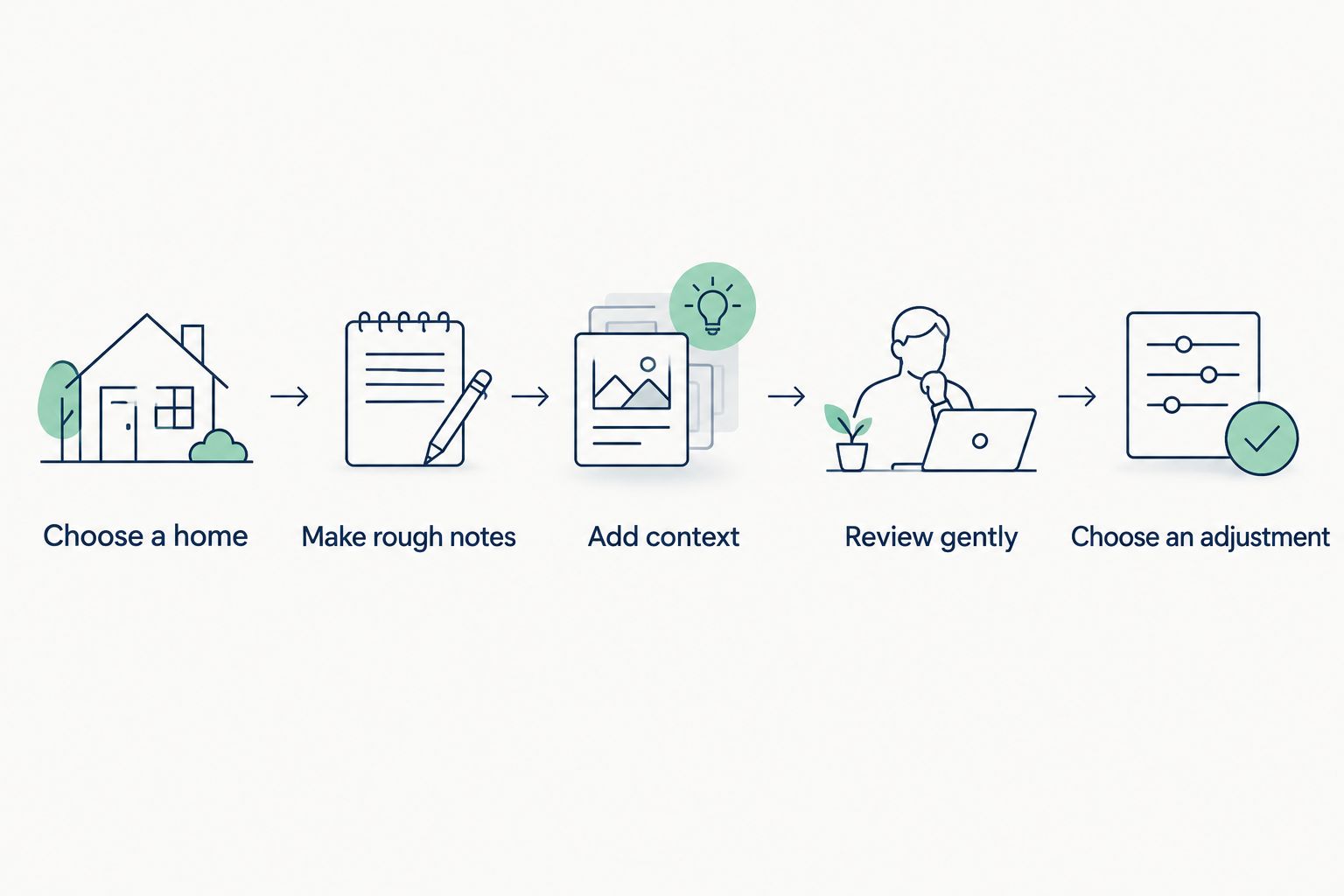
Those numbers are optional boundaries for the exercise. They are not a prescribed tracking schedule, and they do not promise better sleep within a particular period.
If you work nights or sleep at changing times, make the entry after your main sleep period rather than forcing it into a conventional morning. Label the sleep period clearly enough that you can understand it later.
What does a completed entry look like?
Here is an illustrative entry for a morning in 2026. It shows the level of detail you can use; it is not a real person's record or a model of an ideal night.
- Morning date: A Tuesday in 2026.
- Got into bed around: Later than I intended, after finishing household tasks.
- Started trying to sleep around: Shortly after putting my phone aside.
- Falling asleep felt: A while; I did not check the clock.
- Overnight waking I remember: Woke briefly, but I do not remember when.
- Woke for the day around: Near my usual alarm.
- Got out of bed around: Soon afterward.
- My evening looked like: Late dishes, messages from work, then some reading.
- Optional daytime context: An afternoon coffee and no nap.
- This morning or today, I feel: Slow to get started, more settled after breakfast.
- Something to notice again: Whether work messages keep appearing near bedtime.
Notice what the entry does not say: the coffee caused the difficult night, reading fixed anything, or the person failed their routine. It records observations and leaves the explanation open.
You can write actual clock times when you remember them. Words such as roughly and unsure are equally valid when you do not.
Why sleep journal entries vary
Different entries do not mean you are using the template incorrectly. The amount and kind of information you record will reflect the life around your sleep.
- Changing schedules: Late meetings, travel, and different work hours create different evening contexts to record.
- Caregiving responsibilities: Your notes can acknowledge interruptions without framing them as personal mistakes.
- Memory: Some mornings you remember an overnight waking; other mornings you do not.
- Available attention: A busy morning might leave room for a phrase rather than a full entry.
- Your question: If you are exploring how work ends, that detail deserves more space than an unrelated habit.
- Tracking comfort: If detailed notes make you feel scrutinized, remove fields rather than pushing through them.
Keep the core fields similar enough to recognize repeated observations. You can still adapt the rest as your needs change during 2026.
Should you use paper, a digital note, or personal guidance?
Choose the approach you can use without adding pressure. The table compares ways to keep and discuss your notes, not promises of sleep improvement.
| Approach | Best for | Useful feature | Limitation |
|---|---|---|---|
| Paper journal | Adults who prefer writing away from a screen | You can sketch, shorten, or skip fields freely | Looking back across entries means reviewing them yourself |
| Digital note | Adults who already use a notes document | You can copy the same prompts into each entry | Opening a device adds another screen interaction |
| Sleep app | Adults who prefer a structured digital format | Prompts can provide a consistent place to record observations | Features differ; check what the app records and how it handles your information |
| Restweft personal sleep coaching | Adults who want personal guidance and ongoing check-ins | You can connect sleep-pattern tracking with a doable evening routine | It is everyday wellness coaching, not medical care |
A paper journal does not make you more committed, and an app does not make your observations more authoritative. Start with your preferred format before adding another system.
You can also bring self-written notes into a coaching conversation. The journal and personal guidance do not have to be competing choices.
How do you turn sleep notes into a doable evening adjustment?
Look for something specific and within your influence. If several entries mention unfinished work near bedtime, your next step might be deciding where tomorrow's tasks will live before you finish working.
Compare that with a vague goal such as sleeping perfectly. Closing a work document is an action you can choose; falling asleep on command is not.
Use these prompts when reviewing your notes:
- What circumstances show up repeatedly?
- Which parts of the evening feel manageable already?
- What feels crowded, rushed, or difficult to finish?
- Is there a small adjustment that fits my actual responsibilities?
- What would I like to discuss rather than solve alone?
For example, keep a place to jot down an unfinished task, or choose a familiar quiet activity after the household settles. These are options to explore, not instructions that everyone needs to follow.
Restweft sleep coaching is best for adults who want personal guidance and ongoing check-ins while building practical evening routines. If that support fits what you need, you can create an account and complete a private sleep profile without needing a polished journal first.
Make room for your routine
Create an account and complete a private sleep profile to begin with your own evening context.
How long should I keep a sleep journal?
Use 1 week as an optional first review point, not a required tracking period or a promise of results. At that point, decide whether the notes are helping you ask clearer questions or simply adding work.
You can continue, simplify, pause, or bring the entries to a conversation. A journal started in 2026 does not need to become a year-long commitment.
What if tracking my sleep makes me feel more worried?
Reduce the detail or pause the journal if tracking makes you feel more preoccupied with sleep. You do not need to calculate a score, fill every blank, or check the clock overnight.
If sleep difficulties persist, affect daily functioning, or raise health concerns, speak with a qualified healthcare professional. Everyday coaching and a self-guided journal do not replace medical evaluation or advice.
FAQ
What's the simplest sleep journal template I can use?
The simplest sleep journal template records estimated sleep timing, evening context, and how you feel the next day. Add fields only when they answer a question you actually have.
Do I have to record the exact time I fall asleep?
No, you do not need an exact time to use this reflection template. Write a rough impression or unsure rather than checking the clock to complete the form.
Should I write in my sleep diary at night or in the morning?
Use the morning, or the time after your main sleep period, to record what you remember. If helpful, make a brief evening note about your routine before trying to sleep.
Is a paper sleep journal better than a sleep app?
Neither format is automatically the better fit. Paper lets you write away from a screen, while an app offers a digital structure whose features and privacy practices you should check.
What should I do if I miss a day in my sleep journal?
Leave the missed day blank and resume with the next entry. There is no need to reconstruct details you do not remember or restart the journal.
Can a sleep journal tell me whether I have a sleep disorder?
A sleep journal cannot diagnose a sleep disorder. If you have persistent difficulties or health concerns, discuss them with a qualified healthcare professional.
Can Restweft help me use my sleep notes?
Restweft offers personal online sleep coaching that connects sleep-pattern tracking with practical evening routines and ongoing check-ins. It provides everyday wellness support, not diagnosis or medical treatment.
One last thing
Keep a place for what already works. A note such as reading felt comfortable tonight gives you something to recognize, not another problem to solve.
Before adding a new habit, ask whether your evening needs less. Leaving a nonessential task for tomorrow can be a more doable experiment than adding another bedtime activity. Make room for better nights without pressure to be perfect: a rhythm, not a reset button.