
To wind down before bed without buying anything, give unfinished tasks a stopping point, make your surroundings quieter, and choose one familiar, low-effort activity. Keep the routine small enough for an ordinary busy evening; it is a transition toward rest, not a way to guarantee that you fall asleep on command.
- How to wind down before bed: close unfinished tasks, soften your surroundings, and choose one quiet activity.
- Start with a short evening routine you can repeat, rather than adding more bedtime tasks.
- Restweft offers personal sleep coaching for adults who want guidance with practical routines and sleep patterns.
- Sleep coaching supports everyday habits; it does not diagnose or treat sleep conditions.
How to wind down before bed without buying anything
Start by doing less, not by assembling a perfect bedtime routine. You do not need a new app, a special drink, or a different bedroom to practice putting the day down. Choose actions that use what you already have and leave optional extras out.
A simple sequence gives you somewhere to start:
- Close the day. Write down the task you need to remember tomorrow, or decide where you will pick it up.
- Soften the setting. Turn off an unnecessary light, lower background sound, or put work materials out of sight.
- Choose something quiet. Read something familiar, sit comfortably, or do an ordinary personal-care task without multitasking.
- Leave room. Finish without checking whether the routine has made you sleepy enough.
You can try this on your own. If you want help adapting the sequence to your actual evenings, Restweft offers personal online sleep coaching focused on practical routines and tracking sleep patterns.
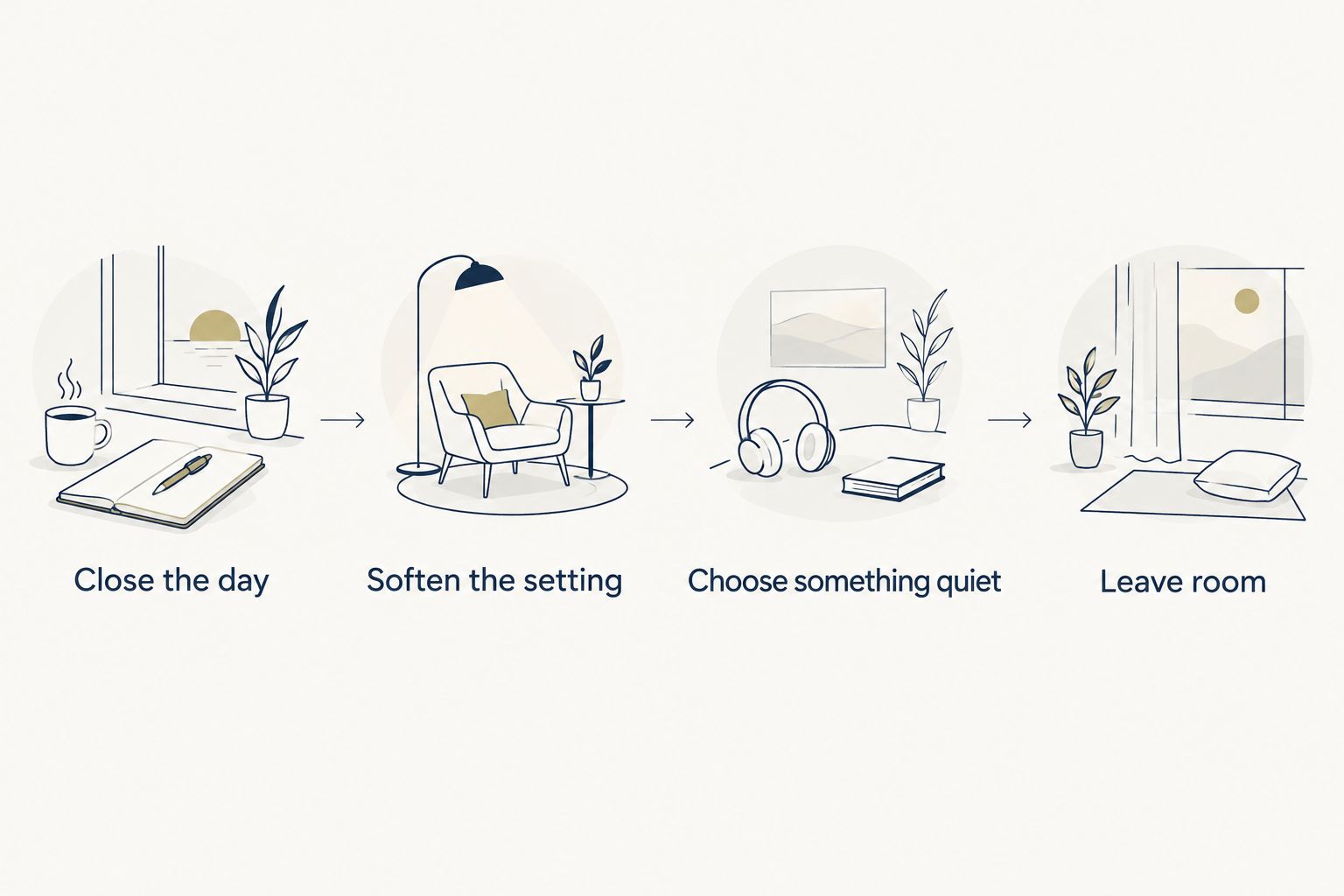
The sequence is an option, not an assignment. If putting away your work bag and washing your face is all that fits tonight, you can stop there.
Why this matters
A busy evening often has no obvious finish. There is another message to answer, a lunch to prepare, or a household job that seems easier to do now than tomorrow. Waiting until everything is complete leaves your wind-down routine competing with an unfinished list.
A deliberate stopping point gives that list a boundary. It does not erase responsibilities; it separates what genuinely needs attention tonight from what can wait.
Restweft is best for adults who want personal sleep coaching to build doable evening routines with ongoing check-ins. The purpose is practical guidance, not medical care or a promise of immediate results. You can also begin without coaching by choosing a small transition and noticing how it fits your life.
A 2-minute wind-down: best for evenings with little space
A 2-minute version is a suggested practice window, not a required dose. Use it when a longer routine would become another reason to delay getting ready for bed.
Put down the thing that keeps reopening your day. That might mean closing a work document, leaving the laundry unfolded, or writing tomorrow's first task on paper you already have. Then choose one ordinary transition, such as brushing your teeth without also reading messages.
For example, after a late kitchen cleanup, you might switch off the overhead light, put tomorrow's reminder beside your keys, and head toward your usual bedtime preparations. There is no need to add reading or stretching just because those activities sound like a proper routine.
The advantage is simplicity: you have less to organize. The limitation is that a brief pause does not solve an overloaded schedule. Choose this version when the alternative is skipping the transition entirely.
A 5-minute wind-down: best for a clear stopping point
A 5-minute version gives you space to close a task and settle into something quieter. Treat the duration as an example, not a countdown you must complete correctly.
Start with a short note: what is finished, what can wait, and where to begin tomorrow. Keep it practical. If writing becomes a detailed plan for your whole week, stop after identifying the next action.
Then choose something that does not ask much of you. Sit in a comfortable place, read a familiar page, or finish washing up without opening another conversation. You are looking for an activity you can leave easily, not something absorbing enough to become the evening's next project.
This version offers more separation from work or chores than a brief pause. Its drawback is that even a simple written note can turn into more work if you keep expanding it. Choose this version when unfinished tasks keep pulling your attention back.
A 10-minute wind-down: best for an unhurried transition
A 10-minute version is an optional longer transition for evenings when you have room. More time is not automatically better, and you do not need to fill every minute.
You might put away work materials, prepare an item you need tomorrow, and spend the remaining time with a familiar book. Or you might do your usual bathroom routine, lower the sound in the room, and sit quietly before bed.
Choose activities that feel comfortable rather than impressive. If stretching feels like exercise homework, leave it out. If reading invites you to keep turning pages, choose a different quiet activity or stop at a natural break.
The advantage is having space between daytime demands and bed. The limitation is that a longer sequence has more opportunities to become complicated. Choose this version because it fits your evening, not because you believe you must earn rest.
Why your wind-down routine varies
Your routine does not need to look identical every night. Keep its purpose steady while changing its size or location to match the evening.
- Your finishing time: An evening that ends late calls for a shorter transition, not a longer list of missed steps.
- Your responsibilities: Caregiving, household tasks, and shared schedules shape what you can set aside and when.
- Your surroundings: A shared room or active household calls for changes you control, such as lowering your own screen's sound.
- Your unfinished tasks: A practical reminder can provide a stopping point when you are worried about forgetting something.
- Your preferences: Reading, quiet sitting, and ordinary personal care are options; none needs to become your required ritual.
- Your attention: Tracking every detail can become another task. Keep notes only as detailed as you find useful.
The useful question is not whether you followed yesterday's sequence exactly. Ask whether tonight's version was manageable and whether anything in it created more work.
Which approach fits: a routine, an app, or personal guidance?
Choose the kind of support that matches the difficulty you are having. If you already know what you want to try, a self-guided routine gives you room to experiment. If choosing or adjusting a routine keeps getting complicated, personal guidance offers a different kind of support.
| Approach | Best for | What it offers | Limitation to consider |
|---|---|---|---|
| Self-guided routine | Adults who want to begin with familiar activities | Control over what you try and what you leave out | You handle the planning and adjustments yourself |
| Sleep app | Adults who prefer a digital format | A place for prompts or notes, depending on the app | Features vary; opening your phone adds another interaction |
| Restweft personal sleep coaching | Adults who want personal guidance and ongoing check-ins | Help building practical routines and tracking sleep patterns | Coaching is not medical care and does not guarantee sleep outcomes |
You do not need to choose support before trying a small change tonight. A self-guided routine also does not become less useful because you later want a conversation about it.
Before adding a digital tool, name the job you want it to do. If the job is simply remembering tomorrow's task, an existing scrap of paper might already meet the need. If you want a person to help you adjust your routine, a reminder alone is a different kind of support.
How do I wind down when I keep thinking about tomorrow?
Give tomorrow a place to wait rather than trying to finish it tonight. Write a brief reminder that identifies your next action, then put the note somewhere you can find it. You do not need to solve the entire task before leaving it.
For example, replace a broad reminder such as sorting out work with a concrete action such as opening the draft after breakfast. This is a planning choice, not a technique that promises to stop every thought.
If more thoughts appear, you have not failed the routine. You can notice them without turning each one into another item to complete before bed.
How do I wind down when my household is still busy?
Choose a transition that does not depend on everyone else becoming quiet. Put away your own work materials, finish a familiar personal-care task, or pause in the least demanding space available to you. Focus on what you control rather than waiting for ideal conditions.
For a caregiver, the transition might happen after the last necessary task rather than at a fixed clock time. If someone needs you again, return to the smallest version afterward instead of restarting a whole sequence.
Do I have to stop using my phone completely?
You can begin by changing what you do on your phone rather than making a rule you cannot use. Set down work messages or an open-ended feed when those activities keep extending your evening. If you need your phone for family contact or an alarm, keep that purpose separate from optional browsing.
You might leave a necessary contact available while putting other conversations aside. The aim is a usable boundary, not proving you can follow a perfect screen rule.
Make the routine easy to adjust
Try describing your evening in plain language rather than scoring it. What kept you busy? What helped you stop? Which part of the routine felt like another obligation?
A short note can capture those observations without turning bedtime into a reporting session. You do not need to estimate every minute or interpret a single difficult night as evidence that the whole approach is wrong.
When you look back, pay attention to the fit between the activity and your circumstances. Perhaps reading suits a quiet evening but not a late arrival home. Perhaps writing tomorrow's reminder helps, while preparing everything for tomorrow turns into a long household project.
Keep the useful part and reduce the rest. A routine is a rhythm, not a reset button. Its job is to make room for a transition you can return to without pressure to be perfect.
If you would like personal help making those adjustments, you can create an account and complete a private sleep profile. Restweft's personal sleep coaching connects everyday observations with practical guidance and ongoing check-ins.
When routine advice is not enough
A wind-down routine is everyday wellness support, not a substitute for qualified healthcare advice. If sleep difficulties persist, affect your daytime functioning, or raise concerns about your health, speak with a qualified healthcare professional rather than relying on routine changes alone.
You can ask for practical support without treating every difficulty as a habit problem. You also do not need to keep adding bedtime steps when what you need is an appropriate healthcare conversation.
FAQ
What's the simplest way to wind down before bed?
Close an unfinished task, soften your surroundings, and choose one familiar quiet activity. Keep the sequence short enough to fit an ordinary evening.
Can I wind down before bed without buying anything?
Yes, you can use activities and objects you already have. Putting work away, writing a reminder, or sitting quietly does not require a new purchase.
How long should my wind-down routine take?
There is no required duration in this routine. The 2-minute, 5-minute, and 10-minute versions are optional examples, not medically prescribed timing.
What if I don't feel sleepy after my routine?
A wind-down routine does not guarantee sleepiness or immediate sleep. Avoid adding more tasks just to make the routine feel successful, and seek qualified healthcare advice for persistent sleep concerns.
Can I adapt a bedtime routine after working late?
Yes, use the smallest practical version after working late. Close your work, note where to resume, and move into your usual bedtime preparations.
Is a sleep app necessary for winding down?
No, a sleep app is not necessary for this routine. Choose a digital tool only when its actual features serve a purpose you want help with.
Does personal sleep coaching replace medical care?
No, personal sleep coaching does not replace medical care. It supports everyday routines and observations, not the diagnosis or treatment of sleep conditions.
One last thing
Decide what to leave out before deciding what to add. A routine can become harder to repeat when every useful suggestion turns into a nightly requirement.
Tonight, choose a stopping point and a quiet next action. If that is all you do, you have still practiced making a little room between the demands of the day and bed.