
Sleep coaching for remote workers is personal guidance for building evening routines and tracking sleep patterns with the aim of making better rest fit a work-from-home schedule. The practical challenge is separating work from home life when both happen in the same place, especially when meetings, messages, or unfinished tasks spill into your evening.
- Restweft sleep coaching for remote workers suits adults who want personal guidance, adaptable evening routines, and ongoing check-ins.
- Start with a work shutdown cue and a simple sleep journal before adding more tools.
- Self-guided routines offer independence; sleep apps organize information; coaching adds personal guidance.
- Sleep coaching supports everyday wellness, not diagnosis, medical treatment, or guaranteed sleep results.
Why sleep coaching matters for remote workers
Working from home removes the physical trip between your workplace and your evening. If you finish a meeting at the kitchen table and eat dinner there afterward, closing your calendar does not necessarily create a clear change of pace. Your routine needs a recognizable ending to work, not an elaborate bedtime project.
Remote work also describes different schedules. You might finish at a predictable hour, support colleagues across time zones, or move work around caregiving. Advice built around an uninterrupted evening needs adapting when your actual evening includes another call or a child's bedtime.
Restweft sleep coaching is best for adults who want personal guidance and ongoing check-ins for a manageable evening routine. Restweft offers personal online sleep coaching and sleep-pattern tracking; it is everyday wellness support, not medical care.
For your 2026 routine, begin with the part of the evening you can influence. You do not need a new bedroom setup, a wearable, or a perfectly empty calendar to identify that starting point.
Build a workable evening routine in 2026
Start with a notebook or a simple note on your phone. The steps below are options to adapt, not requirements to complete every night. Choose a small change, notice what happens, and keep the parts that fit the life you actually live.
Identify where work enters your evening
Before changing bedtime, describe the work pattern that makes your evening difficult. There is a useful difference between a scheduled late meeting, a task that regularly overruns, and checking messages because your laptop is still open. Each calls for a different boundary.
Try a 7-day observation period as a practical starting exercise, not a prescribed assessment. Record when planned work ended, when you actually stopped, and what brought you back. Brief notes give you something specific to adjust without turning the evening into another reporting task.
Include the obligations that come after work. A routine that ignores dinner, caregiving, or a second job is not a useful routine. Write down what your evening contains before deciding what to change.
- Scheduled work: Mark meetings that genuinely fall outside your preferred hours.
- Unfinished tasks: Note the task that kept your laptop open.
- Message checking: Record what prompted you to reopen work.
- Home responsibilities: Include the commitments your routine needs to accommodate.
Choose a clear work shutdown cue
A shutdown cue gives you an observable action that means work is finished for now. Start manually: write tomorrow's next task, close work documents, and put your equipment out of the way. Pick actions you can repeat without needing a separate room.
For example, try a 5-minute shutdown window as a planning choice. Use it to capture unfinished work rather than squeeze in another assignment. If you share a desk with your household, putting the laptop in a drawer can be more practical than redesigning the room.
Set communication boundaries that match your responsibilities and workplace expectations. Do not silence required on-call alerts. Instead, distinguish necessary contact from channels you can leave until your next work period, and make the distinction clear to anyone who relies on you.
- Write the next action for unfinished work in one place.
- Close work tabs rather than leaving them behind entertainment tabs.
- Put work equipment away when your space allows it.
- Adjust nonessential notifications within your work responsibilities.
- Decide what counts as a genuine reason to return to work.
Build an evening transition you can repeat
Choose a transition that feels separate from work and fits your available space. You might change clothes, wash up, prepare something for tomorrow, or sit quietly without opening another task. The aim is a recognizable sequence, not a particular aesthetic.
Start with the self-guided version: choose one familiar action and give it a place after work. If you want help adapting that action around changing meetings or home responsibilities, Restweft offers personal guidance and ongoing check-ins. Coaching adds support; it is not a prerequisite for beginning.
Create a shorter version for crowded evenings. A 10-minute transition is an example of a planning window, not a promise about how quickly you will feel sleepy. If even that feels like another obligation, keep only the action that marks the change from work to home.
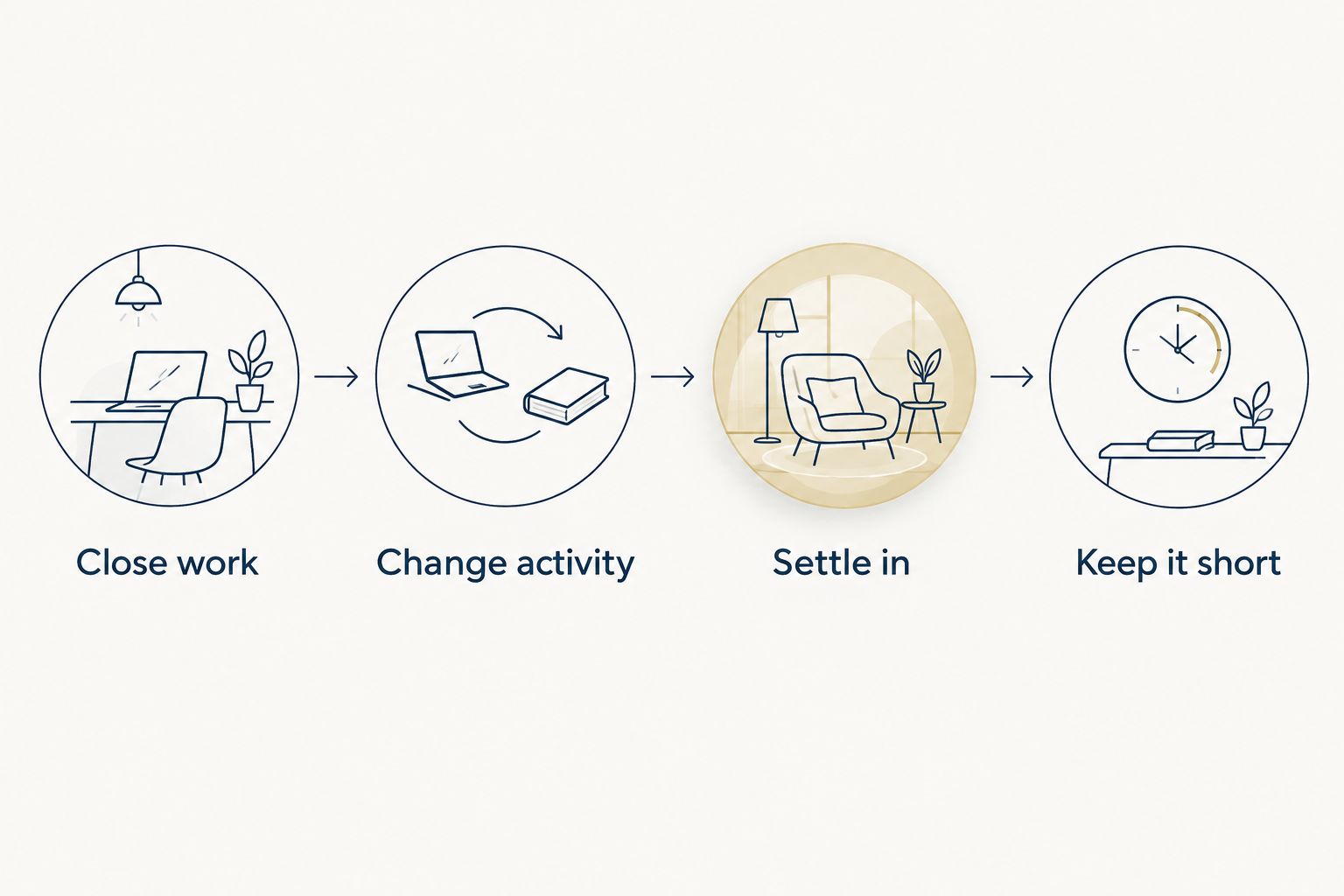
- Close work: Finish with your chosen shutdown cue.
- Change activity: Move to a familiar nonwork task.
- Settle in: Choose a quiet activity you actually enjoy.
- Keep it short: Retain a smaller version for late evenings.
Track patterns without scoring your night
Use a paper journal before deciding whether you want an app. Record a few observations that connect your workday to your evening: when work stopped, what you did afterward, and how the night and following morning felt. Estimates are enough for a personal routine discussion.
A sleep journal template gives your notes a consistent structure. Keep entries short enough that you will use them on an ordinary morning. You are collecting context, not proving that you followed instructions.
Look across several entries instead of judging a single difficult night. A journal cannot diagnose a medical condition or establish that one habit caused a sleep change. Its practical value is helping you describe what happened and choose a question to discuss during a coaching check-in.
- Note your approximate work finish and bedtime.
- Describe your evening routine in a short phrase.
- Record awakenings you remember without trying to capture every detail.
- Add a brief note about how you felt the next morning.
- Include unusual work or household demands for context.
Prepare a version for late meetings
A late meeting needs a different plan from an ordinary evening. Decide in advance what remains after the call and what can wait. Otherwise, the meeting can become the start of another work session while your usual routine stays out of reach.
Make the smaller version specific. After the call, you might capture follow-up tasks, close your laptop, complete necessary household tasks, and choose one quiet activity. Keep the plan modest enough that you do not need to rush through it to feel finished.
If late meetings repeat, discuss the actual schedule during a coaching check-in rather than building a plan around an imaginary early finish. Coaching can help you adapt your choices; it does not change your employer's expectations or remove caregiving responsibilities.
- Separate meeting follow-up that must happen now from work for tomorrow.
- Preserve essential evening responsibilities before adding optional habits.
- Choose one familiar transition rather than several new activities.
- Keep work reminders outside the place where you settle down.
- Return to your ordinary routine when the schedule allows it.
Review one change at a time
Choose a small review point that suits your calendar. Read your notes and ask whether the change was doable, what interrupted it, and whether you want to keep it. A routine you repeatedly avoid needs adjustment, not a harsher set of rules.
Change one element before rewriting the whole evening. For example, keep the same quiet activity while moving work equipment out of sight, or keep the shutdown cue while shortening what follows. This keeps your notes easier to interpret without treating them as a controlled experiment.
Personal guidance is most useful when you bring concrete situations to the conversation. Describe the meeting that ran late or the message that drew you back to work. Ask for an adjustment that fits that situation rather than a universal ideal bedtime.
- Keep the action that felt manageable on an ordinary evening.
- Shorten a step that repeatedly became another chore.
- Bring a specific obstacle to your next check-in.
- Decide what you will try next without promising a perfect week.
If personal support would help, Restweft invites you to create an account and complete a private sleep profile. Describe your real schedule, including the evenings that do not follow a plan.
Make room for your evening
Create an account and complete a private sleep profile to share your routine and work schedule.
Compare support options for remote workers
Choose support by the kind of help you want, not by how much information a tool collects. For a 2026 routine, useful questions include whether you want to work independently, organize observations, or talk through adjustments with someone.
| Option | Best for | Practical benefit | Key limitation |
|---|---|---|---|
| Self-guided routine and paper journal | Adults who prefer independent experiments | You choose the habits and record only what matters to you | You handle interpretation and adjustments yourself |
| Sleep app | Adults who want digital organization | A suitable app can keep routine notes or reminders together; check its listed features | Features vary, and an app does not necessarily include personal guidance |
| Restweft personal sleep coaching | Adults who want guidance and ongoing check-ins | Connects evening routines and sleep-pattern tracking with personal support | Requires your participation and does not provide medical care |
Start with the least complicated option that meets your needs. A journal is a sensible starting point if you mainly need to notice patterns. Personal coaching fits a different need: discussing how to adapt those patterns around work and home responsibilities.
These approaches can also sit alongside each other. You can bring handwritten notes to a coaching conversation without buying a tracking device or replacing a recording method you already find manageable.
Common mistakes remote workers make
Treating the end of a meeting as the end of work
A meeting can finish while follow-up tasks keep your attention on work. Give yourself a clear way to record those tasks and decide which genuinely require action tonight. Closing the call is only part of the shutdown.
Building a routine for an empty evening
A long sequence becomes difficult to use when dinner, caregiving, and household tasks already fill the evening. Build around those commitments and keep a shorter version available. The useful plan is the one you can recognize in your actual home life.
Turning sleep notes into another performance review
Tracking loses its purpose when every entry becomes a judgment about discipline. Record observations in neutral language: work ended late, the routine changed, or the morning felt difficult. Bring the pattern to a conversation rather than assigning yourself a grade.
Asking coaching to solve a medical concern
Coaching supports everyday habits and reflection; it does not diagnose or treat sleep conditions. Discuss persistent sleep difficulties, breathing concerns during sleep, or daytime sleepiness that affects safety with a qualified healthcare professional. Do not use a routine experiment as a substitute for medical advice.
FAQ
What's the best starting point for sleep coaching for remote workers?
Start by describing where work enters your evening and choosing one manageable shutdown cue. A short journal gives you specific situations to discuss if you decide to seek personal guidance.
Is sleep coaching better than a sleep app for working from home?
Sleep coaching fits adults who want personal guidance, while an app fits adults who mainly want digital organization. Check whether a particular app includes human support rather than assuming that tracking and coaching are the same service.
Can I start an evening routine without buying a sleep tracker?
Yes, you can start with a notebook or a simple phone note. Record your approximate work finish, your evening activities, and how the following morning felt; a wearable is not required for this exercise.
What should I do when remote meetings run late?
Use a shorter routine that preserves essential tasks and one familiar transition away from work. Capture follow-up work for later when your responsibilities allow it, rather than automatically extending the meeting into another work session.
How do I get started with Restweft in 2026?
Create an account and complete a private sleep profile. Include your work schedule, evening responsibilities, and the situations where a routine feels hardest to maintain.
Does personal sleep coaching treat insomnia or sleep apnea?
No, personal sleep coaching is everyday wellness support, not medical treatment. A qualified healthcare professional is the appropriate person to assess symptoms, diagnose conditions, and advise on medical care.
What if I cannot follow the same routine every night?
Use an ordinary-evening version and a shorter version for disrupted evenings. Keep a familiar transition where possible, and adjust the surrounding steps to your actual responsibilities without pressure to be perfect.
One last thing
Before adding another bedtime habit to your 2026 plan, choose a place for unfinished work to wait. A note containing tomorrow's next task gives you a practical alternative to leaving the document open all evening.
Make that note part of your shutdown, then leave the rest of the routine small. You are building a rhythm, not a reset button. The next useful adjustment is the one that fits an ordinary evening, including the dishes, the late call, and the responsibilities that remain after work ends.