
Night shift nurses’ sleep coaching is practical support for building sleep routines around overnight work, with the aim of making rest more manageable between shifts. This 2026 guide explains how to plan around changing workdays, track useful patterns, and choose support without turning sleep into another task to get right.
- Sleep coaching for night shift nurses should adapt to overnight work, daytime rest, and changing responsibilities.
- Restweft sleep coaching suits adults who want personal guidance, doable routines, and ongoing check-ins—not medical care.
- Start with a simple sleep journal and one manageable adjustment, rather than a complete routine overhaul.
- Choose coaching for personal support, sleep apps for recording, or self-guided routines for flexibility.
Why sleep coaching matters for night shift nurses
Night work puts your work schedule at odds with the usual day-night pattern. Your intended bedtime can arrive when the household is waking, deliveries are arriving, and daylight fills the bedroom. A routine built for someone finishing work before dinner does not address those constraints.
A useful plan starts with your actual shift, not an ideal bedtime. Record when work ends, when you reach home, and what must happen before you can rest. A sleep journal template gives those observations a place to live without requiring a wearable or another subscription.
For your 2026 routine, separate workdays, recovery days, and days off. Those days have different demands. Treating them as interchangeable makes it harder to identify which part of your routine needs attention.
Coaching belongs in everyday wellness support. Persistent sleep difficulties, breathing concerns during sleep, or sleepiness that affects safety belong in a conversation with a qualified healthcare professional—not a habit checklist.
Build a routine around your shifts
Use the following steps as adaptable options. Start with the part of the day that feels hardest, and leave the rest alone until you have room to work on it.
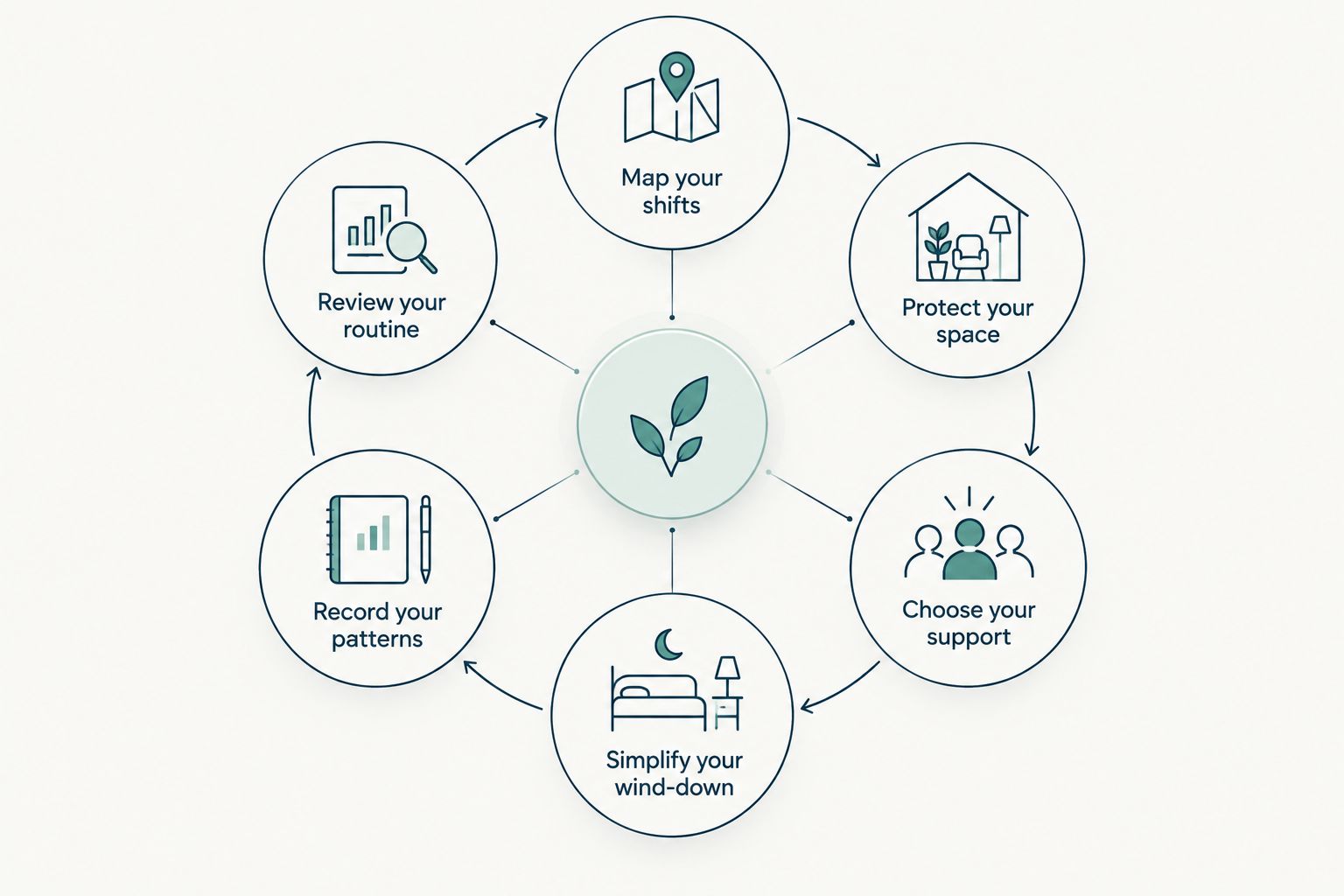
Map your shifts
Start with your calendar and a notebook. Mark your shifts, travel time, caregiving, and other fixed commitments before deciding where rest fits. If the rota changes, map the schedule you have rather than trying to maintain a plan built for a different week.
Suppose you finish work, travel home, and then need to handle a school drop-off. Your wind-down cannot begin at the hospital exit. Naming that constraint helps you plan honestly instead of treating an unavoidable responsibility as a failure.
Keep this first pass descriptive. You are identifying available space, not judging how well you use it.
- Mark workdays and days off separately.
- Include the journey home and essential responsibilities.
- Identify which commitments you can move.
- Note where household activity overlaps with intended rest.
Protect your space
Walk through your bedroom during the hours you intend to sleep. Notice light, noise, temperature, and interruptions. Start with changes available at home: close existing curtains, move a noisy device, or agree on quiet household activities.
Protecting rest includes communication, not just bedroom equipment. A closed door means little if nobody knows when you are trying to sleep. Explain your intended rest period and how someone should reach you when something genuinely cannot wait.
Choose changes that fit your home. You do not need a perfectly silent room to begin making the space more workable.
- Identify the most disruptive source of daylight.
- Discuss household noise during your rest period.
- Adjust notifications while preserving necessary emergency access.
- Place everyday essentials outside the bedroom when practical.
Choose your support
Try writing a short plan yourself first: what happens after work, what usually interrupts rest, and what you want to adjust. A phone note or paper journal is enough to begin. Choose outside support when you want help interpreting those observations or adapting the plan.
Restweft sleep coaching is best for adults who want personal guidance and ongoing check-ins for everyday sleep routines. Restweft offers personal online sleep coaching, practical routines, and sleep-pattern tracking. That support is not medical care and does not replace qualified healthcare advice.
For night shift work, ask whether any prospective coach can work with your actual schedule before choosing support. General adult coaching and specialist experience with overnight nursing are not the same thing.
- Describe your schedule before choosing a coach.
- Ask how check-ins address changing commitments.
- Explain whether you prefer written notes or conversation.
- Confirm the boundary between wellness coaching and healthcare.
Simplify your wind-down
Build a short transition between finishing essential tasks and trying to sleep. The purpose is to make that transition repeatable, not to earn sleep through a perfect sequence. Start with something you already do, such as changing clothes or washing your face.
For example, try a 5-minute wind-down after the necessary parts of arriving home: put work items away, prepare the room, and choose a quiet activity. Five minutes is a planning example, not a recommended dose or a promise of better sleep.
Keep a shorter version for difficult shifts. A routine that survives a late finish is more useful than an elaborate one you regularly abandon.
- Use an existing habit as your starting cue.
- Put unfinished work notes out of sight.
- Choose a quiet activity you genuinely find comfortable.
- Remove optional steps when the morning is crowded.
Record your patterns
Use a 1-minute note after waking if detailed tracking feels burdensome. Record when you tried to sleep, when you woke, how rested you feel, and any obvious interruption. The minute is a practical limit for the task, not a scientific threshold.
A journal records your experience; it does not diagnose a sleep condition. A difficult night also does not prove that the last thing you ate, watched, or did caused it. Look for repeated observations rather than building rules around an isolated entry.
In 2026, a handwritten note remains a valid starting point. Choose an app only if recording digitally makes the habit easier for you.
- Note intended rest and actual waking times.
- Describe interruptions in plain language.
- Mark whether the entry follows work or a day off.
- Include how manageable the routine felt.
- Leave uncertain details uncertain rather than guessing.
Review your routine
Set aside a 2-minute review when you have enough headspace to look back. Ask what helped you follow the routine, what got in the way, and which adjustment is realistic next. Two minutes is simply a suggested boundary to keep reviewing from becoming another project.
Change one part of the routine rather than replacing everything after a difficult sleep. For example, if interruptions repeatedly appear in your notes, address household communication before adding more wind-down activities.
Use personal guidance to discuss those trade-offs when self-review feels unclear. The aim is a rhythm, not a reset button.
- Keep the part of the routine that feels manageable.
- Identify a recurring obstacle in your notes.
- Choose one adjustment linked to that obstacle.
- Revisit the plan when your shift pattern changes.
The process is circular: understand your schedule, make space for rest, choose support, and revise from experience. There is no requirement to complete every step before starting.
Compare support options for overnight work
Choose the kind of help you need, not the longest feature list. Personal guidance, digital recording, and self-directed routines solve different practical problems. You can also use a simple journal alongside coaching rather than treating every option as a replacement for the others.
For a 2026 decision, ask what you will actually use after a demanding shift. More logging fields do not automatically make a record more helpful.
| Option | Best for | Practical advantage | Key limitation |
|---|---|---|---|
| Restweft personal sleep coaching | Adults wanting personal guidance and ongoing check-ins | Connects practical routines with sleep-pattern tracking | Wellness support, not medical care; confirm fit for your night-shift schedule |
| Sleep apps | Adults who prefer digital recording or prompts | Keeps routine notes in a digital format when the selected app supports it | Features vary; an app is not a substitute for a healthcare assessment |
| Self-guided routine and paper journal | Adults who want to begin independently | Lets you adapt the process without learning another system | You must interpret your observations and revise the plan yourself |
If your main obstacle is remembering what happened, start with recording. If you have observations but struggle to turn them into a workable routine, consider personal guidance. If the concern involves safety or persistent symptoms, seek qualified healthcare advice instead of treating the comparison as a care decision.
Common mistakes night shift nurses make
Copying an evening routine without adapting it
Advice built around dinner, sunset, and a conventional bedtime does not map neatly onto arriving home after overnight work. Keep useful activities, but attach them to your own transition from work to rest.
Use the order of events, not someone else’s clock. A quiet activity after essential responsibilities can be more realistic than a fixed bedtime you cannot consistently reach.
Planning only for consecutive workdays
A plan that covers workdays but ignores days off leaves you making fresh decisions whenever the schedule changes. Write down what is different on those days, including family commitments and when you need to be awake.
Do not treat a rotating schedule as a personal consistency problem. Bring the actual variation into your planning or coaching conversation.
Turning tracking into a performance score
Repeatedly checking a sleep record can shift attention away from whether your routine fits your life. If logging feels like another assessment, simplify the record and discuss that reaction with your coach.
Keep notes that help you make a decision. A record does not need to be detailed to reveal that household interruptions or an overloaded arrival-home routine need attention.
Expecting coaching to solve unsafe sleepiness
Coaching can support everyday habits; it does not assess fitness to drive or provide medical treatment. Do not drive when you are too sleepy to drive safely. Arrange a safer way home and raise recurring concerns with a qualified healthcare professional.
Bring work-related safety concerns to the appropriate workplace contact as well. A wind-down routine is not a substitute for addressing a safety issue.
Make your first coaching conversation useful
Bring a real example of a difficult workday and a more manageable one. Explain what changed: the shift finish, the journey home, household activity, or your responsibilities. You do not need polished records or a perfect account of every night.
Ask what the coach expects you to track and how the plan changes when work changes. Clear boundaries matter too: understand which concerns belong in coaching and which need healthcare advice.
If personal support feels right, you can create an account with Restweft and complete a private sleep profile. Describe the life the routine needs to fit, including its awkward parts. There is no need to present a better version of your schedule.
Make room for your routine
Create an account and complete a private sleep profile around your actual schedule.
FAQ
What is sleep coaching for night shift nurses?
Sleep coaching for night shift nurses is practical support for adapting everyday sleep routines to overnight work. It can include planning around shifts, recording sleep patterns, and reviewing manageable adjustments. It is not medical care.
Is personal sleep coaching better than a sleep app?
Personal sleep coaching fits people who want guidance and check-ins; a sleep app fits people who mainly want digital recording or prompts. The better choice depends on the support you need and the features the selected app actually provides.
Can I use sleep coaching if my nursing shifts rotate?
You can discuss a rotating schedule with a prospective sleep coach and ask whether the service fits those demands. Bring examples of workdays and days off so the conversation addresses your real schedule rather than a fixed bedtime.
Do I need a wearable to start tracking my sleep?
You do not need a wearable to start a sleep journal. Paper or a phone note can record rest times, interruptions, and how rested you feel without adding another device.
What should I do after a difficult night shift?
Start with safety, essential responsibilities, and a manageable transition toward rest. Keep optional routine steps short, and do not drive if you are too sleepy to drive safely.
Does Restweft diagnose or treat sleep conditions?
Restweft provides everyday wellness coaching, not diagnosis or medical treatment. Persistent sleep difficulties, breathing concerns during sleep, or sleepiness affecting safety need qualified healthcare advice.
What should I prepare before talking to a sleep coach?
Prepare your shift pattern, essential responsibilities, and a few observations about what interrupts rest. You can also describe what you want help changing; detailed tracking is not a prerequisite for asking questions.
One last thing
For your 2026 plan, write down the shortest version of your routine—the one you can manage after a difficult shift. That version deserves a place in the plan, not an apology. A routine that fits real life leaves room for both demanding workdays and imperfect mornings.