
Truck drivers’ sleep coaching is practical support for building repeatable rest habits around driving schedules, with the aim of making room for better rest. This guide to sleep coaching for truck drivers focuses on routines you can adapt to sleeper berths, changing appointments, and time at home—not medical treatment or a way to make drowsy driving safe.
- Sleep coaching for truck drivers supports adaptable evening routines and sleep tracking; it does not replace adequate rest.
- Restweft is best for adults seeking personal sleep coaching and ongoing check-ins, not medical care.
- Start with a simple sleep journal and one manageable change before adding apps or equipment.
- If you become sleepy while driving, stop somewhere safe. A routine or tracking score cannot establish fitness to drive.
Why sleep coaching matters for truck drivers
A truck driver’s sleep routine has to fit more than bedtime. Loading delays, parking, changing start times, and the difference between sleeping in a cab and sleeping at home all belong in the plan. Advice that assumes you finish work at the same hour every evening leaves those practical problems unanswered.
The useful goal is a repeatable sequence, not a perfectly repeated clock time. You need enough opportunity to sleep, a workable place to rest, and habits that remain manageable when the day changes. A routine cannot compensate for a schedule that leaves inadequate rest.
Restweft offers personal online sleep coaching for adults, with practical routines, sleep-pattern tracking, and ongoing check-ins. That support concerns everyday wellness; it does not establish whether you are fit to drive.
For your 2026 routine, keep safety separate from habit-building. If you feel sleepy behind the wheel, stop somewhere safe rather than trying to finish the route. Coaching, caffeine, open windows, and sleep scores are not clearance to keep driving.
How to build a routine around life on the road
Start manually: a notebook, a realistic look at your schedule, and a conversation about what keeps getting in the way. You do not need a wearable or a subscription to begin noticing patterns.
The steps below are adaptable options, not another checklist to complete perfectly. Start with the part of your day you can influence, then work outward. If dispatch demands or working conditions prevent adequate rest, address that constraint rather than treating it as a failure of motivation.
Map your schedule
Write down what your working day actually looks like before choosing a bedtime routine. Include the point when driving ends, the tasks that follow, and when you realistically have an opportunity to sleep. An off-duty period is not automatically an uninterrupted sleep opportunity.
Keep separate notes for road days and home days. A routine that fits a quiet bedroom might need a different version in a sleeper berth, and neither version needs to copy the other exactly.
For a simple starting exercise, review 3 recent workdays. That is an example for getting started, not a test or a clinical assessment. Look for a practical obstacle you can describe clearly, such as paperwork regularly taking over the beginning of your rest period.
- Note scheduled start times and actual finish times.
- Include parking, meals, calls, and work-related tasks.
- Mark when a genuine sleep opportunity begins.
- Separate road-day patterns from home-day patterns.
- Identify constraints that need a workplace conversation.
Protect your rest
Choose a short transition that signals work has ended once you are safely parked and finished with required tasks. For example, you might put tomorrow’s essentials in place, wash up, and turn down unnecessary light. Keep the sequence small enough to use after a difficult day.
An illustrative 5-minute preparation routine is a place to start, not a recommended limit on winding down or sleeping. If preparing the cab takes longer, account for that honestly. Do not squeeze sleep to make a routine look tidy.
Think about interruptions as well as comfort. If family calls regularly arrive after you settle down, agree on a more workable time. If noise or light is the obstacle, first adjust what you already have before shopping for equipment.
- Finish necessary work tasks before settling down.
- Set out essentials for the next work period.
- Reduce avoidable light and noise where practical.
- Agree on call and notification boundaries.
- Keep required safety communication arrangements intact.
Choose one change
Pick the smallest adjustment that addresses an obstacle you actually recorded. If scrolling fills the gap between finishing work and resting, try putting the phone out of easy reach after necessary messages. If unfinished planning keeps pulling your attention back, write tomorrow’s tasks down before settling in.
Change one thing at a time so you can describe what helped and what did not. This is a practical observation method, not proof that a habit caused a particular night’s sleep. Workload, surroundings, and other circumstances still matter.
Restweft sleep coaching adds personal guidance and ongoing check-ins to this process. It is an option when you want help shaping a doable routine rather than sorting through general advice alone. It is not a substitute for medical evaluation, adequate rest, or changes to an unworkable schedule.
- Choose a change connected to a specific obstacle.
- Describe the action in plain language.
- Make a shorter version for disrupted evenings.
- Keep road-day and home-day versions where needed.
- Leave unrelated habits alone while you observe.
Keep simple notes
Use paper or a basic note on your phone to record the broad shape of your sleep. Approximate times and a short description are enough for an everyday habit discussion. You do not need to reconstruct every awakening or turn the night into a performance report.
For your 2026 sleep journal, include context alongside times: where you rested, what interrupted you, and how you felt afterward. A note about repeated parking interruptions tells a different story from a note about staying awake to finish personal errands.
Treat an app or wearable as an optional recording aid. Consumer sleep estimates do not diagnose a condition, and a favorable score does not establish that you can drive safely. Your notes should support useful conversations, not overrule sleepiness.
- Record approximate sleep and wake times.
- Note whether you slept at home or on the road.
- Describe noticeable interruptions without judging yourself.
- Record how alert or sleepy you felt afterward.
- Keep the record brief enough to maintain.
Review your routine
Look back at your notes when you have a quiet opportunity, not while driving or when you should be sleeping. Ask whether the routine was usable under actual working conditions. A plan that only works after an unusually easy shift needs adjustment.
Compare similar situations where possible: road days with road days, and home days with home days. Avoid blaming a single habit for every difficult night. The useful question is whether the adjustment made preparing for rest more manageable.
Use this simple sequence for your 2026 review: map the day, protect the rest opportunity, choose an adjustment, record what happened, and review the fit. The process is a loop, not a pass-or-fail program.
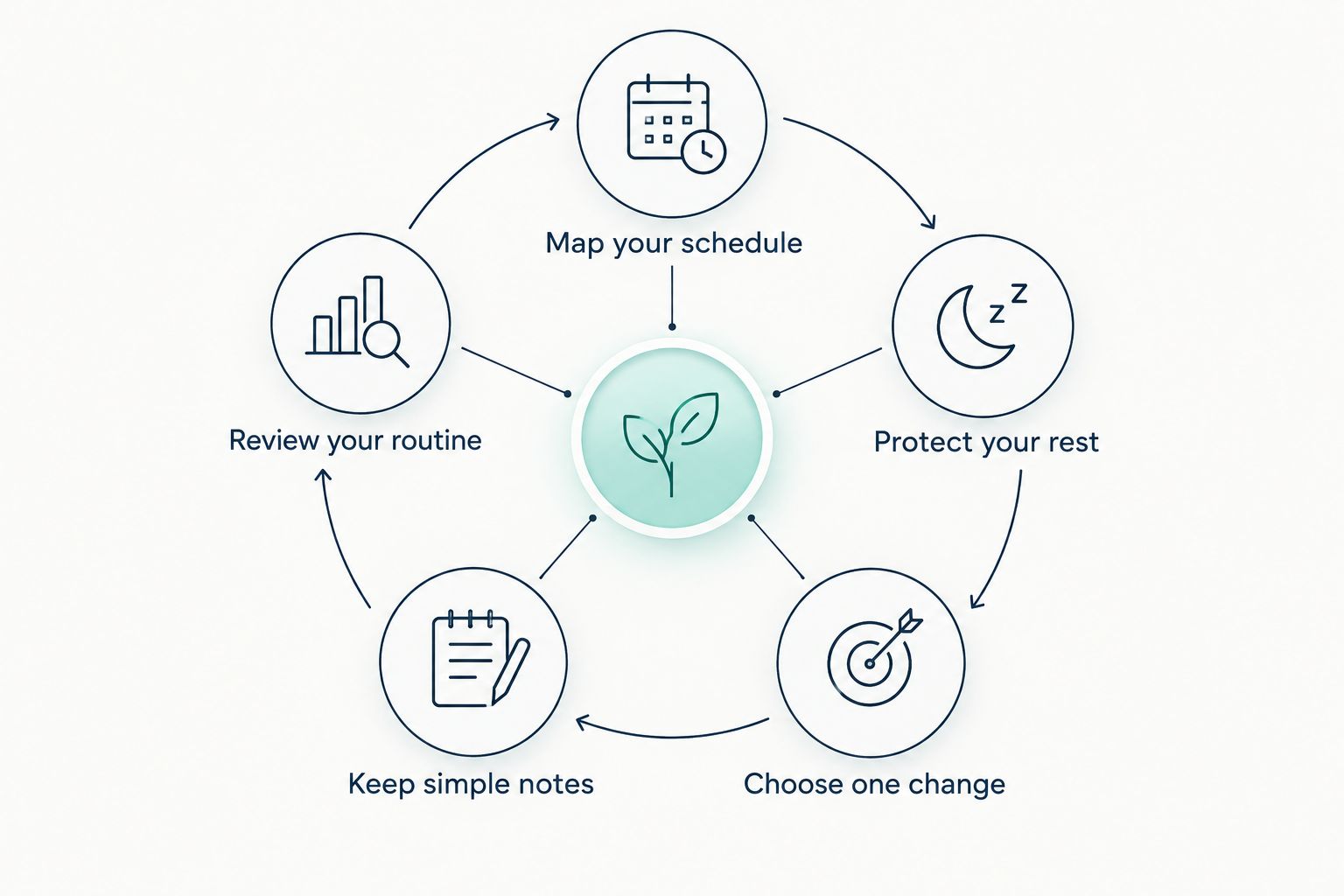
Keep an adjustment that feels workable; simplify one that creates extra effort without addressing the obstacle. Personal guidance is most useful when you can bring a concrete example rather than a general feeling that you should be doing better.
- Compare days with similar work and sleep settings.
- Identify what made the routine easier to use.
- Notice obstacles the routine cannot resolve.
- Simplify steps you repeatedly cannot complete.
- Bring specific examples to a check-in.
Ask for help
Separate a habit question from a health or workplace question. Difficulty finding a manageable wind-down sequence belongs in a coaching conversation. Persistent excessive sleepiness, loud snoring with breathing pauses, or concern about sleep-related symptoms belongs with a qualified healthcare professional.
You do not need to identify the cause yourself before asking for medical advice. Coaching does not diagnose or treat sleep disorders, and this guide does not replace advice from a clinician or your occupational medical examiner.
If you want everyday support, you can create an account and complete a private sleep profile. Describe your real schedule and what you want help changing, without pressure to present an ideal routine.
- Ask a clinician about persistent or concerning symptoms.
- Discuss fitness-to-drive questions with the appropriate qualified professional.
- Raise scheduling barriers with the relevant workplace contact.
- Use coaching for practical routines and habit support.
- Describe your constraints honestly when seeking guidance.
Compare sleep-support options for truck drivers in 2026
Best for means the kind of support you want, not a claim that an option produces better sleep for every driver. Start with the least complicated approach that answers your actual question, and add support when you need it.
| Option | Best for | Practical benefit | Key limitation |
|---|---|---|---|
| Self-guided routine and paper journal | Drivers who want a simple starting point | Lets you record patterns and test manageable adjustments without another device | You interpret the notes and adapt the plan yourself |
| Sleep app | Drivers who prefer digital reminders or records | Can organize routine prompts or entries, depending on the app | Features vary; an app does not replace personal guidance or assess fitness to drive |
| Restweft personal sleep coaching | Adults who want personal guidance and ongoing check-ins | Connects practical routine-building with discussion of sleep patterns | Everyday wellness coaching, not medical care; it cannot change working conditions |
| Qualified healthcare professional | Drivers with persistent symptoms or health concerns | Can evaluate health concerns within their professional scope | Medical evaluation serves a different purpose from everyday habit support |
You can combine a notebook with coaching, or use digital records during a healthcare conversation. More tools do not automatically make the plan more useful. Choose based on the gap you need to fill: recording, adapting a routine, addressing working conditions, or evaluating a health concern.
Common mistakes truck drivers make with sleep routines
Treating off-duty time as guaranteed sleep
Time away from driving can include meals, calls, paperwork, and finding somewhere appropriate to park. Look at the actual opportunity left for rest before adding a longer evening routine. Protect sleep opportunity before adding habits around it. If the schedule is the barrier, a more elaborate routine is not the answer.
Copying a home routine into the cab
A familiar bedroom and a sleeper berth create different practical demands. Keep a shared sequence, such as preparing essentials and reducing interruptions, but adapt the details. The goal is a recognizable transition into rest, not identical surroundings or a particular set of purchases.
Letting a tracking score overrule sleepiness
A device estimate is not permission to drive. If you feel sleepy while driving, stop somewhere safe regardless of what an app reported. Bring recurring sleepiness to a qualified healthcare professional rather than adjusting habits indefinitely or searching for a better score.
Turning every difficult night into a new plan
Adding several changes after each rough night makes the routine harder to follow and your notes harder to interpret. Return to the specific obstacle you identified. Keep the manageable parts, remove unnecessary tasks, and remember that a difficult night is not a verdict on your effort.
Expecting coaching to solve a scheduling problem
Personal guidance can help you organize an evening; it cannot create adequate rest inside an unworkable schedule. Name the barrier accurately. If work demands repeatedly interrupt or restrict sleep opportunity, raise those conditions with the appropriate workplace contact rather than accepting another habit assignment.
FAQ
What is sleep coaching for truck drivers?
Sleep coaching for truck drivers is everyday support for adapting sleep-related habits to driving schedules and practical constraints. It can include routine-building, simple sleep records, and check-ins, but it does not diagnose sleep disorders or establish fitness to drive.
Is Restweft a medical service for truck drivers?
Restweft is everyday wellness coaching, not medical care. Its personal guidance concerns practical routines and sleep patterns; health symptoms and medical fitness questions belong with qualified healthcare professionals.
Can I use sleep coaching if my start times change?
You can build a flexible routine around changing start times rather than relying on one fixed bedtime. The routine still needs an adequate opportunity for sleep and cannot compensate for insufficient rest.
Do I need a sleep tracker before talking to a coach?
You do not need a sleep tracker to begin discussing your routine. Brief notes about approximate sleep times, interruptions, working conditions, and how you feel give you concrete examples to discuss.
What should I do if I feel sleepy while driving?
Stop somewhere safe rather than trying to continue driving. A sleep score, coaching plan, caffeine, or open window does not establish that it is safe to carry on; recurring excessive sleepiness needs qualified medical attention.
Can sleep coaching treat sleep apnea or insomnia?
Sleep coaching does not diagnose or treat sleep apnea, insomnia, or other medical conditions. Speak with a qualified healthcare professional about symptoms, breathing concerns, or persistent sleep difficulties.
What should I put in a sleep profile in 2026?
Describe your actual work schedule, sleep setting, current routine, and the obstacles you want help addressing. Include differences between road days and home days so the conversation starts with the life you actually live.
One last thing
The most useful detail to bring to a coaching conversation might be what happens before you try to sleep. An unfinished task, a predictable call, or an uncertain parking plan gives you something concrete to address; another bedtime rule does not necessarily help.
For your next rest period, choose one manageable preparation step and leave room for the evening you actually have. Restweft can support that everyday routine-building, without promising perfect nights or replacing medical advice. Think of it as a rhythm, not a reset button.