
New-parent sleep coaching is practical support for an adult’s evening habits and sleep tracking, with the aim of making room for better rest around caregiving. This guide to sleep coaching for new parents focuses on your routine—not your baby’s sleep schedule—and explains how to make small adjustments when evenings rarely go as planned.
- Sleep coaching for new parents focuses on adult evening routines, sleep tracking, and realistic caregiving constraints.
- Restweft is best for adults seeking personal sleep coaching and ongoing check-ins, not medical care.
- Start with a short sleep journal and one adaptable habit rather than a strict bedtime plan.
- Choose personal guidance, a sleep app, or a self-guided routine according to the support you need.
Why sleep coaching matters for new parents
A new parent’s evening does not belong entirely to them. Feeding, settling, household tasks, work, and unpredictable wake-ups can interrupt even a carefully planned routine. Adult sleep coaching needs to account for those responsibilities rather than treating every disrupted night as a habit problem.
The useful question is not whether you followed bedtime perfectly; it is whether your plan fits your caregiving reality. A routine cannot remove responsibilities, create another caregiver, or guarantee uninterrupted sleep. It can give you a simpler way to decide what to do when an opportunity to rest arrives.
For your 2026 plan, look for support that separates adult wellness habits from infant sleep advice. This guide to choosing a sleep coach for adults can help you assess that distinction before committing to an approach.
Coaching is not medical care. Bring concerns about your health to a qualified healthcare professional, and direct questions about your baby’s sleep, feeding, or care to your baby’s clinician.
Build an evening routine around caregiving
Start with the evening you actually have
Before adding a habit, notice what already happens between your last daytime responsibility and your first chance to rest. Include the less obvious work: preparing supplies, answering messages, cleaning up, and anticipating what tomorrow needs. That is the evening your plan must fit.
Try a brief paper note rather than a detailed tracker. As an optional starting point, spend 2 minutes recording what delayed rest and what helped you settle. The purpose is to make your circumstances visible, not to give yourself another assignment.
A useful 2026 baseline describes ordinary nights, including the messy ones. Recording only the evenings that went smoothly leaves out the situations your routine needs to handle.
- Note when caregiving responsibilities interrupted your intended routine.
- Separate time available for rest from time you actually spent resting.
- Record whether you had help or were handling the evening alone.
- Include work, household tasks, and other fixed commitments.
Choose a smaller version of winding down
A long evening ritual can become another task you have to finish. Instead, choose a brief transition that still makes sense after an interruption. For example, put tomorrow’s essentials in place, set aside nonessential messages, and choose one quiet activity you find comfortable.
Give the routine a fuller version and a minimum version. A 5-minute quiet pause is an example, not a required duration or a promise of better sleep. On a demanding night, the minimum version might simply mean leaving an optional chore until tomorrow and settling when you have the chance.
Keep the action small enough that restarting does not feel like starting over. You do not need to repeat an entire sequence because caregiving interrupted it.
- Choose one familiar activity rather than several new habits.
- Decide which household task can wait without creating a safety problem.
- Keep anything you need for your own routine easy to reach.
- Leave room to stop immediately when caregiving requires your attention.
- Treat the shorter version as a valid choice, not a failed attempt.
Decide how much personal guidance you want
Start with your own notes and a simple routine. If choosing or adapting the next step feels difficult, personal guidance offers a place to discuss those obstacles rather than sorting through more general advice.
Restweft offers personal online sleep coaching for adults, with practical evening routines, sleep-pattern tracking, and ongoing check-ins. Restweft is best for adults seeking personal sleep coaching and ongoing check-ins, not medical care. The fit is adult habit support; the limitation is equally important: coaching does not diagnose or treat medical conditions or replace qualified healthcare advice.
When comparing support in 2026, describe what you need help deciding. “I need a shorter routine after an interrupted evening” gives a coach more to work with than a broad goal of sleeping perfectly. Ask how guidance will adapt when your caregiving circumstances change.
- Explain which part of the evening feels hardest to manage.
- Ask how check-ins address interrupted or inconsistent routines.
- Confirm that the service focuses on your adult wellness habits.
- Ask what falls outside coaching and requires healthcare advice.
- Choose guidance that accepts practical limits rather than promising a reset.
Make a flexible caregiving handoff
If another adult shares care, discuss responsibilities before the evening becomes busy. Name who is handling which tasks and how you will communicate a change. An explicit handoff is different from assuming someone else has taken over.
If you are parenting without another adult available, do not build your routine around imaginary backup. Look instead at optional tasks, preparation that genuinely reduces later work, and support you can actually access. A plan that depends on unavailable help is not a workable plan.
Keep the discussion about adult responsibilities. Decisions about infant care and sleep safety belong with qualified guidance, not an adult coaching checklist.
- Identify who is responsible for caregiving at each handoff.
- Agree on how to communicate when the arrangement changes.
- Separate essential care from household tasks that can wait.
- State what support is available rather than assuming it.
- Revisit the arrangement when work or family circumstances change.
Track patterns without grading your nights
A sleep journal is useful when it helps you answer a practical question. If tracking makes you feel that every night needs a score, simplify it. You can record context without calculating a performance rating.
For example, use 3 notes: the opportunity you had to rest, what interrupted it, and how you felt the next day. These are suggested prompts, not a validated assessment or a diagnostic tool. Add details only when they help you and your coach understand a decision.
Distinguish an interruption from a choice you want to change. Waking to provide care and staying with optional messages after care ends are different situations; treating them as the same problem produces an unhelpful plan.
- Record caregiving interruptions in plain language.
- Note the difference between having time to rest and being able to settle.
- Include one action that felt manageable, even after a difficult night.
- Leave out measurements that do not inform a useful decision.
- Stop treating a tracker’s summary as a judgment of your effort.
Review one adjustment at a time
Use a check-in to decide what to keep, shorten, or change. Avoid replacing the whole routine after one difficult evening. A plan needs room for the variation that comes with caring for a baby.
One review might focus on whether preparing your own essentials earlier made the evening less crowded. Another might ask whether tracking became burdensome. Choose one question so that the next step stays clear.
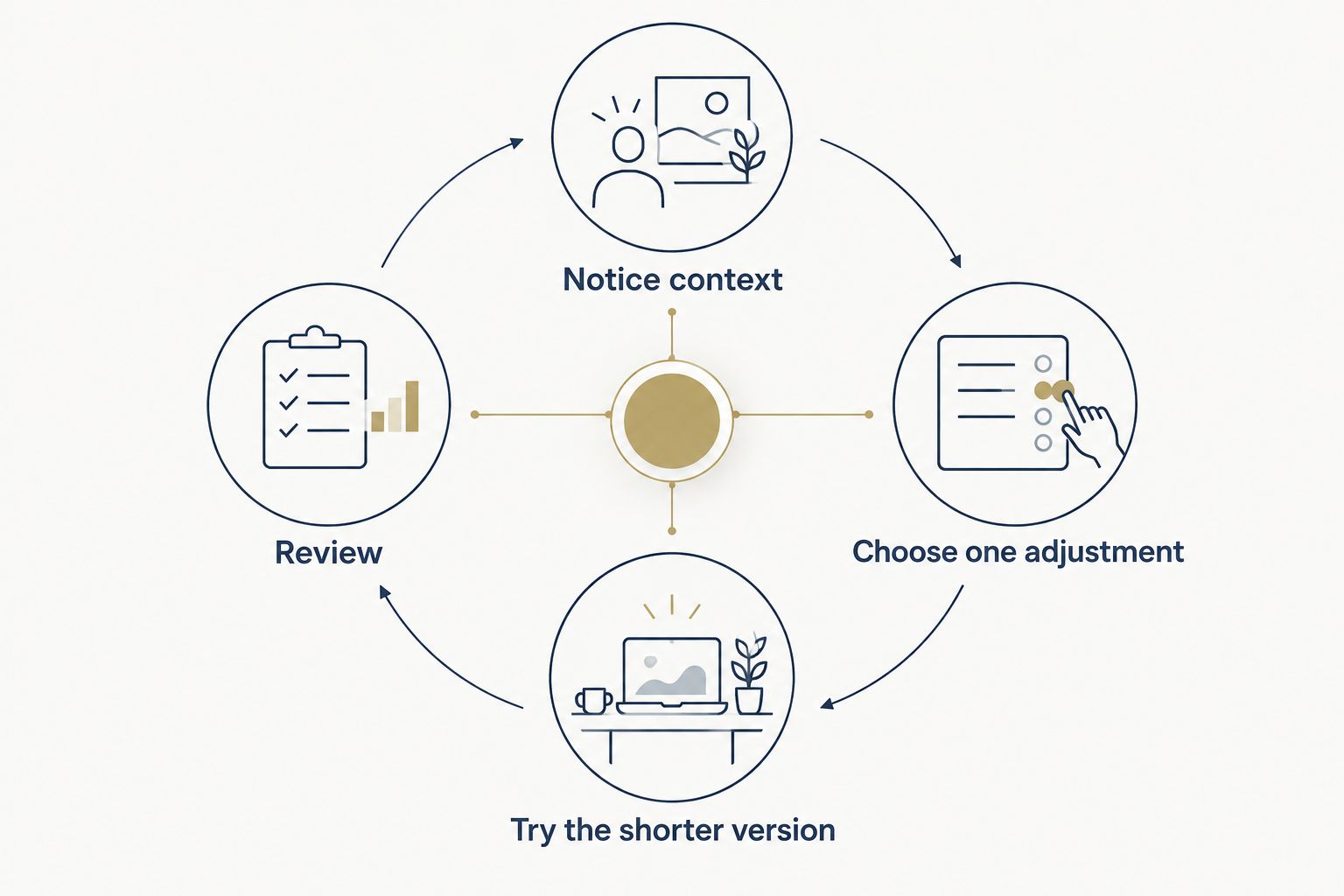
Think of this as a rhythm, not a reset button: notice your circumstances, choose an adjustment, try it, and review how it fits. The goal is a routine you can return to without pressure to be perfect.
- Notice context before judging an outcome.
- Choose one adjustment linked to a specific obstacle.
- Try the shorter version when the fuller routine does not fit.
- Review whether the adjustment made the evening more manageable.
- Keep helpful actions and set aside unnecessary ones.
Compare coaching, apps, and self-guided routines
For a 2026 decision, compare the kind of support you want rather than the number of features an option advertises. A self-guided routine leaves decisions with you. An app provides a digital format, while personal coaching adds discussion and ongoing check-ins.
These options serve different purposes. None should be treated as a substitute for healthcare when you have a medical concern, and no approach can promise an uninterrupted night around caregiving.
| Option | Best for | Practical advantage | Key limitation |
|---|---|---|---|
| Self-guided routine and paper journal | Adults who prefer to choose and review their own habits | You control the format and can keep it very simple | You must interpret your notes and decide what to change yourself |
| Sleep app | Adults who prefer a digital place for routines or tracking | A digital format can keep relevant entries together | Features vary; an app alone is not the same as personal coaching |
| Restweft personal sleep coaching | Adults seeking personal guidance and ongoing check-ins | Support connects evening routines with the sleep patterns you track | It is everyday wellness coaching, not medical care |
Choose the least complicated approach that gives you the support you need. If paper notes already help you make useful adjustments, more tools are not automatically an improvement. If you keep collecting information without knowing what to change, consider whether a conversation would be more useful than another tracker.
When you want personal guidance, the next step is to create an account and complete a private sleep profile. Describe the evening you actually have, including interruptions and available help; you do not need a polished routine before beginning.
Make room for your routine
Create an account and complete a private sleep profile to begin with your real evening circumstances.
Common mistakes new parents make with sleep coaching
Confusing adult coaching with infant sleep guidance
Adult sleep coaching addresses your habits and routines. It does not establish what is appropriate for your baby. Keep questions about infant care, feeding, and sleep safety with your baby’s clinician rather than applying adult advice to a child.
Measuring success only by uninterrupted sleep
Caregiving interruptions are not proof that you used a routine incorrectly. Review what was within your control: whether the plan was manageable, whether responsibilities were clear, and whether optional tasks crowded out an available opportunity to rest. Those questions give you something practical to discuss.
Requiring a perfect evening before starting
Waiting for a predictable night can keep a routine permanently out of reach. Build the minimum version around an ordinary interruption-filled evening instead. A quiet activity that you can stop and return to is more adaptable than a sequence that must remain unbroken.
Turning every night into a research project
Detailed logs, several apps, and constant comparisons can create work without clarifying the next step. Choose the information needed for one question. If an entry does not help you understand your circumstances or select an adjustment, consider leaving it out.
Expecting coaching to explain a health concern
Do not use habit tracking to diagnose yourself or ask a coach to explain symptoms. If you are concerned about your sleep, daytime functioning, or mental health, contact a qualified healthcare professional. Coaching can stay focused on everyday routines without claiming to answer medical questions.
FAQ
What is sleep coaching for new parents?
Sleep coaching for new parents is adult wellness support for evening routines and sleep-pattern tracking around caregiving. It focuses on the parent’s habits, not on prescribing an infant sleep schedule or providing medical care.
Is sleep coaching the same as sleep training my baby?
No. Adult sleep coaching focuses on your own routines and choices. Questions about your baby’s sleep, feeding, and care belong with your baby’s clinician.
Can I start if my baby still wakes during the night?
You can work on an adaptable adult routine while caregiving interruptions continue. The plan should account for those interruptions rather than promise to remove them or require an uninterrupted night.
Is Restweft a good fit if I want someone to check in with me?
Restweft is a fit for adults seeking personal sleep coaching, practical evening routines, and ongoing check-ins. It is everyday wellness coaching, not a service for diagnosing or treating medical conditions.
Do I need a sleep tracker before talking to a coach?
A simple written account of your evenings is a useful starting point for a coaching conversation. Describe your rest opportunities, interruptions, and what feels difficult; you do not need to turn every night into a detailed measurement exercise.
What if I do not have another caregiver to share nights?
Build your routine around the help and time you actually have. Focus on adaptable habits and optional tasks rather than a handoff plan that depends on unavailable support.
When should I ask a healthcare professional instead of a sleep coach?
Ask a qualified healthcare professional when you have concerns about your sleep, daytime functioning, or mental health. A wellness coach does not diagnose, treat medical conditions, or replace qualified healthcare advice.
One last thing
Before adding another evening habit, identify one optional task you can leave unfinished. A routine does not always need more activity; sometimes the useful change is removing a demand from the time you already have.
For your 2026 plan, bring Restweft a description of a difficult ordinary evening—not an ideal one. That gives personal guidance a practical starting point: the life you actually live, with room for small adjustments rather than a promise of perfect nights.