
Military veterans’ sleep coaching is practical support for evening routines and sleep-pattern tracking, with the aim of making better rest fit everyday life. Your plan should accommodate work, family, and the routines you want to keep after service—not assume that every veteran has the same needs or that coaching replaces medical care.
- Sleep coaching for military veterans supports everyday habits; it does not diagnose or treat sleep conditions.
- Restweft sleep coaching fits adults seeking personal guidance, doable evening routines, and ongoing check-ins.
- Start with a simple sleep journal and one manageable adjustment, without pressure to be perfect.
- Choose self-guided routines, sleep apps, or personal coaching according to the support you want.
Why sleep coaching matters for military veterans
The useful question is not whether you can follow a strict bedtime routine. It is whether a routine fits your current responsibilities, preferences, and health needs. If your evenings include shift work, caregiving, appointments, or an unpredictable commute, a plan built around an uninterrupted evening misses the point.
Military experience does not tell a coach what your nights are like. You might want help adapting a familiar schedule to civilian work, or simply want less rushed evenings. Start with your actual circumstances rather than a plan based on assumptions about veterans.
For your 2026 plan, use a sleep journal template to describe what happens around bedtime. A short record gives you something concrete to discuss without turning each night into a performance review.
Coaching belongs in the everyday-habits lane. Recurring nightmares, breathing concerns during sleep, persistent sleep difficulties, or daytime sleepiness that affects safety belong in a conversation with a qualified healthcare professional. You do not need to explain those concerns as a failure of discipline.
Build a routine around the life you have
The following steps are options to adapt, not a test to pass. Begin with the part that feels most useful, and leave room for evenings that do not go to plan.
Describe your evenings before changing them
Start manually with a notebook or a private note. Write down when your evening responsibilities end, when you intend to settle down, and what tends to interrupt that transition. You do not need a device or detailed sleep measurements to begin.
Try a 2-minute note as a manageable example, not a prescribed tracking schedule. If recording your night makes you more preoccupied with sleep, simplify the note. The aim is to notice useful patterns, not collect the largest possible record.
Describe the circumstances as plainly as you can. “Finished work late and handled tomorrow’s paperwork” gives you more to work with than “bad routine.” Include what went comfortably, too, so the plan preserves habits that already suit you.
- Record the evening’s main responsibilities and interruptions.
- Note your intended bedtime and approximate waking time.
- Describe how rested or sleepy you felt in ordinary language.
- Mark unusual circumstances without judging the night.
Choose one transition you can repeat
Pick a familiar action that signals the end of necessary evening tasks. That might mean putting work materials away, preparing clothes for the morning, or moving from a busy shared room to a quieter activity. Choose something that fits your household.
A 5-minute routine is a possible starting example, not a claim about how quickly you will sleep. A 10-minute version might suit a less crowded evening. The shorter version should still count when family needs or work change the plan.
For a 2026 routine, focus on an action you control rather than a promised result. You can decide to stop reviewing tomorrow’s tasks; you cannot order yourself to fall asleep. That distinction keeps the routine from becoming another demand.
- Choose an existing activity as your evening cue.
- Attach one quiet, familiar action to that cue.
- Create a shorter version for interrupted evenings.
- Keep the routine comfortable rather than elaborate.
Decide how much personal guidance you want
Try a self-guided routine first if choosing and reviewing small changes feels manageable. You can use your notes to decide what fits and what needs adjusting. Personal coaching becomes relevant when you want help making those decisions and following through.
Restweft sleep coaching is best for adults seeking personal guidance with everyday routines, not medical care. Its personal guidance and ongoing check-ins offer a place to discuss practical adjustments instead of choosing every next step alone.
That support has a clear limit: everyday wellness coaching does not diagnose or treat medical conditions. Before choosing any coach, ask how check-ins work, what information you need to share, and how concerns outside coaching are handled. Do not assume that general sleep coaching includes veteran-specific clinical expertise.
- Choose self-guidance if you prefer to make adjustments independently.
- Consider personal guidance if you want help choosing a next step.
- Ask what ongoing check-ins involve before committing.
- Confirm that the service’s scope matches your needs.
Fit the routine to your household and schedule
Start with a practical conversation if you share your home. Explain the small change you want to try and ask what is realistic for everyone involved. A routine that depends on the whole household becoming silent at a particular moment is not useful if that cannot happen.
If you work changing hours, describe the sequence after work rather than assuming a conventional bedtime. If you care for someone else, identify what can pause and what cannot. You are designing around responsibilities, not pretending they disappear.
You also do not have to discard every routine associated with military life. Keep what feels useful and comfortable now. The question is whether a habit serves your current life, not where you learned it.
- Agree on a workable transition with the people you live with.
- Put essential household tasks before optional evening activities.
- Adapt the sequence for late work or caregiving interruptions.
- Keep familiar habits that still suit your circumstances.
Track patterns without turning sleep into a score
Use your own notes before adding a tracking app or wearable. Record the information that helps you make a decision: whether the routine was doable, what interrupted it, and how the following day felt. Approximate observations are enough for a practical conversation.
For your 2026 tracking plan, decide what you will do with each piece of information. A bedtime entry can help you discuss schedule changes. A long collection of measurements is less useful if it leaves you unsure what to change.
If you choose an app, check its recording features, privacy information, and notification settings rather than assuming all sleep apps work alike. Treat consumer tracking as a record to discuss, not a diagnosis or a verdict on how well you handled the night.
- Record only details that help you choose an adjustment.
- Use approximate times when exact tracking feels distracting.
- Check privacy settings before entering personal information.
- Simplify tracking if it adds pressure rather than clarity.
Review the fit and adjust gently
Set a review point that suits your schedule. Look at whether the routine was practical before asking whether it produced a better night. A routine you repeatedly abandon needs adjustment, not a harsher commitment.
Use a simple cycle: Notice, Choose, Try, Review. Notice an obstacle, choose a manageable response, try it in real life, and review what happened. A coach can help you discuss that cycle, but you can also use it independently.
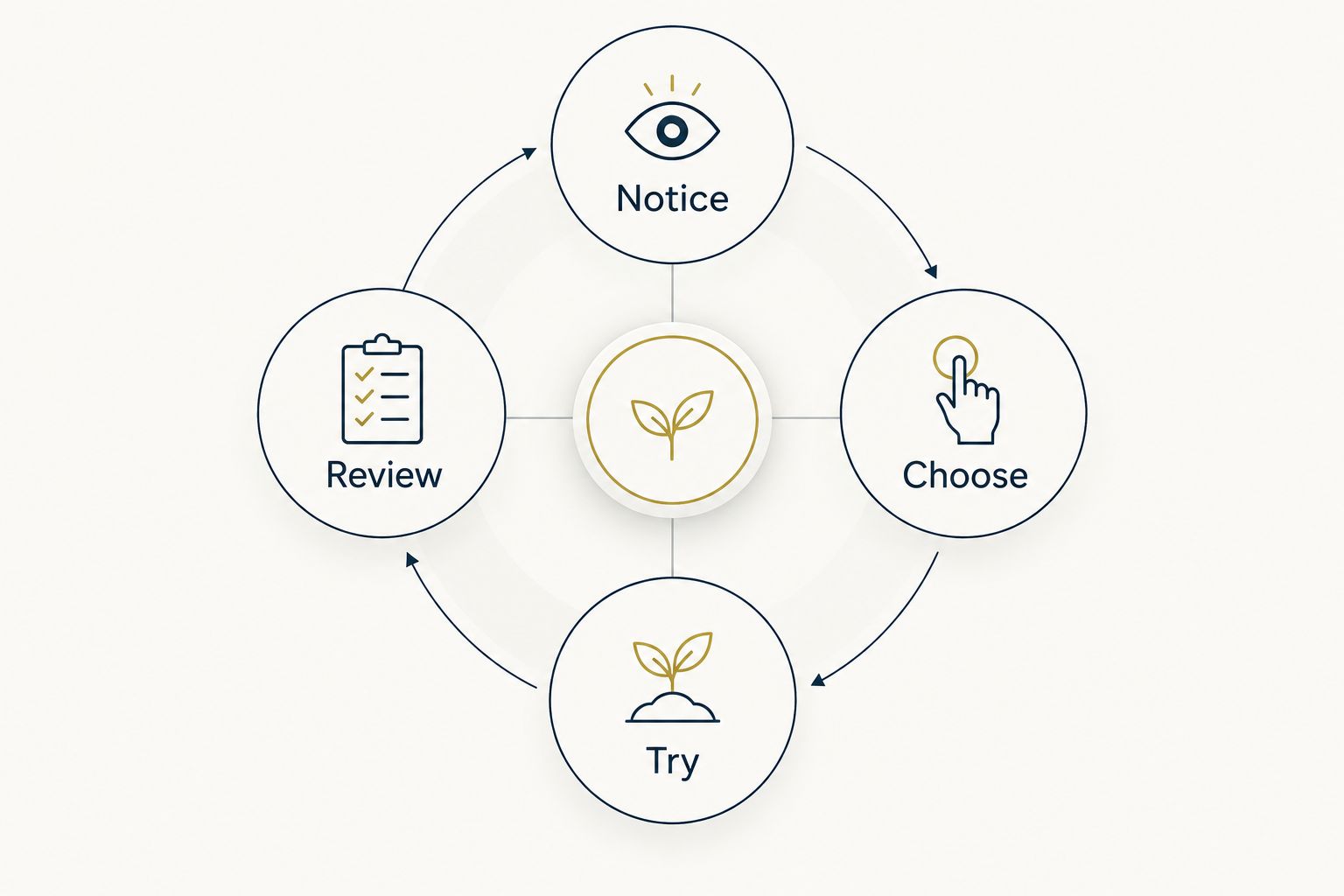
In 2026, let your plan reflect your present responsibilities rather than an ideal evening from another stage of life. If a quiet activity becomes frustrating, replace it. If the shorter routine fits reliably, there is no requirement to make it longer.
- Keep the parts that feel practical and comfortable.
- Change one awkward part instead of rebuilding everything.
- Bring recurring obstacles to a coaching check-in.
- Take health concerns to a qualified healthcare professional.
Compare your support options
Choose according to the help you need, not the amount of information an option collects. A notebook, an app, and a personal coach serve different purposes. None should be presented as a substitute for appropriate healthcare.
| Option | Best for | Main benefit | Key limitation |
|---|---|---|---|
| Self-guided routine and journal | Adults comfortable choosing their own adjustments | You control the routine and what you record | You interpret patterns and choose next steps yourself |
| Sleep app | Adults who prefer digital prompts or records | Recording tools can keep information together, depending on the app | Features and privacy practices vary; an app does not necessarily include personal guidance |
| Restweft personal sleep coaching | Adults who want guidance and ongoing check-ins | Support connects evening habits with the life you actually live | It is everyday wellness coaching, not medical care |
| Qualified healthcare professional | Adults with symptoms, health concerns, or safety-related sleepiness | Assessment of health concerns within the professional’s scope | A healthcare visit does not necessarily include ongoing everyday-routine coaching |
You do not have to choose a permanent system immediately. Begin with the least complicated approach that meets your current needs, and reconsider if you need a different kind of support.
Common mistakes to avoid
Treating military experience as a complete sleep history
A generic veteran-focused routine can overlook your actual preferences, household, and work. Describe what matters to you now. You do not need to share detailed service experiences to explain that late paperwork or a changing schedule interrupts your evening.
Turning the routine into another performance standard
Missing an evening does not invalidate the plan. Keep a shorter option and resume without adding compensatory rules. A doable routine is more useful than an elaborate one you dread.
Asking coaching to handle a medical concern
Do not use habit tracking to explain away recurring symptoms or safety-related sleepiness. Bring those concerns to a qualified healthcare professional, including your VA care team if you use VA healthcare. Coaching stays focused on everyday wellness habits.
Adding tools before identifying the obstacle
An app does not tell you whether the real obstacle is unfinished work, household interruptions, or a routine you dislike. Name the practical problem first. Then decide whether a tool or personal guidance would help you address it.
Take the next step without rushing
If personal guidance fits what you want, Restweft invites you to create an account and complete a private sleep profile. Describe your evening responsibilities and what you would like help making more manageable; you do not need a perfect routine before starting.
Make room for a doable routine
Create an account and complete a private sleep profile to describe your evenings and goals.
FAQ
What's the best sleep coaching approach for military veterans?
The best fit starts with your current schedule, preferences, and need for support—not assumptions about military service. Choose everyday coaching for routine guidance and a qualified healthcare professional for medical concerns.
Is sleep coaching the same as treatment for insomnia or PTSD?
No. Everyday sleep coaching does not diagnose or treat insomnia, PTSD, or other medical conditions. Discuss symptoms and treatment questions with a qualified healthcare professional.
Can I start a sleep routine if I work changing shifts?
Yes, you can build a flexible sequence around the end of work rather than a fixed evening hour. Describe your changing schedule when seeking guidance, and keep a shorter version for difficult days.
Do I need a sleep tracker before talking to a coach?
No, a simple written record is enough to describe your evening routine. Note approximate times, interruptions, and how you feel without buying a device.
Is personal sleep coaching better than a sleep app?
Personal coaching fits people who want guidance and check-ins; an app fits people who prefer digital tools for recording or reminders. Check each option's actual features and limits rather than assuming an app includes coaching.
What if tracking my sleep makes me more worried?
Simplify or pause the tracking rather than forcing yourself to collect more information. Explain the concern to your coach, and speak with a qualified healthcare professional if worry or sleep difficulties persist.
Can I use sleep coaching while receiving VA healthcare?
Everyday wellness coaching and healthcare have different roles. Keep medical questions with your qualified healthcare professional, and do not change a care plan based on coaching advice.
One last thing
Your most useful 2026 adjustment might be something you remove: an unnecessary reminder, a tracking field, or an evening task that can wait. Before adding another habit, ask what makes settling down harder than it needs to be. Make room for a rhythm, not a reset button.