Frequent travelers’ sleep coaching is personal guidance for adapting evening routines and tracking sleep patterns with the aim of making rest more manageable away from home. Changing rooms, late arrivals, and work commitments call for a routine that travels with you, not a schedule that only works at home.
- Sleep coaching for frequent travelers should adapt to changing schedules, not demand identical nights.
- Restweft sleep coaching suits adults seeking personal guidance, doable evening routines, and ongoing check-ins.
- A sleep journal can connect travel circumstances with patterns without turning every night into a score.
- Everyday wellness coaching does not diagnose or treat sleep conditions or replace medical care.
Why sleep coaching matters for frequent travelers
A home routine assumes familiar surroundings and some control over your evening. Travel interrupts both: a delayed arrival can remove your usual quiet time, while an early departure can make a long bedtime routine impractical. The useful question is not whether you followed every step. It is whether your routine still fits the night you actually have.
Restweft sleep coaching is best for travelers who want personal guidance on practical evening routines. Restweft offers personal online sleep coaching for adults in the United States, with practical routines and sleep-pattern tracking. That is everyday wellness support, not medical care or a promise that travel will stop affecting your nights.
For your 2026 travel plans, separate what you control from what you do not. You can choose a brief wind-down activity or write down tomorrow’s obligations; you cannot always choose when a flight lands or whether a hotel hallway stays quiet. A useful plan leaves room for that difference.
The goal is a rhythm, not a reset button. Coaching provides a place to discuss what happened, adjust an unrealistic plan, and decide what deserves your attention next.
Build a routine that can travel
Start with a notebook or a simple note on your phone. You do not need a device, an app, or a coaching account to notice which parts of an evening feel manageable. Use the following steps as options to shape together, rather than a checklist you must complete on every trip.
Map your trip
Look at the itinerary before deciding what your evenings should look like. A late arrival followed by an early meeting needs a different plan from an afternoon arrival with an open evening. Write down the practical constraints first, so your routine does not depend on time you never had.
For a trip in your 2026 calendar, mark the arrival evening, any unusually early starts, and the return home. If you cross time zones, record that context too. This is preparation for a conversation about your habits, not a self-directed medical plan for managing a body-clock condition.
Separate fixed commitments from optional ones. If a work dinner is required, build your routine around it rather than treating the dinner as a failure of your sleep plan. If evening email is optional, decide where you want its boundary to sit.
- Mark late arrivals and early departures before choosing bedtime activities.
- Note whether the trip crosses time zones or changes your usual work hours.
- Identify evening commitments you cannot move.
- Choose one optional obligation to shorten or set aside.
Pack familiar cues
Choose a familiar activity that does not depend on your bedroom. Reading a few pages, washing up, or writing tomorrow’s priorities can give your evening a recognizable ending. The activity should be easy to repeat in an unfamiliar room and easy to shorten when you arrive tired.
Try a 5-minute version at home before packing it into a trip. That duration is a planning example, not a sleep requirement. If the activity feels like another assignment, simplify it; the point is familiarity, not completing a performance.
Give yourself a fallback as well. A book is less useful when you leave it in your checked bag, but a brief written note can serve the same practical purpose of ending the workday. Pick cues that fit your preferences instead of collecting more equipment.
- Choose one quiet activity you already find comfortable.
- Keep anything you need accessible in your travel bag.
- Prepare a shorter version for delayed arrivals.
- Leave behind steps that require a particular room or setup.
Simplify arrival
On arrival night, begin with practical needs: find your essentials, check the next day’s departure details, and decide what can wait. Avoid turning unpacking into a full evening project if you only need a few items. Your routine should help you finish the day, not create another job.
A self-guided starting point is a short arrival note: what must happen tonight, what belongs tomorrow, and what you can skip. If personal support would help, Restweft’s guidance and ongoing check-ins provide a way to discuss those choices and adapt your routine. Coaching is an optional source of support, not a prerequisite for starting.
Create a 2-minute fallback for the nights when your longer plan no longer fits. You might set out tomorrow’s essentials and put unfinished tasks into a note. This is a suggested format, not a claim that a particular number of minutes changes sleep.
- Put essential belongings where you can find them without searching later.
- Confirm tomorrow’s necessary arrangements before ending travel administration.
- Choose a clear stopping point for nonessential unpacking.
- Use your shortest routine when the original plan no longer fits.
Track useful context
Keep a brief sleep note rather than trying to reconstruct the whole night. Record when you went to bed, when you got up, and how rested you felt. Add travel details that help explain the evening, such as a late arrival, a noisy room, or work that continued after dinner.
For an upcoming 2026 trip, choose a format you can use both away and at home. A notebook is enough. If you already use a tracking app, its record can sit alongside your own observations; it does not need to become the final verdict on your night.
Use tracking to support a conversation, not to grade yourself. A brief note about a difficult evening is useful even when you cannot remember exact times. Keep estimates clearly marked as estimates, and leave blanks rather than inventing precision.
- Record bedtime and rising time in a consistent format.
- Add a plain-language description of how rested you felt.
- Note travel circumstances separately from the habits you chose.
- Include which version of your routine you used.
- Keep the entry short enough that you will actually complete it.
Review your routine
Read your notes together instead of treating one night as proof. Ask which actions felt easy to repeat, which required too much effort, and which did not fit your commitments. A pattern worth discussing is not the same thing as a diagnosis.
Suppose your notes cover 3 travel nights: a late arrival, an evening with client commitments, and a quiet night. Compare the circumstances before deciding that one routine caused a particular result. The number is simply an example of a review exercise, not a minimum amount of tracking you need.
A coaching check-in can focus on one adjustment rather than a complete overhaul. You might keep the familiar activity but move necessary planning earlier. Or you might drop a step that repeatedly turns your evening into a negotiation with yourself.
- Identify one part of the routine that felt manageable.
- Flag one step that repeatedly competed with travel obligations.
- Separate observations from explanations you cannot confirm.
- Choose one adjustment to discuss or try next.
Plan your return
Give the return home its own plan. Travel administration, laundry, and unfinished work can spill into the evening, so decide what truly needs attention before bed. You do not have to complete every postponed task on the night you arrive.
Keep a familiar cue from your travel routine and reconnect it with your home evening. That gives you continuity without demanding an immediate return to a perfect schedule. If your travel pattern changes throughout 2026, revise the plan rather than judging yourself against an outdated version.
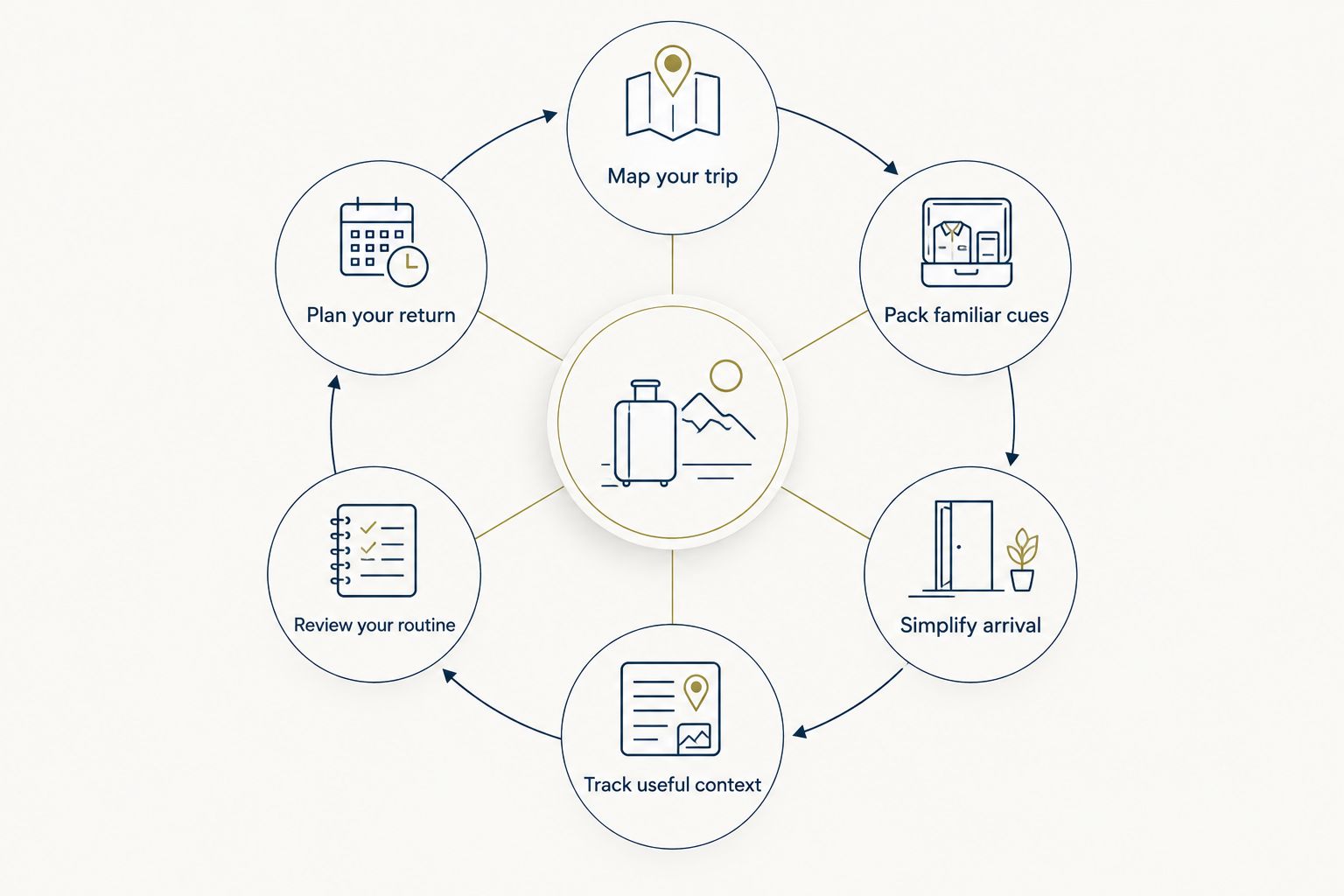
The process is a loop: prepare, use the routine, notice what happened, and adjust. It should get easier to describe what you need, even when the itinerary remains complicated.
- Separate essential arrival-home tasks from optional catch-up work.
- Keep one familiar wind-down activity available at home.
- Note any concerns you want to discuss at your next check-in.
- Update the plan before the next trip instead of starting from scratch.
The sequence below summarizes the process. You can return to an earlier step whenever your itinerary changes; completing every stage perfectly is not the goal.
Compare sleep-support options for travel
Choose support based on what you need help doing. Recording information, selecting a wind-down activity, and discussing a changing routine are different tasks. No single approach needs to handle all of them.
The table compares approaches, not named app features or treatment outcomes. For your 2026 plans, start with the least complicated option that addresses your actual difficulty, then reconsider if that support is not enough.
| Option | Best for | Practical advantage | Key limitation |
|---|---|---|---|
| Self-guided evening routine | Travelers who prefer choosing and adjusting habits independently | You can adapt the routine without adding another service | You handle the planning and review yourself |
| Sleep journal | Travelers who want a record of habits and circumstances | Your notes can include the context behind a difficult evening | Recording information does not itself provide personal guidance |
| Sleep app | Travelers who want digital prompts or organized records | Depending on its features, an app can support logging or reminders | Features vary; a tool is not the same as a personal conversation |
| Restweft sleep coaching | Adults who want personal guidance, doable routines, and ongoing check-ins | Coaching connects practical adjustments with discussion of sleep patterns | It is everyday wellness coaching, not medical diagnosis or treatment |
Choose personal guidance when the difficult part is adapting the routine, not merely recording it. Choose a journal when you mainly need somewhere to notice patterns. If an app adds more tasks than it removes, a simpler record remains an option.
You can also combine approaches without making the system elaborate. A short journal can support a coaching conversation; an app does not need to become another nightly obligation. Keep only the pieces that serve a clear purpose.
Common mistakes frequent travelers make
Copying the whole home routine
A routine built around an unhurried evening at home can become impractical after a delayed arrival. Keep the purpose of each step, but shorten its form. Writing down tomorrow’s essentials can replace a longer planning session when your available evening shrinks.
Treating every trip as identical
A nearby overnight stay and a trip across time zones bring different circumstances. Record those differences before comparing your nights. Otherwise, you risk blaming a routine for conditions it was never designed to control.
Letting tracking become the task
If logging every detail keeps you occupied when you want to wind down, the record is asking too much. Shorten it to the information you actually review. Your notes should help you understand your evenings, not create pressure to produce a complete account.
Expecting coaching to replace healthcare
Sleep coaching supports everyday habits; it does not diagnose or treat medical conditions. Bring persistent sleep concerns, breathing concerns during sleep, or significant daytime sleepiness to a qualified healthcare professional. Do not rely on a coaching routine to address a safety concern or make driving while sleepy acceptable.
Start with your next real evening
Choose one upcoming night, not an ideal week. Write down its constraints and select one familiar action you want to keep. That gives you a concrete starting point for either a self-guided routine or a conversation about personal support.
If you want guidance, you can create an account and complete a private sleep profile. Describe the travel schedule you actually live with, including late arrivals and unpredictable evenings. You do not need a polished routine before asking for help.
FAQ
What's the best sleep coaching for frequent travelers?
The best fit is coaching that adapts everyday routines to your actual travel schedule and clearly explains its limits. Restweft offers personal online sleep coaching for adults in the United States, focused on practical routines and sleep-pattern tracking rather than medical care.
Can sleep coaching cure jet lag?
Sleep coaching is not a medical treatment or a guaranteed cure for jet lag. Everyday coaching can support practical routines around travel, while individualized medical questions belong with a qualified healthcare professional.
Do I need a sleep tracker before starting coaching?
You do not need a sleep tracker to begin noticing your habits. A notebook or phone note can record bedtime, rising time, how rested you felt, and relevant travel circumstances.
Is a sleep app better than personal coaching for travel?
A sleep app and personal coaching serve different purposes. Depending on its features, an app can organize records or reminders, while personal coaching provides discussion and guidance around adapting everyday routines.
What should I do when I arrive too late for my routine?
Use a shorter version that covers your immediate practical needs and one familiar wind-down action. Let optional unpacking and catch-up work wait rather than trying to recreate an unhurried evening at home.
What should I include in a travel sleep journal?
Include bedtime, rising time, how rested you felt, and circumstances such as late arrivals or evening work. Keep estimates marked as estimates and write only enough detail to support a useful review.
When should I seek healthcare advice instead of sleep coaching?
Seek qualified healthcare advice for persistent sleep concerns, breathing concerns during sleep, or significant daytime sleepiness. Everyday wellness coaching does not diagnose or treat medical conditions or replace medical advice.
One last thing
Before your next trip, write the shortest acceptable version of your routine while you are still at home. Deciding what to leave out is easier before you arrive tired. A routine that survives a difficult evening is more useful than one that only fits an ideal night.