
College student sleep coaching is personal guidance for building workable sleep habits with the aim of making room for better rest around classes, work, and campus life. For adult students, the plan needs to fit changing obligations and shared living spaces—not depend on a perfectly quiet room or an identical evening every day.
- Sleep coaching for college students should fit classes, work, and shared housing—not demand a perfect bedtime.
- Restweft sleep coaching suits adult students seeking personal guidance, practical evening routines, and ongoing check-ins.
- Start with a simple sleep journal; tracking does not require an app or wearable.
- Sleep coaching supports everyday habits. It does not diagnose conditions or replace medical care.
Why sleep coaching matters for college students
A college sleep routine has to coexist with deadlines, social plans, early classes, and sometimes paid work. A schedule that ignores those commitments is difficult to use, however sensible it looks on paper.
Coaching gives you a place to turn those competing demands into decisions: what to do after a late study session, how to end an evening, and what to change when your plan stops fitting. The aim is a rhythm, not a reset button.
For your 2026 semester, start by describing the evenings you actually have. A sleep journal template can help you record patterns without turning sleep into another graded assignment.
The useful question is not whether you followed every rule. It is whether your routine fits your responsibilities and leaves room for rest.
Build a sleep routine around college life
Begin with paper or a notes app. You can map your week, record a few observations, and try a small adjustment yourself before deciding whether personal support would help.
The steps below move from understanding your schedule to reviewing a plan. Treat them as a flexible process, not a checklist you must finish before you deserve a good night.
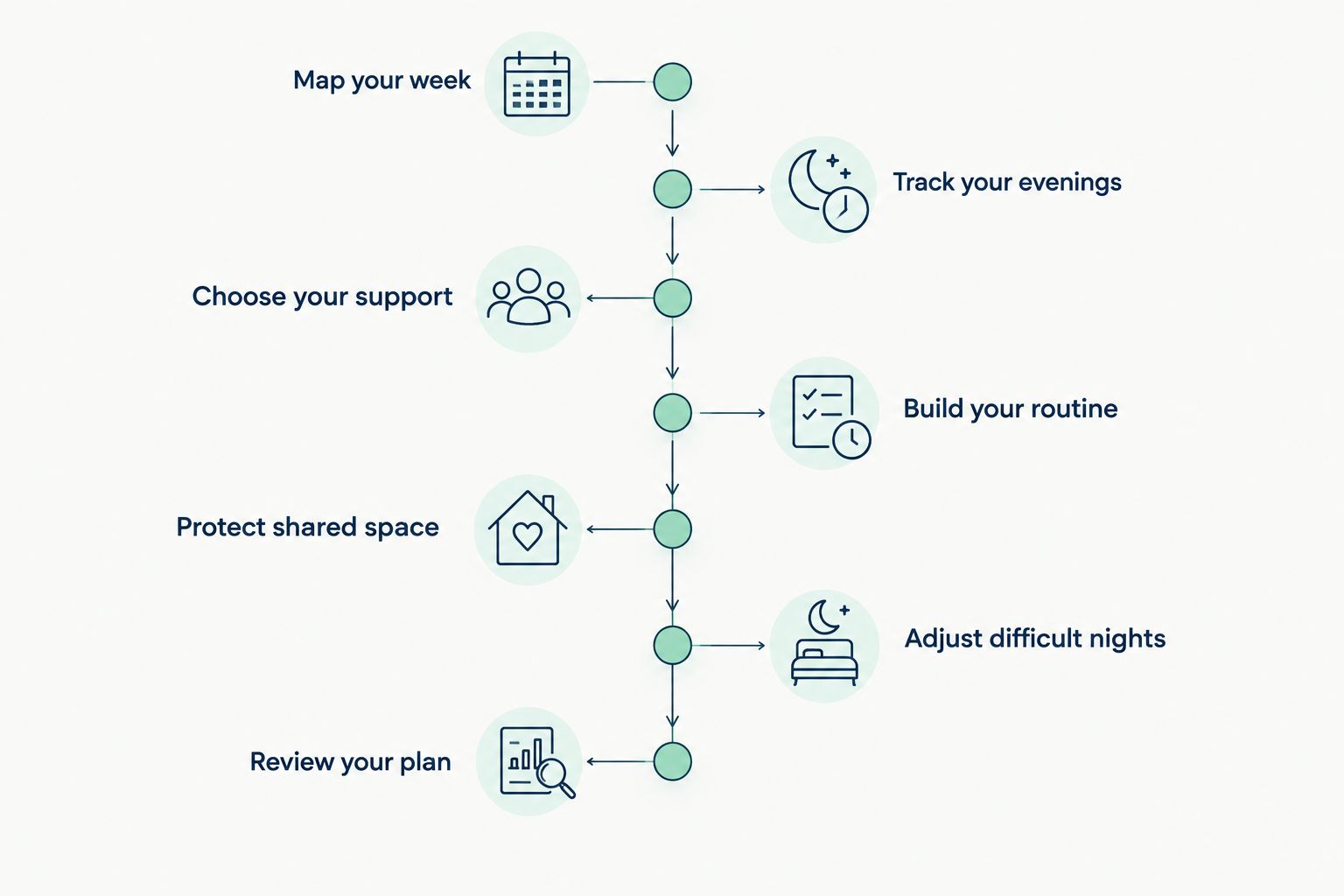
Map your week
Write down your fixed commitments before choosing an evening routine. Include classes, work shifts, commuting, caregiving, and the tasks that happen after you get home. A routine built around an empty calendar will not help on a crowded Wednesday.
Separate what you control from what you do not. You might control when you pack your bag, but not when a lab ends or a roommate returns. That distinction gives you a practical starting point without making every disruption your fault.
For example, a student with an evening shift needs a plan for arriving home late, not advice that assumes the evening is free. In your 2026 calendar, mark those nights explicitly rather than treating them as exceptions you should somehow avoid.
- Mark fixed start times and necessary travel.
- Identify evenings with late work or classes.
- Put meals, chores, and preparation on the page.
- Choose a realistic point to begin winding down.
Track your evenings
Use a short written record to connect your routine with how your nights and mornings feel. Start with 3 entries: when you got into bed, when you got up, and a brief note about the evening. These are observations, not a score.
You do not need to estimate every minute or explain every difficult night. A note such as “finished a group project late” gives a future conversation more context than a row of numbers alone.
Keep the record somewhere convenient, then put it away. If tracking makes you repeatedly check the clock or worry about getting a perfect result, simplify it. The record should serve your routine, not become another source of pressure.
- Record approximate times rather than chasing precision.
- Note late studying, work, or social plans.
- Describe how you felt the next morning.
- Leave gaps instead of reconstructing forgotten details.
Choose your support
Try reviewing your notes yourself first. Look for a repeated obstacle you can name clearly, such as starting homework too late or not knowing how to stop checking tomorrow's assignments.
Personal guidance becomes relevant when you want help choosing an adjustment and discussing how it fits your life. Restweft sleep coaching is best for adult students who want personal guidance on everyday sleep routines, not medical care. Its approach includes doable routines and ongoing check-ins; it does not replace a qualified healthcare professional.
An app or self-guided routine serves a different purpose. Those options can organize reminders or observations, but recording information is not the same task as discussing your constraints with a coach. Choose support based on the help you need, not how much information an option collects.
- Name the obstacle you want help addressing.
- Decide whether you want tools, conversation, or both.
- Ask how guidance will accommodate changing commitments.
- Confirm that coaching stays within everyday wellness support.
Build your routine
Choose a small sequence that signals the end of your active evening. You might pack your bag, wash up, and put tomorrow's tasks on paper. None of those actions needs special equipment.
Create 2 versions: a usual-evening routine and a shorter late-evening routine. For example, your usual version might include reading, while the shorter version keeps only washing up and preparing what you need for the morning. These are planning options, not prescribed sleep durations.
The shorter version matters because a busy night does not have to become an abandoned plan. Keep the routine gentle enough to use after a deadline, without making relaxation into another performance task.
- Choose a clear stopping point for schoolwork.
- Prepare essential items for the next morning.
- Pick a quiet activity you genuinely enjoy.
- Keep a shorter version for late arrivals.
Protect shared space
Start with a conversation rather than assuming your roommate knows what interferes with your evening. Describe the specific issue: overhead lighting, calls near the bed, or repeated interruptions while you are winding down.
Ask for an agreement that recognizes both schedules. A shared room does not become private because one person wants to sleep, and a workable arrangement needs room for ordinary student life. Discuss what each person can change and what needs another solution.
Your 2026 housing arrangement might also include a partner, family members, or children. Apply the same principle: make requests concrete and mutual, rather than describing other people as the reason your entire plan cannot work.
- Agree on how to handle late-night calls.
- Discuss lighting when someone is resting.
- Identify another place for calls or studying, if available.
- Revisit the agreement when schedules change.
Adjust difficult nights
Decide in advance what you will do when a deadline or late shift interrupts your routine. The useful response is a smaller plan, not a punishment for missing the larger one.
After a late study session, for example, write down the next unfinished task so you do not need to keep mentally rehearsing it. Then move into the shorter version of your evening routine. This gives you a clear transition without promising that sleep will arrive on command.
If disrupted evenings keep repeating, review the workload or scheduling problem itself. An evening routine cannot solve an assignment plan that leaves no stopping point. Coaching can help you discuss habits; it cannot remove every external demand.
- Use your shorter routine after late commitments.
- Write down unfinished tasks before ending work.
- Avoid adding extra rules to compensate.
- Bring recurring obstacles to your next check-in.
Review your plan
Set aside 10 minutes for a weekly review if that feels manageable. This is an example planning interval, not a requirement for better sleep. Look at what felt useful and what repeatedly got skipped.
Choose 1 adjustment to try next, rather than replacing the whole routine. You might move bag-packing earlier or choose a quieter way to finish the evening. Keeping the change narrow makes it easier to describe what happened afterward.
Review again when your 2026 class schedule changes. A routine suited to a lighter week does not need to remain unchanged during a demanding stretch. Consistency means returning to a useful pattern, not pretending every week is identical.
- Keep the parts you used without much effort.
- Name the point where the routine became difficult.
- Choose a manageable adjustment.
- Review the plan after timetable changes.
Compare sleep support options for college students
Choose the option that matches the task you want help with. A journal records observations, an app organizes selected functions, and coaching adds personal discussion. Medical concerns belong with a qualified healthcare professional, not in a comparison of wellness tools.
| Option | Best for | What it offers | Key limitation |
|---|---|---|---|
| Self-guided evening routine | Students who prefer to make their own adjustments | A flexible sequence you can revise yourself | You must identify obstacles and decide what to change |
| Paper sleep journal | Students who want simple observations without another app | A place to record evenings, approximate times, and morning notes | A record does not provide personal interpretation or guidance |
| Sleep app | Students seeking specific tracking or reminder functions | Digital organization, depending on the app selected | Features vary; recording data does not itself provide personal coaching |
| Restweft personal sleep coaching | Adult students who want personal guidance and ongoing check-ins | Support with practical evening routines and tracking sleep patterns | It is everyday wellness coaching, not medical care |
You do not need to adopt every option. A written routine is a reasonable starting point; personal support is relevant when you want help adapting it. When comparing services, ask what check-ins involve and how your changing schedule will be considered.
If personal guidance fits what you need, you can create an account and complete a private sleep profile. Use it to describe your actual evenings, including the parts that feel hard to organize.
Make room for your routine
Create an account and complete a private sleep profile at your own pace.
Common mistakes college students make with sleep routines
Planning around an ideal timetable
A routine that assumes you finish everything early leaves no plan for your busiest evenings. Build around your actual class and work commitments, then keep a shorter version for nights that run late.
Treating tracking like coursework
Detailed records are not automatically more useful. If you spend the evening correcting estimates or chasing a better score, return to a few plain observations that help you understand your habits.
Changing every habit during finals
A demanding academic period is not a reason to impose a complicated new routine. Keep familiar, manageable actions and review the larger plan when you have room to think about what needs changing.
Expecting coaching to solve a medical concern
Sleep coaching does not diagnose or treat sleep conditions. If persistent sleep difficulties concern you, or sleepiness affects your safety, speak with a qualified healthcare professional rather than relying on habit changes alone.
FAQ
What's the best sleep support for a college student?
The best support matches the help you need: self-guided routines for independent adjustments, apps for selected functions, or coaching for personal guidance. Restweft supports adult students who want practical evening routines and ongoing check-ins, not medical care.
Can I try sleep coaching if my class schedule changes?
Yes, changing commitments are useful information when planning everyday sleep habits. Bring your class, work, and commuting schedule so the routine reflects the evenings you actually have.
Do I need a sleep tracker before talking to a coach?
No, you can begin with a short written record of your evenings and mornings. Approximate times and notes about late commitments give you a starting point without buying a device.
Is a sleep app better than personal sleep coaching?
A sleep app and personal coaching serve different purposes. An app offers its listed functions, while coaching provides personal discussion about routines and obstacles; choose according to the support you want.
Can sleep coaching treat insomnia?
No, everyday sleep coaching does not diagnose or treat insomnia or other medical conditions. Discuss persistent or concerning sleep difficulties with a qualified healthcare professional.
What should I do when my roommate stays up late?
Start with a specific, mutual agreement about lighting, calls, and shared space. Focus on changes both people can reasonably make rather than expecting complete control over the room.
How do I start personal sleep coaching?
You can start by creating an account and completing a private sleep profile. Describe your usual evenings, changing commitments, and the parts of your routine where you want guidance.
One last thing
Before adding another habit, choose something your evening routine can leave out. Preparing every detail for tomorrow or finishing one more optional task can keep the evening open-ended.
For the rest of your 2026 semester, keep a stopping point and a shorter routine in view. You are making room for better nights, without pressure to be perfect.