
Best overall: Headspace for guided meditation. Best for bedtime stories: Calm. Best for teacher variety: Insight Timer. Best for learning mindfulness: UCLA Mindful. This 2026 guide compares the best meditation apps for sleep by what you want to hear at bedtime—and how much browsing you want to do.
- Headspace is the best starting point for adults who want guided meditation and sleep-focused audio.
- Calm is the strongest fit when bedtime stories appeal more than meditation instruction.
- Insight Timer suits listeners who want to explore different teachers; UCLA Mindful suits mindfulness learners.
- Restweft complements meditation apps for sleep with personal guidance, practical routines, and ongoing check-ins.
Why this matters
Choosing an app and building an evening routine are different decisions. A recording gives you something to follow; a routine determines where that recording fits when dinner runs late, work spills over, or someone needs you.
If choosing audio is not your main difficulty, Restweft offers personal online sleep coaching for adults. That is a different kind of support—not another meditation library, and not medical care.
For your 2026 shortlist, start with the experience you want rather than the longest feature list. You do not need to become an experienced meditator before deciding whether a particular voice or format feels comfortable.
What makes the best meditation apps for sleep
Use these criteria to narrow your choices before exploring individual apps:
- Listening format: Decide whether you want meditation instructions, a narrated story, or background sound. These are different experiences, even when they share a sleep category.
- Voice fit: Listen to the narrator before committing to a routine. A voice you enjoy during the day is not automatically one you want at bedtime.
- A clear stopping point: Choose a recording before settling down so that finding something to play does not become the evening's main activity.
- Manageable effort: Notice whether the session asks you to concentrate, imagine a scene, or simply listen. Choose the effort level that fits your evening.
- Room for imperfect nights: A useful routine leaves room for interruptions. Missing a session should not turn the next evening into a catch-up assignment.
These criteria favor fit over volume. A large collection offers choice, but a familiar recording removes a decision; neither advantage matters equally to every listener.
Best meditation apps for sleep at a glance
This 2026 comparison separates the apps by their clearest use cases. Features and content change, so check each app's current description before choosing.
| App | Best for | Standout feature | Key limitation |
|---|---|---|---|
| Headspace | A guided starting point | Guided meditation alongside sleep-focused audio | Structured instruction is not the right format for every listener |
| Calm | Bedtime storytelling | Sleep Stories alongside meditation and sound content | Stories are a different experience from learning meditation |
| Insight Timer | Exploring teachers and styles | A broad library of teacher-led recordings | More choice leaves more selection work to you |
| UCLA Mindful | Learning mindfulness | Guided practices connected to UCLA's mindfulness education | Its focus is mindfulness practice rather than bedtime entertainment |
The ranking is a decision guide, not a clinical comparison. None of these recommendations establishes that one app treats a sleep condition better than another.
1. Headspace: best meditation app for a guided starting point
Headspace offers guided meditation and sleep-focused audio, including Sleepcasts. It is the default recommendation here for someone who wants a recognizable starting point rather than an open-ended search through different teachers.
The distinction matters on a busy evening. If you want someone to guide your attention, choose a meditation; if instructions feel like another task, explore a listening-focused format instead.
Headspace pros:
- Guided practices give you instructions to follow rather than requiring you to create a meditation yourself.
- Meditation and sleep-focused listening sit within the same app.
- Sleepcasts provide an alternative to a conventional guided meditation session.
Headspace cons:
- A guided voice adds input when you might prefer quiet or simple background sound.
- Having different content formats still requires you to decide which experience suits the evening.
Best for: Adults who want a guided introduction and a choice between meditation and sleep-focused listening.
Start by sampling the voice while you are still deciding what to use, not after you have settled into bed. Choose one recording to revisit before adding several alternatives. Familiarity is a useful selection preference, not a promise of better sleep.
Verdict: Choose Headspace when you want a guided starting point; skip it if spoken instruction is exactly what you want to avoid.
2. Calm: best meditation app for bedtime stories
Calm includes Sleep Stories, guided meditations, and sound content. Its clearest place in this comparison is for adults who would rather listen to a narrated story than follow a meditation exercise.
That does not make a story a better meditation. It makes storytelling a different way to spend the transition out of a busy evening, without asking you to practice a particular attention skill.
Calm pros:
- Sleep Stories give you a narrative option rather than only meditation instruction.
- Meditation and sound content offer alternatives when a story does not fit.
- Narration gives you something specific to evaluate: whether you actually enjoy listening to that voice.
Calm cons:
- An engaging story can be something you want to keep following, rather than background listening.
- Choosing Calm mainly for stories does not necessarily serve a goal of learning meditation.
Best for: Adults who enjoy bedtime narration and do not want every evening to feel like a practice session.
Try separating your preferences from expectations. You can like a story without expecting it to make you fall asleep, and you can stop listening without needing to finish it. The recording is optional company for the evening, not an assignment.
Verdict: Choose Calm for bedtime stories; choose a more instruction-led approach when learning meditation is your main goal.
3. Insight Timer: best meditation app for teacher variety
Insight Timer offers guided recordings from many teachers, including sleep-focused content, alongside a meditation timer. Its main advantage is the opportunity to explore different voices and approaches rather than settle immediately on one presentation style.
That flexibility asks you to make more choices. If browsing is enjoyable, it belongs in your selection process; if it is tiring, do the exploring earlier and keep bedtime listening simple.
Insight Timer pros:
- Different teachers give you alternatives when one voice or approach does not suit you.
- Guided recordings and a meditation timer support different practice preferences.
- Sleep-focused content gives your search a clearer direction than browsing the entire library.
Insight Timer cons:
- A broad selection leaves you responsible for narrowing the options.
- Recordings from different teachers do not necessarily provide the same style or structure.
Best for: Adults who know that narrator fit matters to them and want room to explore.
Choose a teacher or recording during a quieter part of the day. At night, return to that choice instead of comparing several unfamiliar sessions. This is especially useful if you notice that searching for the perfect recording becomes more demanding than listening to one.
Verdict: Choose Insight Timer for variety; hold off if a large collection feels like another decision to manage.
4. UCLA Mindful: best meditation app for learning mindfulness
UCLA Mindful provides guided mindfulness practices associated with UCLA's mindfulness education. It fits adults who want to learn what mindfulness practice involves, rather than make bedtime entertainment the center of their routine.
Mindfulness practice involves noticing present experience. That purpose differs from trying to produce sleep on command, so approach these recordings as instruction rather than a test of whether you fall asleep afterward.
UCLA Mindful pros:
- Guided practices offer an introduction to mindfulness without requiring you to invent your own exercise.
- The educational focus gives the app a clear role in this comparison.
- You can evaluate the practice separately from whether it belongs in your bedtime routine.
UCLA Mindful cons:
- A mindfulness-learning focus is not the same as a bedtime-story experience.
- Following instructions can feel like more effort than you want late in the evening.
Best for: Adults interested in learning mindfulness and deciding where practice fits in everyday life.
Consider trying an unfamiliar practice earlier in the evening, when you can pay attention to the instructions without making bedtime the experiment. Keep it only if the format suits you; there is no requirement to turn every quiet moment into a formal meditation.
Verdict: Choose UCLA Mindful for mindfulness education; skip it when your main preference is storytelling or passive listening.
When personal guidance fits better
Restweft is best for adults who want personal sleep coaching alongside meditation apps for sleep. Its role is helping you build practical evening routines and track sleep patterns, with personal guidance and ongoing check-ins—not supplying another collection of recordings.
An app, a self-guided routine, and coaching answer different needs:
| Approach | Best for | What you bring | Main limitation |
|---|---|---|---|
| Meditation app | Choosing something to follow or hear | Your listening preferences | Audio is not a personalized evening plan |
| Self-guided routine | Keeping the process independent | Your own observations and adjustments | You organize and review the routine yourself |
| Personal sleep coaching | Working through everyday routine decisions | Context about your evenings | Wellness coaching does not replace healthcare |
Coaching pros: Personal guidance can connect the routine to the life you actually live, while check-ins provide a place to discuss adjustments.
Coaching cons: Coaching requires participation and honest reflection. It is not medical care and does not diagnose or treat sleep conditions.
If that kind of support fits, you can create an account and complete a private sleep profile without pressure to have everything figured out first.
Make room for your evening routine
Explore personal sleep coaching, then create an account and complete a private sleep profile.
Fit one recording into a real evening
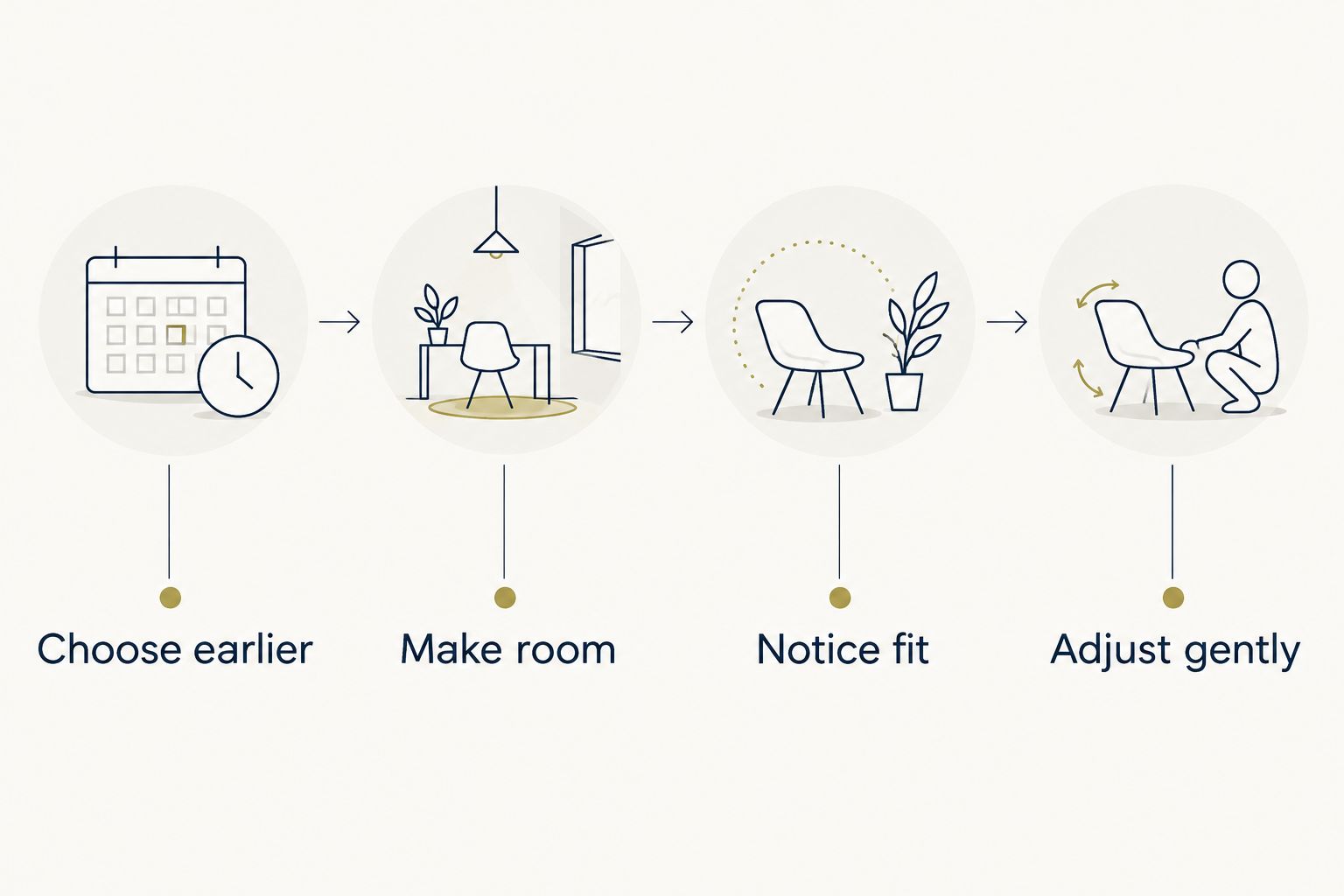
For 2026, use a small experiment instead of rebuilding your whole evening around an app. The following example is a way to organize your choice, not a recommended dose of meditation or a promised timeline for results.
Choose earlier
Set aside 5 minutes before your wind-down period to sample a voice and pick a recording. You are choosing something comfortable enough to try, not proving that it is the best recording in the library.
Make room
Try a 10-minute opening in an evening you already have. For example, finish a necessary household task, put tomorrow's essentials in place, and then listen; avoid adding an elaborate preparation routine.
Notice fit
After 3 evenings, ask whether the recording was easy to start, pleasant to hear, and manageable when plans changed. These are observations about usability, not evidence that an app has changed your sleep.
Adjust gently
Change the part that created friction. That might mean choosing a different narrator, moving listening earlier, or deciding that silence fits you better.
A late meeting does not cancel the experiment. Use a shorter version of your evening, leave out the recording, or return to it another night. A routine is a rhythm, not a reset button.
How the apps are ranked
This 2026 ranking uses listening format, voice fit, selection effort, and the distinction between learning meditation and bedtime listening. Headspace is the default because guided practice is a clear starting point; the other apps earn their places through distinct preferences.
The ranking does not report hands-on testing, clinical outcomes, or a measured improvement in sleep. Choose by the experience you want, and keep health questions separate from app selection.
Which meditation app for sleep should you choose?
Start with Headspace if you want guided meditation and have no stronger format preference. Choose Calm for stories, Insight Timer for teacher variety, or UCLA Mindful for mindfulness education.
Do not install all four to begin. Pick the option that matches your main preference, listen to a sample, and give yourself permission to stop if it adds effort rather than making room for a quieter evening.
FAQ
What's the best meditation app for sleep in 2026?
Headspace is the best default in this comparison for adults who want guided meditation alongside sleep-focused audio. Calm is the better fit when bedtime stories are your main preference.
Is Calm better than Headspace for sleep?
Calm is the better fit for bedtime storytelling; Headspace is the default here for guided meditation. That is a comparison of listening formats, not proof that either app produces better sleep outcomes.
Which sleep meditation app gives me different teachers to try?
Insight Timer is the strongest fit in this comparison for exploring different teachers and styles. Choose recordings earlier in the day if browsing feels tiring at bedtime.
Can I use UCLA Mindful before bed?
You can choose a UCLA Mindful practice for your evening, but its purpose is mindfulness instruction rather than making you fall asleep. Try unfamiliar instructions earlier if concentrating feels demanding at bedtime.
Do I need to meditate every night?
You do not need a nightly meditation rule to explore whether listening fits your routine. Keep the practice flexible enough for late work, family responsibilities, and evenings when you prefer quiet.
Should I choose sleep coaching instead of a meditation app?
Choose coaching when your main question is how to build and adjust an everyday routine, rather than what recording to play. Restweft provides personal sleep coaching with practical routines and ongoing check-ins; it is wellness support, not medical care.
Can a meditation app replace help for an ongoing sleep problem?
A meditation app does not replace qualified healthcare advice. Speak with a healthcare professional about persistent sleep difficulties or concerns about your health.
One last thing
Before you switch apps, ask what actually felt difficult. If you liked the recording but never found a workable moment to start it, another library does not answer that scheduling question.
Keep the smallest useful part of the evening. A familiar voice, a simpler transition, or permission to leave the recording off can each belong in a doable routine—without pressure to be perfect.