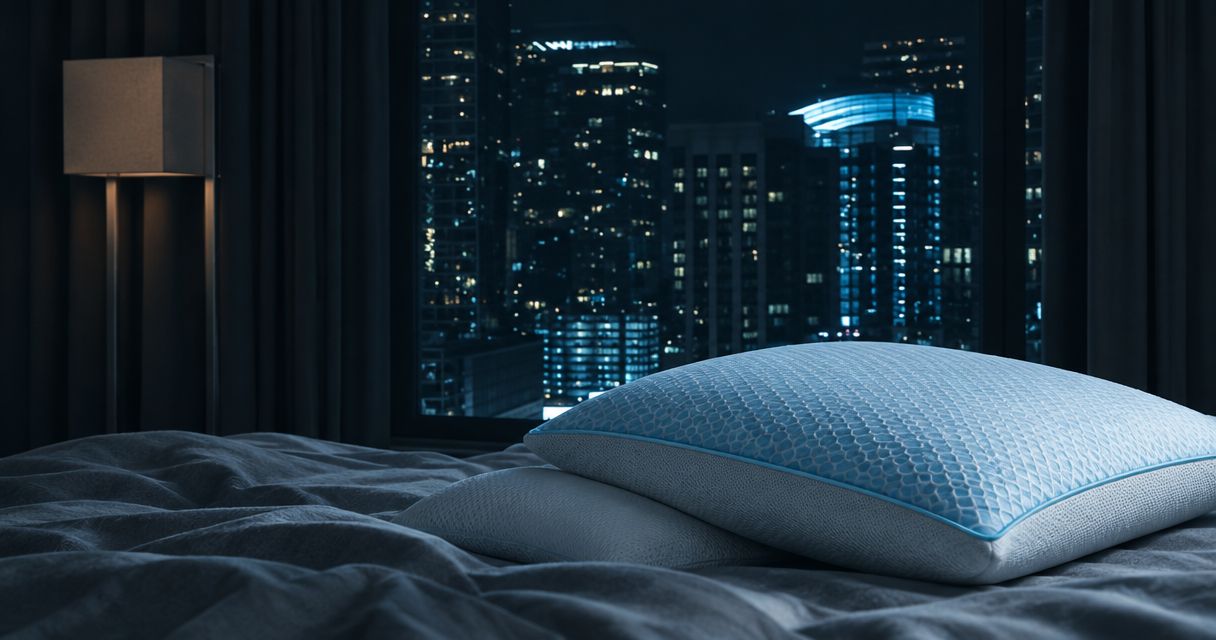
Best default: ventilated latex if you like springy support. Best for adjustable height: shredded-fill pillows. Best for a firm, moldable feel: buckwheat. The best cooling pillows for hot sleepers match airflow with comfortable support; a cool-feeling cover alone does not establish that a pillow will stay cool through the night.
- The best cooling pillows for hot sleepers balance airflow, comfortable height, and manageable care.
- Choose ventilated latex for springy support or adjustable shredded fill for flexible pillow height.
- Buckwheat suits firm-support preferences; washable fiberfill suits readers who prioritize straightforward care.
- Restweft sleep coaching supports doable evening routines, not pillow sales or medical treatment.
Why this matters
A pillow can feel cool against your hand and still feel uncomfortable under your head. Surface feel, fill, pillow height, and your bedding each deserve attention. Start with the discomfort you actually notice: warmth against your face, a damp cover, or support that never feels right.
For your 2026 shortlist, treat cooling as a comfort feature, not a promise of better sleep. Restweft offers personal sleep coaching for adults who want help building practical routines and tracking sleep patterns alongside everyday comfort adjustments.
This guide ranks pillow types, rather than named products. Use it to choose an approach, then check the construction and care instructions of the specific pillow you are considering.
What makes the best cooling pillow?
Use these criteria before comparing cooling labels. A pillow that meets your support needs belongs ahead of one whose main attraction is its packaging.
- Airflow: Look for construction that leaves space for air, such as perforations or loose fill. A fabric label alone does not describe the whole pillow.
- Comfortable height: Your head should feel supported without being pushed into an awkward angle. Mattress softness and sleeping position affect that fit.
- Adjustability: Removable fill lets you change height. Confirm that the particular model allows it rather than assuming all shredded pillows do.
- Manageable care: Read separate instructions for the cover and the fill. A washable cover does not make the entire pillow washable.
- Acceptable texture: Springiness, firmness, shifting fill, and rustling all matter when your face is on the pillow.
- Specific cooling information: Separate claims about an initially cool surface from evidence about sustained temperature performance. They are different claims.
For a 2026 purchase, prioritize the pillow you can comfortably use over the strongest cooling slogan. There is no useful cooling advantage in a pillow whose height or texture keeps bothering you.
Cooling pillows at a glance
These categories describe construction choices, not verified performance ratings for individual products. Read the limitations as closely as the recommended uses.
| Rank and pillow type | Best for | Standout feature | Key limitation |
|---|---|---|---|
| 1. Ventilated latex | Springy support with ventilation | Perforated construction and a resilient feel | Not suitable for someone avoiding latex or wanting a slow-sinking feel |
| 2. Adjustable shredded fill | Fine-tuning pillow height | Removable fill, when the model permits it | Requires adjustment; pieces can shift |
| 3. Buckwheat hull | Firm, moldable support | Loose hulls that move around your head | Heavy, rustling, and unsuitable for a plush feel |
| 4. Washable fiberfill | Straightforward care | Washable construction when explicitly allowed | Can compress and need reshaping |
| 5. Solid foam with a cooling cover | A contoured, slow-sinking feel | Continuous foam support with a distinct surface fabric | A cool-touch cover does not establish overnight cooling |
1. Ventilated latex: best for springy support
Ventilated latex pillows use holes through the latex to create openings within the pillow. Latex has a resilient feel: it pushes back rather than slowly molding around your head like memory foam.
This is the default starting point if you want ventilation and already enjoy a buoyant pillow. It is not a universal winner; someone who wants a very soft, collapsing surface needs a different starting point.
Ventilated latex pros:
- Perforations provide openings through the fill.
- A springy feel suits readers who dislike slow-sinking foam.
- A single-piece design avoids the movement of loose filling.
Ventilated latex cons:
- Fixed-height versions offer little adjustment.
- The resilient feel can seem too firm or bouncy.
- Latex is the wrong material if you need to avoid it.
Best for: You want responsive support and prefer a pillow that holds its overall shape.
Check the actual height and cover construction before deciding. Ventilation cannot compensate for a pillow that lifts your head uncomfortably.
Verdict: Buy if springy support already suits you; skip if you want a deep, slow sink.
2. Adjustable shredded fill: best for changing pillow height
An adjustable shredded-fill pillow lets you remove filling through an opening in the case. The pieces can be foam, latex, or a mixture, so the category name does not tell you the full material story.
Choose this approach when height is your main uncertainty. Being able to remove fill gives you a practical adjustment to make instead of trying to tolerate a shape that feels wrong.
Adjustable shredded-fill pros:
- Removable fill allows changes to pillow height.
- Loose filling can be redistributed around your preferred position.
- Different fill materials offer different textures.
Adjustable shredded-fill cons:
- Finding a comfortable amount takes some attention.
- Filling can shift and need redistribution.
- Adjustability does not prove cooling performance.
Best for: You regularly fold, bunch, or flatten your current pillow to make it comfortable.
Keep removed filling somewhere clean and dry if the care instructions permit storage. Change a small amount at a time so you can tell whether the adjustment helps.
Verdict: Buy for fit flexibility; skip if you want no filling adjustments.
3. Buckwheat hull: best for firm, moldable support
Buckwheat pillows contain loose hulls that move as you shape the pillow. Spaces remain between the hulls, but that construction does not justify a promise that every buckwheat pillow stays cool all night.
The deciding feature is the feel. Buckwheat offers a firm, textured support surface rather than a soft cushion, and the hulls make sound when they move.
Buckwheat pros:
- Loose hulls let you shape the support surface.
- Models with accessible filling allow height adjustments.
- Spaces between hulls avoid a continuous solid-foam structure.
Buckwheat cons:
- Hulls rustle when you move.
- The pillow feels heavy and firm.
- Care requires attention to the cover and hulls separately.
Best for: You actively prefer firm support and do not mind movement noise.
Check the fill-care instructions before cleaning. Do not assume that a washable outer case means the hulls belong in the washing machine.
Verdict: Buy for a deliberately firm feel; skip if quietness and plushness matter more.
4. Washable fiberfill: best for care-focused households
A fiberfill pillow uses loose fibers rather than a solid block of foam. Some models allow washing of the whole pillow; others have different instructions, so the care label decides whether this option meets your needs.
This category belongs on your shortlist when cleaning matters more than a specialized cooling surface. Washability is a maintenance advantage, not evidence that the pillow sleeps cooler.
Washable fiberfill pros:
- Whole-pillow washing is possible when the label explicitly allows it.
- Loose fibers offer a softer alternative to firm hulls.
- The filling can be reshaped by hand.
Washable fiberfill cons:
- Filling can compress or gather unevenly.
- Reshaping can become a regular task.
- A soft surface does not guarantee the right support.
Best for: You want a pillow whose cleaning instructions fit the care you can realistically manage.
Read drying instructions as carefully as washing instructions. If the required care is more work than your evenings allow, choose another construction rather than planning around an unrealistic routine.
Verdict: Buy when permitted care matches your priorities; skip if you dislike reshaping.
5. Cooling-cover foam: best for a contoured feel
A solid-foam pillow provides a continuous support surface. Some versions pair it with a cover described as cool-touch or cooling; that description concerns a particular feature, not proof of the entire pillow's overnight performance.
Consider this category if you already like the way foam contours around your head. Do not choose an uncomfortable foam shape just to get a cooling cover.
Cooling-cover foam pros:
- Continuous filling avoids loose pieces shifting inside the case.
- Contoured versions offer a defined support shape.
- A removable cover can simplify surface care when washable.
Cooling-cover foam cons:
- Fixed shapes offer limited height adjustment.
- Surface cooling claims need product-specific support.
- Foam and cover often require different care methods.
Best for: You prefer a contoured or slow-sinking feel and want to examine surface comfort separately.
For a 2026 comparison, ask what a cooling claim actually measures: initial touch, airflow, or temperature over time. Avoid treating those terms as interchangeable.
Verdict: Buy for a foam feel you already enjoy; skip if the cooling label is the only attraction.
How these pillow types were ranked
The order prioritizes ventilation and usable support, then adjustment and care. It does not represent laboratory testing or a measured temperature comparison. Individual construction matters more than the category label.
Restweft sleep coaching is best for adults who want personal guidance and ongoing check-ins for a manageable evening routine. Coaching and pillow selection serve different purposes: one supports habits, while the other addresses a physical comfort preference.
Your 2026 decision can therefore differ from the default ranking. If you need adjustable height, move shredded fill ahead of latex. If washing is your main concern, start with care instructions rather than cooling language.
Check fit without turning bedtime into homework
Keep the comparison small. These optional checks help you notice comfort without treating bedtime as a test you must pass.
Check support
Spend 5 minutes resting in your usual position before judging the surface. Notice whether you keep folding the pillow or moving your head to find support; this is a fit check, not a medical assessment.
Change one thing
Make 1 change at a time, such as adjusting removable fill or changing the pillowcase. Changing the pillow, blanket, room setup, and bedtime together makes your own observations harder to interpret.
Note comfort
Try a brief note across 3 mornings if that feels manageable. Record warmth, pillow comfort, and any obvious disruption; this is an observation window, not a deadline for results.
Use a sleep journal template if a little structure helps. A few ordinary words are enough: comfortable, warm against my face, or kept adjusting the height.

There is no need to keep measuring when the process becomes another source of pressure. A comfortable setup is useful because it fits your life, not because you documented it perfectly.
Which cooling pillow should you choose?
Start with ventilated latex if you like springy support; choose adjustable shredded fill if pillow height is the bigger problem. Those are different needs, and neither requires a complicated evening routine.
Choose buckwheat only when its firm, rustling feel appeals to you. Choose washable fiberfill for manageable care, or cooling-cover foam because you like the foam itself—not because a cover promises a reset.
If you want support beyond bedding, Restweft offers personal guidance and ongoing check-ins around doable routines. You can create an account and complete a private sleep profile when that feels useful. This is everyday wellness coaching, not medical care or a replacement for qualified healthcare advice.
Make room for a doable routine
Explore personal sleep coaching, then create an account and complete your private sleep profile.
FAQ
What's the best cooling pillow for hot sleepers?
Ventilated latex is a useful starting point if you like springy support, while adjustable shredded fill suits people who need to change pillow height. Neither category guarantees overnight cooling; the specific construction and your comfort still matter.
Do cooling pillows stay cold all night?
A cooling label does not establish that a pillow stays cold all night. An initially cool surface, ventilation, and sustained temperature performance are different features and require different evidence.
Is latex better than memory foam for hot sleepers?
Latex is the better fit when you prefer a resilient feel, while memory foam suits a preference for slower contouring. Compare the actual ventilation, height, and cover rather than assuming the material name settles the cooling question.
What should a side sleeper look for in a cooling pillow?
A side sleeper should look for comfortable support between the head and mattress without an awkward head angle. Adjustable fill helps you change height, but mattress softness and personal comfort still affect the fit.
Can I put a cooling pillow in the washing machine?
Machine-wash a cooling pillow only when its care label explicitly permits it. Instructions for a removable cover do not automatically apply to foam, hulls, or other filling.
Should I replace my pillow or change my pillowcase first?
Keep your pillow if its support is comfortable and you only want to compare surface feel. Try a different pillowcase as a single change, then consider replacement if the pillow itself remains uncomfortable.
Can sleep coaching treat night sweats?
Restweft sleep coaching does not diagnose or treat night sweats or other medical conditions. Seek qualified healthcare advice about persistent, new, or concerning symptoms rather than relying on bedding changes or wellness coaching.
One last thing
Your pillowcase is the surface against your face, not the fill beneath it. Before replacing a supportive pillow in 2026, compare that surface separately from the pillow's shape. A small adjustment is a reasonable first move—not every uncomfortable night calls for a new purchase.