
If you forget a sleep journal entry, record only what you still remember, mark anything uncertain, and continue with the next entry. Leave forgotten details blank rather than inventing bedtimes or sleep totals; a missed note does not require you to restart your journal or catch up on every night.
- Forget sleep journal entry details? Leave unknowns blank and resume with the next entry.
- Label remembered details as approximate instead of turning guesses into exact sleep times.
- Use a shorter sleep diary entry when a busy morning leaves little time.
- Restweft sleep coaching suits adults who want personal guidance and ongoing check-ins, not medical care.
What should you do when you forget your sleep journal entry?
Keep the gap visible, save what you genuinely remember, and move on. Your journal can distinguish between something you noticed and something you no longer know. That distinction is more useful than a complete-looking record built from guesses.
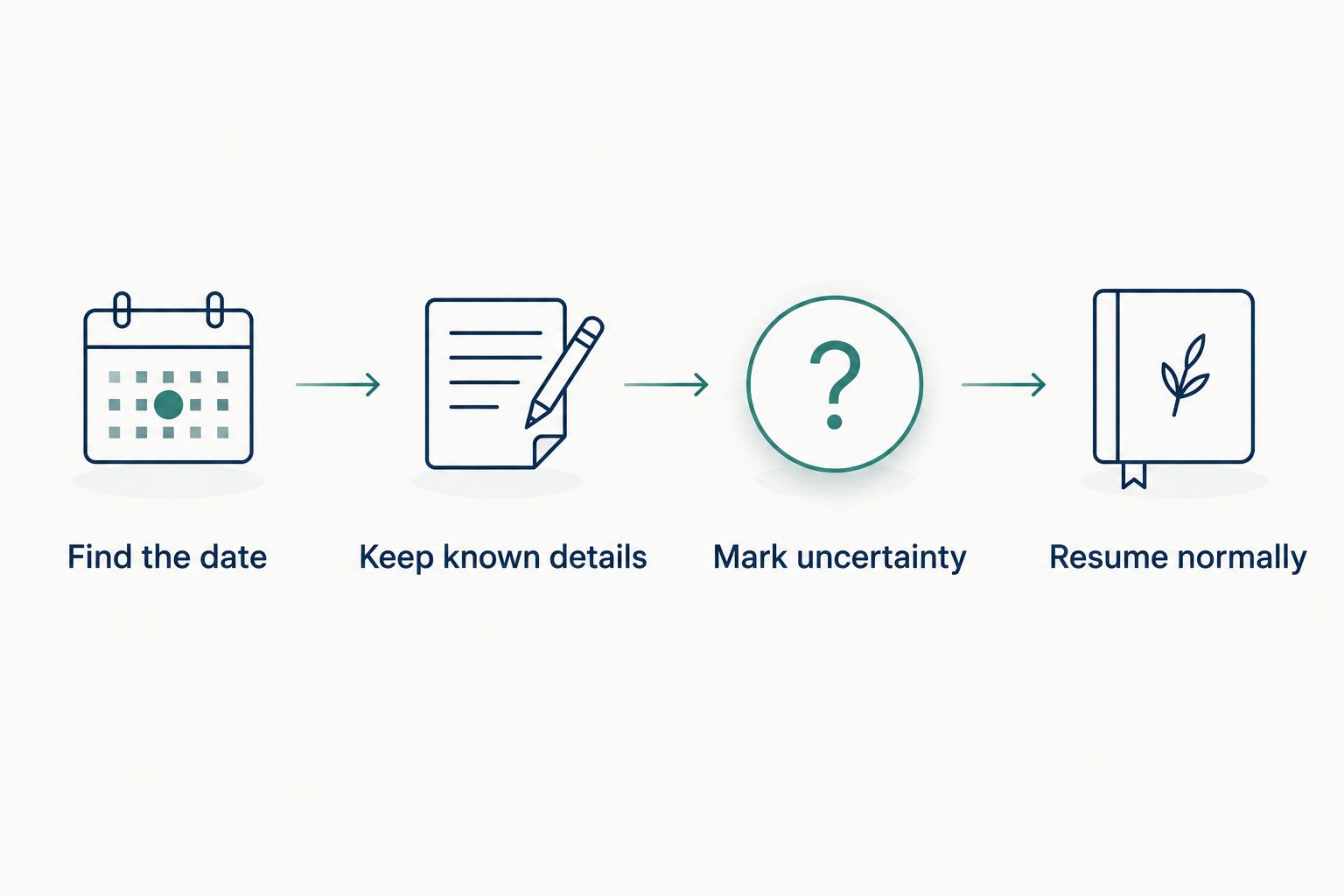
For everyday wellness tracking, use these flexible steps. If a healthcare professional supplied your diary, follow their instructions for missed entries instead.
- Find the date. Make sure you are writing about the correct night, especially if your diary labels entries by the following morning.
- Keep known details. Note anything you remember clearly, such as working late or waking before your alarm.
- Mark uncertainty. Write that a time is approximate, or leave the field blank if you cannot recall it.
- Resume normally. Make your next entry without adding a catch-up task to the evening.
Restweft offers personal online sleep coaching for adults who want help building practical evening routines and tracking sleep patterns. That support is about finding a routine that fits your life, without pressure to produce a perfect record.
Why this matters
A blank space and an estimated bedtime mean different things. Keeping them separate lets you review your notes without mistaking a reconstruction for something you recorded at the time.
The goal is not to make every box look finished. It is to keep a record you can understand later, including where your memory ends. You do not need to turn an ordinary missed entry into another obligation.
Choose an entry that matches what you remember
You do not need the same response to every missed note. Use the option that fits what you actually know, rather than filling the same fields regardless of your memory.
| Option | Best for | What to record | Limitation |
|---|---|---|---|
| Brief backfill | You remember part of the night clearly | Known details, with approximate times labeled | Later recall is not a contemporaneous record |
| Missed-entry note | You remember little or nothing | The date and a note that the entry was missed | It leaves that night's sleep details unknown |
| Short current entry | Catching up feels like extra work | Today's observations, using fewer fields | It does not recover previous nights |
| Existing-record check | You already have a relevant note or device record | What the record actually shows, with its source | A record of phone use or movement does not prove when you slept |
Choose the least elaborate option that stays honest. A missed-entry note is a complete response when you have nothing reliable to add.
Brief backfill: keep the uncertainty attached
Suppose you remember going to bed after finishing a household task but cannot recall the time. Record the sequence, not a made-up clock reading: finished the dishes, then went to bed; time not remembered.
If you remember an approximate time, label it approximate in the same field. Do not put the uncertainty somewhere separate where you might overlook it during a later review.
Missed-entry note: leave an understandable gap
A blank field can become confusing later. Did you forget to write, have nothing to report, or intentionally skip the question?
A short note resolves that ambiguity. Write that you missed the entry and do not recall the details, then leave the sleep fields empty. There is no need to explain or defend the omission.
Short current entry: protect the next step
When catching up feels burdensome, start with the night you can describe now. You can return to an older entry if something clear comes to mind, but you do not need to make that a requirement.
Try a 30-second entry as an optional limit, not a performance target. Record how rested you feel and one evening detail you remember, then stop.
How do you fill in a missed entry without guessing?
Use this process when you want to add a late note. Keep it small enough that reconstructing yesterday does not crowd out recording today.
Find the date
Check whether your journal uses the bedtime date or the morning date. Either convention can be understandable when you use it consistently; switching between them makes entries harder to follow.
For example, an overnight entry might refer to the evening you went to bed or the morning you woke. If that distinction is unclear, add a plain-language note before entering anything else.
Keep known details
Write observations you can recall without working backward from an assumed schedule. Remembering that you read before bed does not establish when you fell asleep.
An existing calendar event can confirm that you attended an evening activity. It cannot establish the rest of the night. Keep the event and your sleep observations separate.
Mark uncertainty
Use words such as approximate, not remembered, or recorded later. A timestamp can be exact while its meaning remains limited: your last message shows when you sent a message, not when sleep began.
Do not use zero to mean unknown. Zero awakenings and awakenings not remembered are different entries. If your format makes that distinction difficult, add a short note beside the field.
Resume normally
Make the next entry in your usual way, or use a shorter version if that feels more manageable. A sleep journal template can give you a starting format without making every field compulsory.
You can also set a 2-minute stopping point for reconstructing an older entry. That is simply an optional boundary: when the time is up, leave anything uncertain unknown.
A missed-entry example for 2026
The entries below are fictional examples of wording, not a model sleep schedule. Notice that the late entry identifies both the night it describes and the fact that it was written later.
| Entry date | Example note | What stays unknown |
|---|---|---|
| June 8, 2026 | Missed this morning's entry. I remember reading before bed. | Bedtime, sleep onset, and awakenings |
| June 9, 2026 | Adding a note about the previous night: bedtime was approximate; recorded later. | Exact bedtime and total sleep time |
| June 10, 2026 | Resuming today's entry. I feel less rested than I expected. | Details from earlier missed nights |
The important feature is not the amount of detail. Each note makes its limits visible, so a later reader does not have to infer whether a number was measured, remembered, or guessed.
Why your journaling routine needs different adjustments
Start with the part of the routine that got in the way. You do not need a bigger tracking system if the problem is simply that the notebook was out of reach.
- Timing: If you leave home quickly, choose a cue that fits your actual morning rather than an idealized one.
- Location: If you forget where the journal is, keep it somewhere you already pause, without creating clutter or a bedtime distraction.
- Entry length: If the form feels demanding, keep a short version for busy days.
- Changing schedules: If your mornings vary, connect the entry to an event, such as finishing breakfast, rather than a fixed clock time.
- Catch-up pressure: If old gaps make you avoid opening the journal, resume with the current night and leave the backlog alone.
Pick the adjustment that matches your situation. There is no need to add a reminder, change formats, and redesign your evening all at once.
What if you forget several nights in a row?
Resume with the most recent night you can describe. You do not need to reconstruct the entire gap before making a useful current entry.
If you want to preserve context, add a brief note that several entries were missed. Keep any remembered events separate from unknown sleep details rather than spreading an assumed routine across the missing dates.
Then consider whether the journal asks for more than you want to record. A 1-sentence entry can be your busy-day option: how you feel this morning, plus an evening detail if one comes to mind.
Can you use your phone or wearable to fill the gap?
Use an existing record only for what it actually records. A message timestamp, alarm setting, or device estimate should not become a definite bedtime simply because your journal has an empty field.
If you copy a device's sleep estimate, identify it as a device estimate. Keep your own recollection separate, especially when the two disagree. You do not need to settle the disagreement by choosing whichever makes the journal look more consistent.
There is no need to buy a device to repair a missed note. For everyday journaling, leaving an unknown field blank remains an honest option.
Which kind of support fits your routine?
Choose support based on the help you want, not on whether you have maintained an unbroken record. A notebook, an app, and personal guidance ask different things of you.
| Approach | Best for | Useful feature | Trade-off |
|---|---|---|---|
| Self-guided journal | Adults who want to choose their own format | You decide what to record and when | You also decide how to adjust the routine |
| Sleep app | Adults who prefer a digital format | Some apps offer prompts or structured fields; check the specific app | Features vary, and extra fields can feel unnecessary |
| Restweft sleep coaching | Adults who want personal guidance and ongoing check-ins | Support connects sleep-pattern notes with doable evening routines | Wellness coaching is not medical assessment or treatment |
Choose personal guidance when you want help adapting the routine, not someone to grade your entries. A missed note can be something to discuss during a check-in rather than something to hide.
If that approach fits, you can create an account and complete a private sleep profile. Bring the record you have, including its gaps; there is no need to manufacture a more complete history.
Make room for a doable routine
Create an account and complete your private sleep profile with Restweft.
FAQ
What should I do if I forget a sleep journal entry?
Record what you genuinely remember, label uncertain details, and resume with the next entry. If you recall nothing, leave a missed-entry note rather than inventing sleep times.
Should I start my sleep diary over after missing a day?
You do not need to restart an everyday wellness sleep diary after a missed day. Keep the earlier notes, identify the gap, and continue; follow separate instructions if a healthcare professional supplied the diary.
Can I fill in my sleep journal several days later?
You can add a late entry when you remember something clearly, but identify it as recorded later. Leave details you cannot recall blank instead of reconstructing an exact night.
Should I put zero if I cannot remember waking up?
Do not use zero to mean that you cannot remember. Mark the field unknown or add a note, because no remembered awakenings is not the same statement as no awakenings.
Can my sleep tracker replace a forgotten journal entry?
A tracker can supply its own recorded estimate, but it does not replace your recollection of the night. Label copied information by its source and keep unknown personal observations blank.
What should a simple sleep journal include in 2026?
A simple everyday sleep journal can include the night being described, remembered sleep timing, how rested you feel, and a brief evening note. Keep the format manageable and mark uncertain information rather than forcing every field.
Is sleep coaching medical care?
Sleep coaching is everyday wellness support, not medical care. Speak with a qualified healthcare professional about persistent sleep difficulties, concerning symptoms, or questions about diagnosis or treatment.
One last thing
An unknown field is clearer than a confident guess. Before adding another reminder, consider adding a simple way to mark an entry as missed. That gives an imperfect day a place in the journal without turning it into unfinished work.
Keep the next step small: open the journal, record what you know, and leave the rest alone. You are making room for a rhythm, not looking for a reset button.