Best overall for simplicity: a paper sleep diary. Best for automatic logging: a wrist-worn tracker. Best without wearing anything: an under-mattress sensor. This 2026 guide compares the best sleep trackers for seniors by everyday usefulness—not by how many scores they produce.
- The best sleep trackers for seniors make patterns easier to understand without adding bedtime pressure.
- Choose a paper sleep diary for simplicity, a wrist tracker for automatic logging, or a sensor to avoid wearables.
- Restweft offers personal sleep coaching for adults who want guidance alongside their tracking.
- Consumer sleep tracking does not diagnose sleep conditions or replace qualified healthcare advice.
Why this matters
A sleep tracker is useful when it helps you answer a practical question: What does your evening look like, and what would you like to adjust? A detailed dashboard is not automatically more helpful than a short morning note.
Restweft is best for adults who want personal guidance alongside sleep tracking, rather than another device. Restweft offers personal online sleep coaching, doable routines, and ongoing check-ins; it is everyday wellness support, not medical care.
For this 2026 comparison, “best” means the best fit for a particular preference. Being a senior does not determine whether you want a notebook, an app, or a wearable. Your comfort with the tool matters more than your age.
What makes the best sleep tracker for seniors?
Use these criteria before comparing features:
- Readable information: You can comfortably read the main screen, entries, or summary without searching through menus.
- Manageable upkeep: Charging, syncing, writing, or positioning the tracker fits your day.
- Overnight comfort: The tool does not introduce an unwelcome wristband, ring, or bedroom setup.
- Useful context: You can connect sleep observations with evening activities and how you feel the next day.
- Clear limits and privacy: You understand what is estimated, what is recorded, and who can access your information.
If a tracker meets the first criterion but creates work everywhere else, it is not the right match. Start with the least complicated option that answers your question.
Best sleep trackers for seniors at a glance
These are categories of tracking tools, not endorsements of specific devices. Features differ between individual products, so verify the exact model before choosing.
| Rank and option | Best for | Standout feature | Key limitation |
|---|---|---|---|
| 1. Paper sleep diary | Simple, screen-free reflection | Records your experience in your own words | Requires manual entries; does not measure sleep |
| 2. Wrist-worn tracker | Automatic overnight logging | Collects sensor information while worn | Requires overnight comfort and device upkeep |
| 3. Ring-style tracker | Wearable tracking without a wristband | Keeps the wearable off your wrist | Fit and finger comfort need careful consideration |
| 4. Under-mattress sensor | Tracking without wearing a device | Places the sensor in the bed rather than on your body | Compatibility and shared-bed handling vary |
| 5. Phone-based sleep app | Tracking without another dedicated device | Uses a phone you already use | Permissions, placement, and features vary by app |
1. Paper sleep diary: best sleep tracker for simple reflection
A paper sleep diary records what you remember about the night and how you feel afterward. It does not measure sleep stages, but it gives you room to note the details that matter to your routine.
For a simple starting point, try a 2-minute morning entry. Write down your approximate bedtime, when you got up, and a few words about your morning energy; exact timestamps are not required.
Paper sleep diary pros
- No charging, syncing, or account setup.
- Space for context, such as a late dinner or an unusually busy evening.
- Flexible handwriting size and page layout.
- Easy to keep the entry short when you are tired.
Paper sleep diary cons
- Depends on memory and regular entries.
- Does not automatically record overnight information.
- Comparing patterns takes your attention rather than an automatic summary.
Best for: You want to understand your routine without wearing anything or checking another screen.
Keep observations separate from judgments. “Read in bed and felt alert afterward” gives you something to discuss; “failed at bedtime again” does not help you choose a manageable adjustment.
Buy / skip verdict: Choose a paper sleep diary first if simplicity matters most; skip it if manual recording is the task you want to avoid.
2. Wrist-worn tracker: best sleep tracker for automatic logging
A wrist-worn sleep tracker uses sensors and software to estimate aspects of your sleep while you wear it. The information shown depends on the device; a sleep label is an estimate, not a clinical finding.
The main reason to choose this category is convenience after setup. You wear the device overnight instead of writing down every observation yourself.
Wrist-worn tracker pros
- Reduces the need to remember overnight timing.
- Brings repeated nights together in one viewing place.
- Fits an existing habit if you already wear a compatible device.
Wrist-worn tracker cons
- A strap that feels fine during the day can feel different in bed.
- Charging and syncing become part of the routine.
- Small screens or dense app displays need checking before purchase.
Best for: You want automatic logging and are comfortable wearing something on your wrist overnight.
For a 2026 purchase, inspect the current companion app as carefully as the wearable. Check whether you can find the main sleep summary, enlarge text through supported settings, and understand the display without opening several menus.
Buy / skip verdict: Choose a wrist-worn tracker for automatic logging; skip it if overnight wrist comfort or device upkeep is already a concern.
3. Ring-style tracker: best sleep tracker for avoiding a wristband
A ring-style sleep tracker moves the wearable from your wrist to your finger. It still involves wearing a sensor overnight and reviewing information through the product's supported interface.
Choose this category because the physical format suits you, not because a ring shape proves better sleep measurement. Accuracy claims need evidence for the particular device and measurement.
Ring-style tracker pros
- Leaves your wrist free overnight.
- Offers an alternative if you dislike straps.
- Provides another wearable format for ongoing tracking.
Ring-style tracker cons
- Fit needs attention; an uncomfortable ring is not a useful bedtime companion.
- Charging and app use still require upkeep.
- Handling a small device can be inconvenient for some users.
Best for: You want wearable tracking but prefer not to wear a wristband.
Before choosing, review the manufacturer's sizing instructions and how you would remove and charge the device. Think about your own hands and routines rather than assuming a smaller tracker means less effort.
Buy / skip verdict: Choose a ring-style tracker when finger comfort is a better match than wrist comfort; skip it if fit or small-device handling adds friction.
4. Under-mattress sensor: best sleep tracker without a wearable
An under-mattress sensor places the tracking hardware in the bed rather than on your body. Setup requirements and the information produced depend on the individual product.
This category deserves a closer look if wearing a ring or wristband is the main reason you have avoided tracking. It trades body-worn hardware for a bedroom installation.
Under-mattress sensor pros
- Nothing needs to stay on your wrist or finger overnight.
- Tracking can remain associated with your usual bed.
- Avoids putting on and removing a wearable each evening.
Under-mattress sensor cons
- Mattress and bed compatibility must be checked.
- Shared-bed use needs a clear explanation from the manufacturer.
- A fixed installation is less convenient when you sleep elsewhere.
Best for: You want tracking in your usual bed without wearing a device.
Before choosing, read the exact placement instructions. Check how the product handles your mattress, another sleeper, and any required connection; do not assume every sensor works with every bedroom arrangement.
Buy / skip verdict: Choose an under-mattress sensor only after confirming your setup fits its requirements; hold off when compatibility is unclear.
5. Phone-based sleep app: best sleep tracker without extra hardware
A phone-based sleep app uses your phone as the main tracking or recording tool. Some apps support manual logs, while others use phone sensors or audio-based features; check the specific app rather than treating the category as one technology.
The advantage is familiar hardware. The trade-off is deciding whether keeping your phone involved at bedtime helps your evening routine.
Phone-based sleep app pros
- Uses a device you already know how to operate.
- Offers a digital alternative to a paper diary.
- Keeps supported notes and summaries together.
Phone-based sleep app cons
- Permissions and data-sharing settings require attention.
- Phone placement and charging instructions vary.
- Opening an app at bedtime can lead into unrelated phone use.
Best for: You prefer a digital log and do not want another dedicated tracking device.
For a 2026 app choice, read the current feature description and privacy information. Our guide to sleep tracking apps for adults offers a next step if you prefer the phone-based route.
Buy / skip verdict: Choose a phone-based app if it simplifies recording; skip it if keeping the phone nearby makes winding down harder.
How these options rank
The ranking prioritizes readability, manageable upkeep, comfort, context, and clear limits. Paper comes first for simplicity—not because it measures sleep more accurately than a sensor.
The other options each solve a different problem: automatic logging, avoiding a wristband, avoiding wearables entirely, or avoiding extra hardware. No single format wins every criterion, and this comparison does not claim a clinical accuracy ranking.
Turn tracking into a doable routine
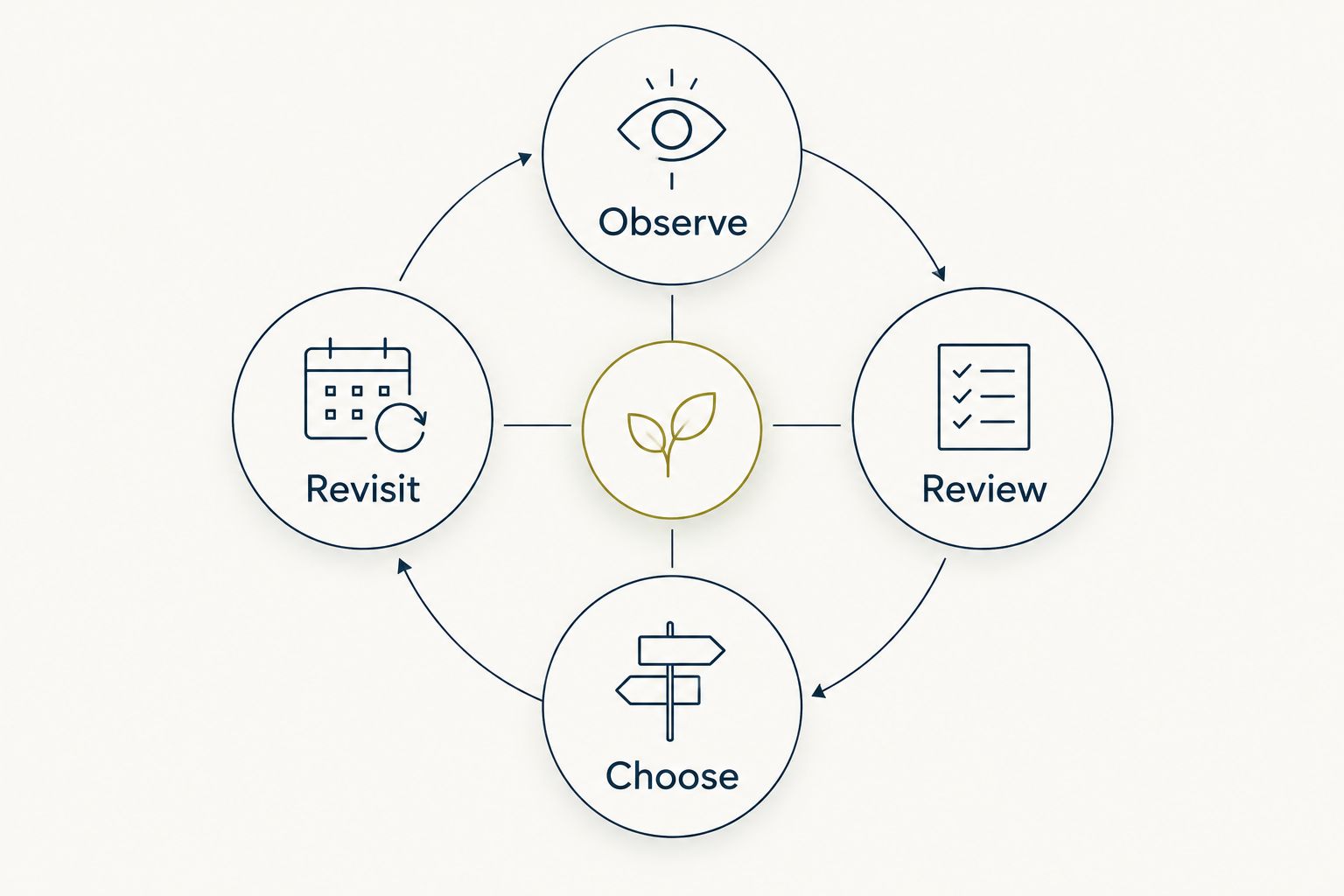
Tracking needs a next step, not a perfect score. Try this flexible sequence during a 7-day starting period; the period is a manageable example, not a deadline for better sleep.
Observe
Record your usual evening without trying to improve everything at once. Include a short note about what happened before bed and how you felt the next morning.
Review
Look across several entries rather than treating one night as a verdict. Ask whether the information is understandable and whether keeping track feels manageable.
Choose
Pick 1 small adjustment connected to your observations. For example, if unfinished tasks keep occupying your evening, write tomorrow's first task down before starting your wind-down routine.
Revisit
Check whether the adjustment fits the life you actually live. Keep it, simplify it, or choose something different without treating the experiment as a pass or fail.
Restweft connects sleep-pattern tracking with personal guidance and ongoing check-ins. If you would like that support, you can create an account and complete a private sleep profile without pressure to have everything figured out first.
Make room for better nights
Start with a private sleep profile and explore personal guidance for a doable routine.
Which sleep tracker should you choose?
Start with a paper diary if you are undecided. It helps you identify what you want to learn before you choose more equipment.
If remembering to write is the obstacle, consider a wrist tracker. If wearing anything is the obstacle, investigate an under-mattress sensor. Choose a ring for its physical format or an app for familiar hardware—not because either promises a better night.
Your best choice in 2026 is the tool you can understand and use comfortably. Tracking is a rhythm, not a reset button.
FAQ
What's the best sleep tracker for seniors who dislike technology?
A paper sleep diary is the simplest starting point for seniors who dislike technology. It needs no charging or syncing, but you must enter observations yourself.
Is a sleep ring better than a wrist tracker for an older adult?
A sleep ring is a better fit when you prefer wearing something on your finger rather than your wrist. The format alone does not establish better accuracy; compare comfort, handling, and the specific device's evidence.
Can I track my sleep without wearing a watch?
Yes, you can use a paper diary, a phone-based app, or an under-mattress sensor without wearing a watch. Each option has different recording, setup, and privacy requirements.
Can a sleep tracker tell me if I have a sleep disorder?
A consumer sleep tracker cannot diagnose a sleep disorder. If you have persistent sleep concerns, bring them to a qualified healthcare professional rather than relying on a device score.
What should I check before choosing a tracker for my parent?
Start with your parent's preferences for comfort, readability, and daily upkeep. If you plan to help with setup or view information, agree together on what support and access they want.
Do I need to track every night?
You do not need a perfect record to reflect on your routine. Use a manageable approach and avoid treating a missed entry as a failure.
Does Restweft replace a sleep tracker or medical care?
Restweft provides personal online sleep coaching, not a tracking device or medical care. Its guidance supports practical routines and sleep-pattern tracking without diagnosing or treating medical conditions.
One last thing
Before choosing any tracker, decide what you will do with the information. “I want to understand why my evenings feel rushed” is a more useful starting point than “I want a better number.”
If you cannot name a question yet, begin with a notebook. Make room for better nights without making bedtime another performance review.